
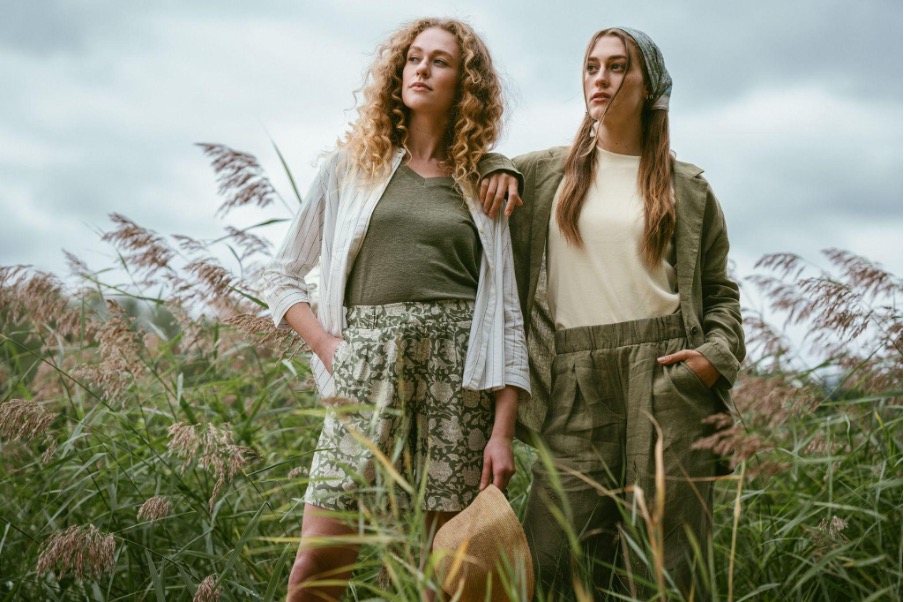
Photo Courtesy of Living Crafts
In Selbitz, a quiet Bavarian town far from fashion’s usual capitals, a warehouse tells a different story about the future. Inside those boxes is the memory of another era, when organic clothing lived on the fringes of co-op shelves and mail-order catalogues, a curiosity for those who asked hard questions of their closets. Back then, sustainable fashion was not a sector; it was a small act of dissent.
Forty years on, that dissent has a balance sheet. Living Crafts, the German brand that began with organic socks in a garage, now reports €12 million in annual revenue and 15 percent year-on-year growth, serving around 200,000 customers across Europe and beyond. That is not the profile of a fad. It is the outline of a market finally admitting what activists and garment workers have long said: clothing is never just clothing, and the cost is never just the price on the tag.
The Moral Arithmetic of Growth
In an age of “green” capsules and recycled marketing copy, it is tempting to dismiss sustainable fashion as another pose—a gloss on overproduction. But the math in Selbitz resists that cynicism. Living Crafts’ growth has not come from slapping a leaf icon on fast fashion. It has come from building around organic cotton, wool, and linen; from adhering to the Global Organic Textile Standard; from treating climate neutrality and fair labor not as extras, but as entry conditions.
This is not perfection. No company sourcing across continents can claim innocence in a system built on cheap labor and fragile ecosystems. Yet there is a difference between treating ethics as marketing and treating them as architecture. Living Crafts has chosen the latter – running logistics from Selbitz, focusing on basics rather than disposable trends, and pricing its products so sustainable textiles can be worn daily, not just displayed online.
That model is also economically aligned with the world as it is becoming. The sustainable fashion market is forecast to grow strongly as consumers increasingly refuse to pretend that sweatshop wages and toxic dyes are invisible. Surveys consistently show that most online shoppers prefer sustainable brands and are willing to change habits to reduce harm. Living Crafts is not riding a passing wave; it is rising with a long-forming tide.
Leadership That Refuses Amnesia
Behind these numbers is leadership that refuses to forget the company’s origins. Managing director Frank Schell has guided Living Crafts since 2008 through supply-chain shocks and cost surges, keeping its focus on essentials—socks, underwear, nightwear—because habits change the world faster than hashtags.
Alongside him, e-commerce and marketing lead Benjamin Brendel translates this ethic into a digital language that can compete with algorithmic giants. His task is not just to sell, but to make natural fibers, certifications, and four decades of sustainability legible to a generation raised on one-click consumption.
Together, they wager that there is still an appetite for truth in an industry built on denial. The bet is paying off – not spectacularly, not unicorn-style, but steadily, in the quiet compounding of double-digit growth.
Beyond the Comfort of Excuses
The easy story says ethical consumption belongs only to the wealthy and the woke. Living Crafts complicates that. By anchoring its range in affordable essentials and distributing through both organic supermarkets and online channels, it rejects the idea that sustainability is only for the few. Its ambition is simpler and more radical: to make the better choice the everyday one.
This is where 15 percent growth takes on meaning beyond a ledger. It suggests that when sustainable fashion is done seriously – grounded in traceable materials, fair labor, and realistic pricing – people will come. Not everyone, not yet. But enough to show that “ethical fashion cannot scale” is less a fact than a failure of imagination.
Living Crafts will not undo the damage of an extractive industry on its own. But in its steady climb from garage to global e-commerce brand, it has given the lie to the idea that sustainability is a phase. The world is not moving on. The climate is not moving on. The workers cannot move on.
Fifteen percent growth, in that light, is not just a business result. It is a signal, a reminder that there are profits in telling the truth, and a market for clothes that do not ask us to forget what we already know.
Author: Mae Cornes
S
Disclaimer: This article is sponsored content. The views expressed are those of the author and the featured company.