
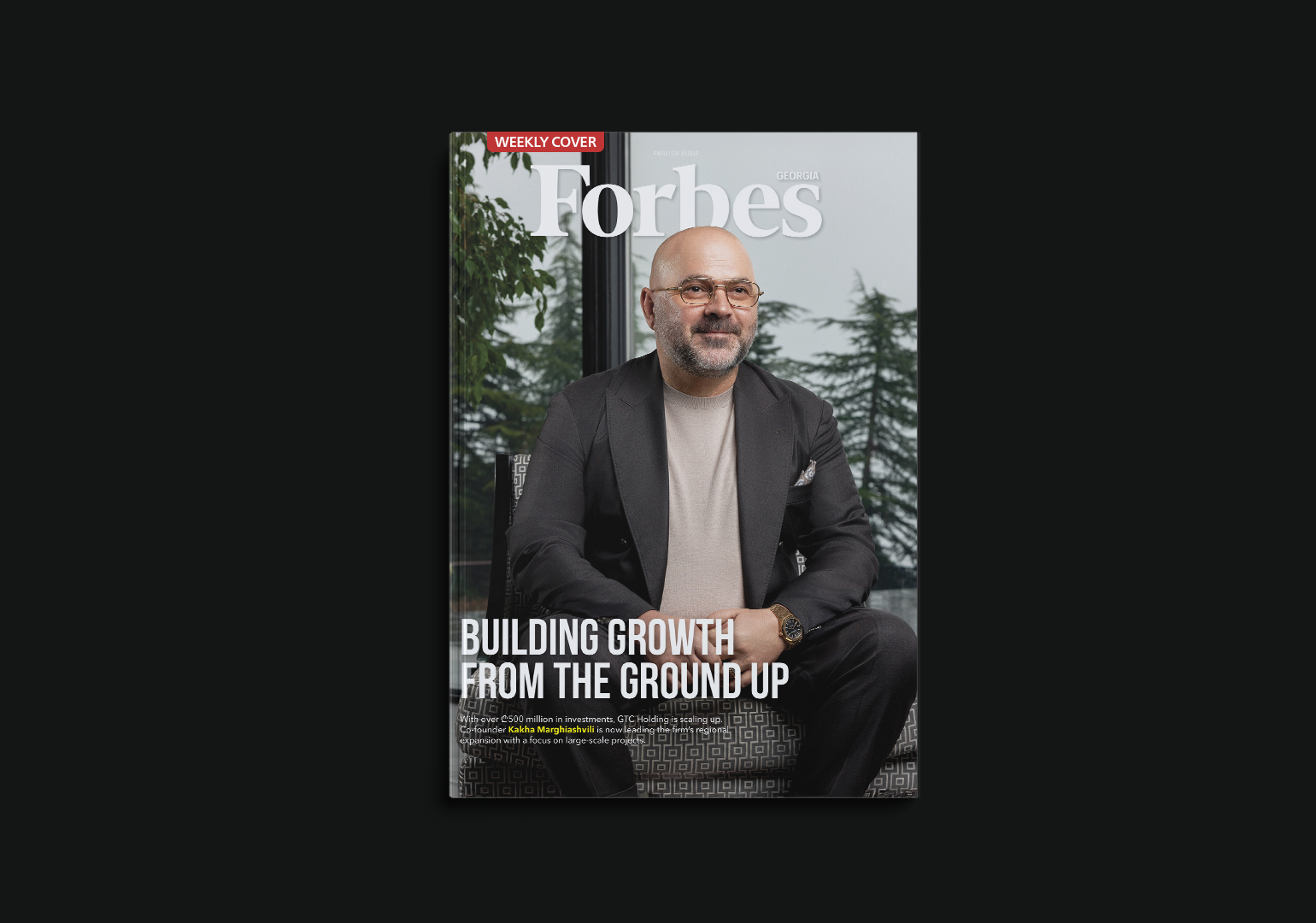
Founded by two partners in 2010, GTC holding has grown into one of the key players in the construction sector. Initially focused on supplying construction equipment and related services at a time when the market lacked high-quality products and professional services, the company gradually expanded its operations. Over the years, the holding has invested several hundred million lari across various businesses. Today, the GTC holding brings together hundreds of professionals and nine companies, operating within a unified ecosystem to deliver comprehensive construction solutions. Kakha Marghiashvili, general director and co-founder of the company, spoke to us about the journey behind its development.
First of all, what experience led you to start a business in the construction sector?
Before starting a business in the construction sector, I built my professional path on practical experience. Over the years, I have had direct involvement in construction processes, both in project management and in technical and operational roles. This experience allowed me to truly understand the sector’s challenges and needs.
My main support and motivation have always been my family; they strengthened me at each stage and, to this day, share both challenges and achievements with me. At the same time, the professional knowledge accumulated over the years gave me the confidence to respond to any challenge with the right solution.
On this journey, I should give particular importance to those people who shared my vision from the very beginning—the team and partners with whom we started this process. It was thanks to their professionalism and shared values that we were able to create not just a holding, but a system built on trust, support, and common purpose.
Today, this is an environment where each person is not only part of the team but also a member of a large family—this is precisely the formula for GTC holding’s success.
GTC is a holding founded by two people that today unites businesses across several areas. How did the holding’s story begin? What was the most difficult thing during the first steps?
The story of GTC holding begins in 2010. Initially, we focused on the supply and service of construction inventory, where the market was experiencing a shortage of quality products and professional services. This is what determined our goal—to fill the market deficit with high standards.
The first steps were the most difficult. We had to work in several directions simultaneously: finding reliable partners, building trust in the market, establishing operational processes, and allocating financial resources effectively. The biggest challenge was gaining trust. For a new company, it’s difficult to prove it can maintain consistent quality and uphold its responsibilities.
At that stage, our hands-on involvement proved decisive. We handled everything ourselves, from sales to logistics and client communication.
Today, investment in the holding’s formwork direction alone exceeds 300 million lari, while investment in production infrastructure is close to 200 million lari. The development direction’s investment portfolio amounts to hundreds of millions of lari. We can clearly see that the experience gained at that stage and the detail-oriented approach created a strong, sustainable foundation on which GTC stands today.
What was your vision when starting the business? Did you know from the beginning that the company would grow to this scale? What helped you get there?
When starting the business, our vision was clear—we wanted to create a company that wouldn’t be limited to just product supply but would offer customers complete, reliable, and professional services.
From the very beginning, the main emphasis was on quality, responsibility, and long-term partnerships.
We had ambition and plans for large-scale growth from the start. We knew this path would entail serious challenges, but we were prepared for exactly that, both strategically and mentally. Our goal was not only development but also the creation of a strong, sustainable, multi-directional company that would occupy a significant position in the market over time.
What helped us most in the growth process was the following: first, sound strategic decisions and analysis of market demand; second, partnerships with strong international brands, which gave us additional assurances of quality and reliability; third, a team that has grown with the company and now unites more than 500 professionals. And most importantly, all decisions were directed toward long-term results, which determined the company’s large-scale growth.
How was GTC formed as a holding? What was its main mission at the beginning, and what is it today?
The holding’s formation was a natural continuation of the path we started with, initially focused on a single direction. Over time, a better understanding of market needs and our accumulated experience showed us that we could work on a broader scale. This is how the idea arose to create a holding structure in which various but interconnected directions would work within a unified system.
At the outset, our main mission was to offer the construction sector a high-quality product and professional services that would simplify work processes and increase efficiency.
GTC’s goal is to be a reliable partner in construction and infrastructure projects, not only at the product-supply level but also with comprehensive engineering and service support. We are creating an ecosystem where products, technology, engineering, and services are united in one space, enabling our partners to implement projects faster, more efficiently, and more safely.
Today, our vision is to be one of the leading players in the region for quality construction.
As you mentioned, the holding today unites several companies—what directions are included in GTC Holding, and what strategy led to the business’s expansion?
GTC’s expansion was not spontaneous. From the beginning, we saw that the construction sector needed not only individual products but also an integrated service. It was precisely this approach that determined our expansion strategy as well—we gradually developed a model in which different directions would work in synergy to offer customers a complete service in a single space.
Today, the holding comprises a number of companies, including GTC X Doka, which brings together GTC Trading and GTC Rent. It also includes GTC Cranex, Formax, Deka Development, GTC Continental, GTC Service Group, GTC Construction, and Safe X.
How do you manage to maintain your position in a competitive market? What is your advantage?
Maintaining a position in a competitive market is not achieved through pricing or one-time offers alone; it is the result of systematic work, which includes the following: integrated services — the customer receives everything in one place; a focus on quality — we work with international brands; speed and flexibility — making decisions quickly and adapting to project needs; trust — which we have built over time through long-term cooperation with our partners.
It is these competitive advantages that have enabled us to become a market leader in the construction industry.
Doka is one of the world’s leading brands in formwork systems. How did your partnership with this company begin? How important is cooperation with international partners for the development of the Georgian construction sector?
In 2018, GTC began a collaboration with Doka, an Austrian brand that is one of the world’s largest manufacturers of formwork and safety systems. At that time, the holding already had a clear vision to introduce scaffolding materials produced in compliance with international standards to the Georgian market.
In 2020, the partnership deepened, and GTC was granted the status of Doka’s exclusive distributor in Georgia. GTC became the first company in the South Caucasus and Eastern Europe to sign an exclusive distribution agreement with Doka.
Cooperation with international partners has been critical to the development of the Georgian construction sector. This was not merely the import of formwork systems—it involved the sharing of knowledge, standards, and experience.
Such partnerships deliver several key outcomes, including access to modern technology and innovative solutions, adherence to European safety and quality standards, global experience, and increased competitiveness.
For us, cooperation with Doka is not only a business partnership but also an opportunity for continuous development, ultimately benefiting both our customers and the market as a whole.
What role does each direction play in GTC Holding’s overall business strategy?
Each company within the holding is an integral part of the overall business strategy. While each entity aims to be a leader in its own segment, together they form a unified and robust value chain. This allows us to offer clients not just a product but a comprehensive solution, thereby strengthening the holding’s competitiveness.
Deka Development holds a particularly important role within the holding, and its role in the overall strategy is significant. Deka Development’s establishment was a logical continuation of the experience and synergy accumulated across GTC’s various business lines over the years. This integration enabled us to create a development arm.
Today, Deka Development brings together several completed and ongoing projects totaling approximately ₾300 million. Among them is the notable Deka Lisi premium residential complex, located near Lisi Lake, which stands out for its unique concept and its 10,000 square meters of recreational space and infrastructure.
In the near future, we are also launching another major project in Krtsanisi, one of Tbilisi’s historic districts. This premium residential complex will be more private and exclusive, distinguished by its architecture, recreational areas, and high standards of quality. This will further strengthen our position in the premium segment and introduce a new standard to the city’s urban development.
How important is the development of in-house production, such as the Formax direction?
Formax represents the first large-scale construction equipment manufacturing facility in Georgia. Production is carried out in compliance with European standards, positioning Formax as a reliable partner in construction. Strategically, this direction is one of the most important steps the company can take.
It provides us with independence—we are no longer fully dependent on external suppliers and can manage both delivery timelines and product quality with greater flexibility.
Local production also enables us to adapt quickly to market demands — tailoring solutions to specific projects and client needs — a capability that is often critical in the construction sector.
Most importantly, Formax is not just a manufacturing unit. It creates added value for the entire holding. It strengthens our market position, enhances our competitiveness, and enables us to offer more integrated solutions to our clients.
For this reason, in-house production is not merely a business direction for us; it is one of the key pillars of our long-term development.
How does synergy work between the different companies across construction, logistics, development, and manufacturing?
For us, synergy is not just a theoretical concept; it is a daily operating model through which each direction reinforces the others.
For example, the process begins with engineering planning—selecting the right solution determines what type of formwork system and resources will be required.
This is followed by the deployment of project-specific formwork and safety systems, which increase efficiency and reduce time and cost.
Next comes internal logistics, ensuring the timely delivery of materials.
Throughout the process, continuous technical and engineering support is provided to ensure safe and efficient construction.
Ultimately, the client receives a well-managed, end-to-end process from a single partner. This is one of our strongest competitive advantages.
How do you assess the current dynamics of Georgia’s construction market?
Today, Georgia’s construction market is characterized by steady growth and high competition. While the market experienced faster, somewhat impulsive growth a few years ago, it is now much more balanced.
Demand remains strong, particularly in the residential segment. However, customers have become more informed and demanding. Decision-making is no longer driven solely by price; increasing importance is placed on project quality, location, the developer’s reputation, and additional services.
At the same time, supply in the market has increased significantly, further intensifying competition. As a result, we are now seeing a natural filtration process—companies that fail to ensure quality and stability are finding it increasingly difficult to maintain their positions.
At this stage, the market dynamics can be described as a phase of healthy development, where growth continues but the main focus shifts toward quality, efficiency, and customers’ real needs.
How has the construction sector changed in recent years? What are the biggest challenges for companies operating in this field?
In recent years, the construction sector in Georgia has undergone a significant transformation—both technologically and in terms of approach.
Where the market was once primarily focused on volume and rapid construction, today the industry is clearly shifting toward quality, safety, and systematic management. Demand for modern technology, international standards, and sound engineering solutions has increased.
In this chain, maintaining continuity and fast service is essential. This is precisely why GTC Holding is represented through its branches in cities such as Batumi and Kutaisi. For long-term partners carrying out large-scale projects, this fact is significant when making decisions about collaboration.
Consumer behavior has also changed significantly—today, customers demand a more complete product: energy efficiency, infrastructure, comfort, and long-term value. This forces companies to take a more comprehensive approach to projects and create not just buildings but fully developed living environments.
As for challenges, one of the most important is effective cost management. The prices of construction materials, logistics, and labor remain key factors that directly impact the final cost of projects.
Another major challenge is the shortage of qualified personnel—against the backdrop of rapid sector growth, demand for professional engineers and technical staff has increased significantly.
Finally, perhaps the most critical factor is intense competition, which compels companies to continuously develop both their products and services. In today’s market, construction alone is no longer sufficient for success; it requires the right vision, strategy, and a customer-centric approach.
Tell us about your plans. What is the next stage of development for GTC Holding?
The next stage of the holding’s development will be characterized by more substantial and systematic growth.
The first key step is regional expansion. We are already present in the markets of Azerbaijan and Armenia through our partnership with Doka, which represents an important milestone in our growth. This experience and our accumulated resources enable us to expand our operations in the region on a larger, more strategic scale.
We are also actively working on developing our in-house production. Our goal is to strengthen this direction further, increase production capacity, and implement new technological solutions.
We place special emphasis on innovation and digitalization—process automation, data-driven management, and the implementation of modern technology are areas that will create significant competitive advantages in the future.
Ultimately, our goal is to transform GTC Holding from a strong local player into one of the leading companies in the region, setting standards for high-quality construction.
How do you see the development of Georgia’s construction sector in the coming years?
I believe that in the coming years, Georgia’s construction sector will continue to develop through stable growth and a stronger focus on quality. The market will become more competitive and demanding, where success will depend on companies that deliver not just volume but also well-planned, high-quality, long-term products.
At the same time, the role of innovation, digitalization, and international standards will increase, elevating the entire sector to a higher professional level.