
Author: Giorgi Tsintskiladze
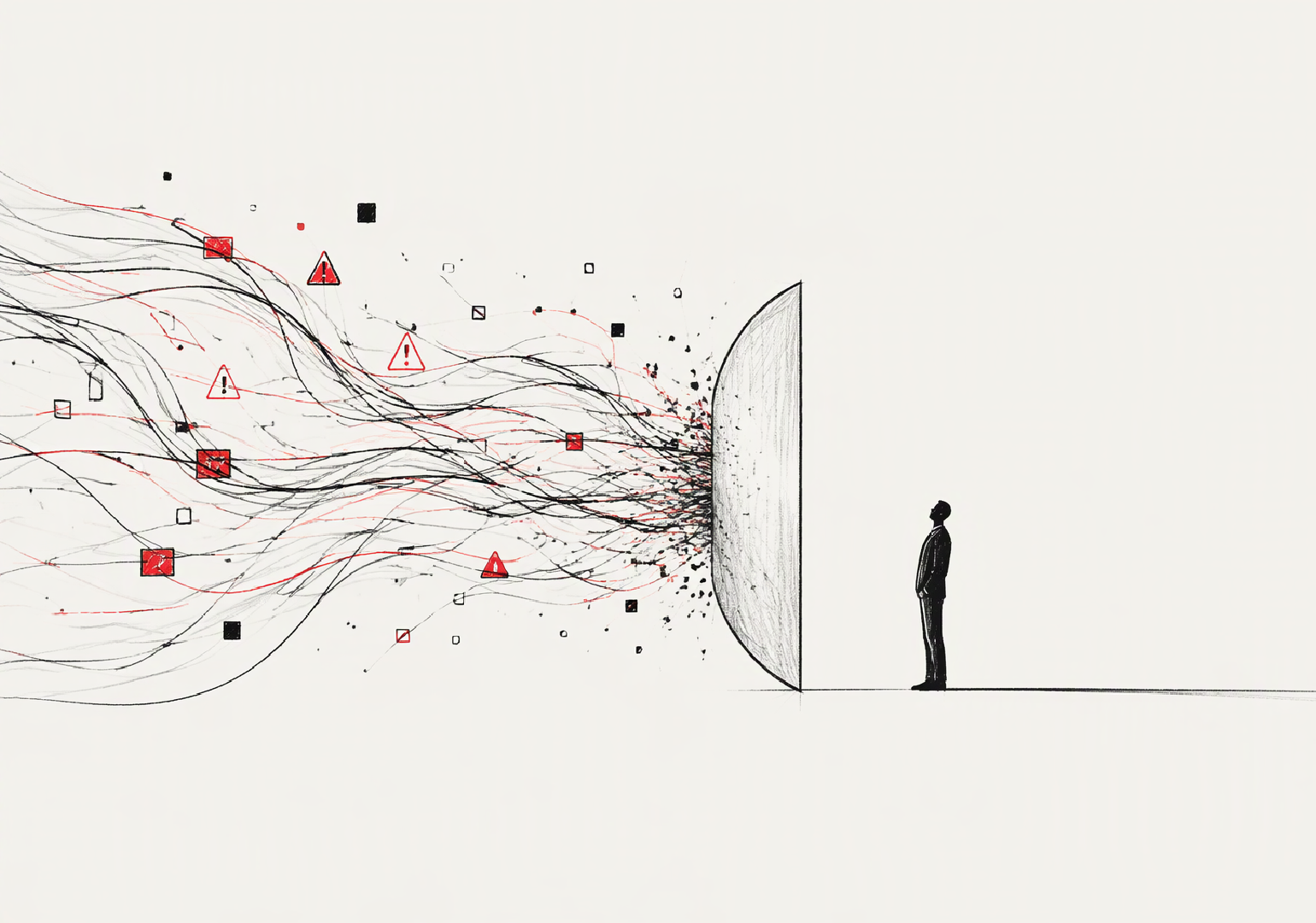
For years, sophisticated cyberattacks required time, money and scarce expertise, giving defenders a meaningful window to identify and remediate vulnerabilities. In many organisations, high and critical vulnerabilities have therefore been managed through remediation timelines measured in weeks. Frontier AI is changing that balance.
Attackers still seek the same outcomes: access, data, fraud or disruption. What is changing is the speed, scale and economics of getting there. Work that once required specialist teams and weeks of effort can increasingly be compressed into hours by Frontier AI models. Vulnerability discovery is accelerating, exploitation windows are shrinking and sophisticated AI-enabled cyber capabilities are becoming cheaper and more accessible to threat actors.
This leaves boards and executives with a critical question: are governance and defence adapting at the same speed?
Why the risk is compounding
At a recent EY Executive Roundtable in Tbilisi, technology and cybersecurity leaders, regulators and the professional community discussed Georgia’s cyber resilience in the era of frontier AI. One conclusion was clear: the same AI capabilities creating significant productivity and competitive opportunities for businesses are also changing their risk exposure. Both developments deserve explicit board attention. It is an early warning for boards that the balance between attackers and defenders is shifting, elevating the enterprise risks.
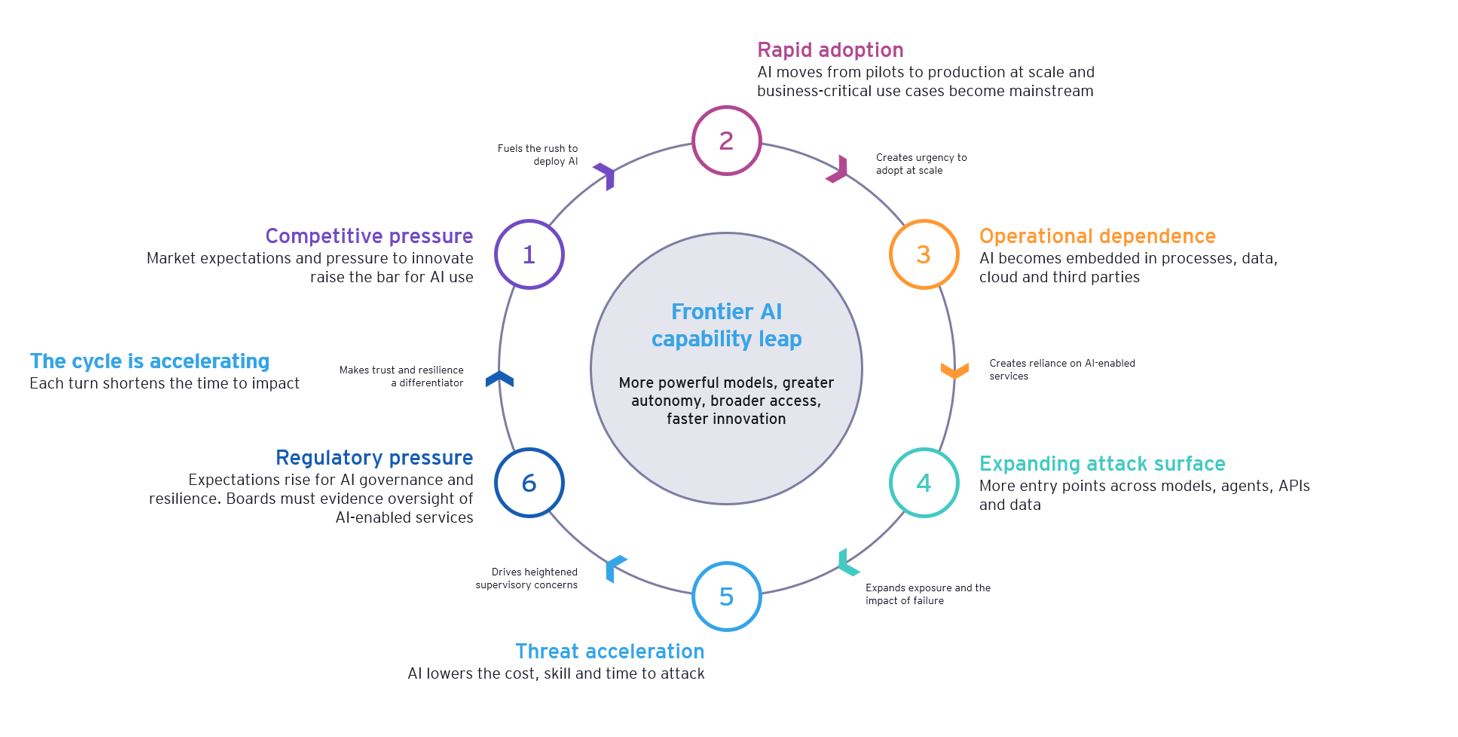
Why now? A capability leap and competitive pressure encourage businesses to adopt AI rapidly, while security governance and operational resilience take longer to mature. The faster that gap widens, the greater the exposure.
Visibility must become decision intelligence
The first imperative remains simple: you cannot protect what you cannot see.
Visibility now requires more than an inventory of servers and applications. An organisation must understand its critical services, the infrastructure and data supporting them, the vulnerabilities within those assets, how they are exposed and how an attacker could reach them.
Without these relationships, vulnerability data is information, not decision intelligence. For instance, one severe weakness on an isolated system may matter less than several low- or medium-severity weaknesses that can be chained to disrupt critical service.
For nearly two decades, the Common Vulnerability Scoring System (CVSS), has provided a standard 0-to-10 measure of vulnerability’s severity and has become a primary input to scanners, remediation SLAs and executive reporting. It remains useful, but severity alone cannot remain the sole basis for action. Revised prioritization mechanisms should consider asset criticality, attack vector, exploitability, business impact and any compensating controls.
The management question is no longer only, “How many critical vulnerabilities do we have?” It is, “Which exposures create the most credible path to disruption of the services that matter most?”
The paradigm shift: AI vs AI
CrowdStrike reported that, through Project QuiltWorks[1], an EY Fortune 100 client identified nearly 45 million vulnerabilities within hours, many of which had gone undetected for years. The example illustrates the power of frontier AI-enabled vulnerability discovery but also makes evident that no human team can manually process findings at that speed and distinguish the exposures that materially threaten critical services from the millions that do not.
And sooner or later these frontier capabilities will appear in the hands of bad actors, further challenging the balance between attackers and defenders.
One participant of EY Executive Roundtable provided a practical example of how this prioritization works today. Faced with a recent critical vulnerability, the organisation first identified all assets using the affected product, then narrowed the population to those running the vulnerable version. From there, the team assessed the importance of the assets and services involved and their level of exposure. Finally, it considered existing compensating controls before determining which assets required the most urgent remediation.
It was pragmatic, but correlating that intelligence still took hours.
This is precisely where AI can fundamentally change the operating model. Much of this aggregation, correlation and initial prioritization can be performed at machine speed, allowing experts to validate analysis, weigh trade-offs and make accountable decisions.
And, where context allows, AI-enabled workflows can support selected responses, from containment to approved patches. The objective is machine-speed analysis and governed action, not uncontrolled autonomy.
Achilles’ heel: third parties
Even perfect visibility inside the enterprise would not solve the whole problem. Organisations increasingly depend on infrastructure they do not own, vulnerabilities they cannot patch directly and providers whose ability to remediate and recover they cannot fully control.
Initiatives such as GlassWing and QuiltWorks demonstrate how frontier AI, cybersecurity platforms, regulators and specialist vendors can collaborate to accelerate vulnerability discovery and remediation at scale. Yet most third parties remain outside these initiatives, without access to comparable capabilities. And even where such capabilities are available, there is no guarantee that every critical supplier will be able to remediate the vulnerabilities that matter most within the required timeframe.
The challenge becomes even sharper in smaller markets such as Georgia. Critical services may depend on a small number of specialised providers, some of which may have limited access to global collaboration initiatives like GlassWing. Viable alternatives may also be scarce. And even where a provider with a “cleaner” risk profile exists, simultaneous demand from multiple customers could create onboarding delays, integration bottlenecks and capacity constraints.
Boards should therefore test a severe but plausible scenario: what happens if several critical providers cannot remediate vulnerabilities or provide sufficient assurance within the required timeframe? At that point, the issue is no longer simply third-party cyber risk. Concentration, limited alternatives and switching constraints can turn a cybersecurity problem into an enterprise-wide operational resilience event, potentially with consequences greater than those of an isolated security incident.
A board-level resilience agenda
Every technology wave creates benefits and risks. Frontier AI is shifting the speed, scale and economics of cyber threats, creating an enterprise resilience challenge.
Regulators are responding, for example:
- In June 2026, the European Systemic Risk Board (ESRB) warned that Frontier AI could overwhelm existing cyber-remediation processes and increase the risk of systemic cyber incidents
- Shortly after, in July 2026, the European Central Bank (ECB) asked the CEOs of the regulated institutions to assess their exposure and submit action plans by 31 October 2026.
Georgian boards should not wait for local supervisory measures equivalent to those emerging in Europe. Nor should they treat Frontier AI solely as a technical topic delegated to cybersecurity teams. They should require management to connect cyber exposure to enterprise resilience.
This does not require rebuilding cyber programmes around an uncertain future. It requires modernising the fundamentals for a faster threat environment: better visibility, context-driven prioritisation, stronger third-party resilience, realistic scenario testing and AI-enabled defence with appropriate human oversight.
* This article is the first in a series exploring how Frontier AI is reshaping enterprise risk, cybersecurity and resilience.
[1] An industry collaboration project designed to use frontier AI to discover, prioritise and accelerate the remediation of vulnerabilities
S
Forbes Opinion is a non-editorial category created by individuals with diverse interests and ideas. The texts published within this category represent the views of the authors and may not reflect the position of Forbes Georgia’s editorial team.