

By Alexander Krasnobaev, PhD, CEO of DELTA
For years, the customer journey online was linear. A user typed a query into a search bar, opened a few websites from the top 10 results, compared terms and made a decision. Today, much of that early shortlisting has moved inside AI chatbots and the AI-generated summaries built into search engines.
Three Shifts in the Age of AI Search: Audience, Clicks and Conversion
Global data from leading technology companies and research organizations confirms the scale of this shift.
1. The Reach of AI-Generated Answers in Search
Alphabet shared its latest figures at Google I/O in May 2026. AI Overviews, the AI-generated summaries in Google Search, has surpassed an audience of 2.5 billion monthly users in more than 200 countries. Google AI Mode, the conversational search experience, and the Gemini app have each passed 1 billion monthly users [1].
2. Fewer Clicks to Websites When an AI Answer Appears
Pew Research Center analyzed the real-world browsing behavior of 900 U.S. adults, covering 68,879 searches made in March 2025.
According to the published findings, when an AI-generated summary appears on a search results page, users click a traditional organic link in only 8% of cases, compared with 15% on pages without one. Only 1% of the audience clicks a link inside the AI answer itself. And 26% of users end their search session right after reading the summary, versus 16% with traditional results [2].
3. The Quality of the Traffic That Still Reaches Websites
Adobe Digital Insights, Adobe’s analytics division, found that in the first quarter of 2026, referral traffic from generative AI services to U.S. retail websites grew 393% year over year. In March 2026, visitors referred by AI tools converted at a rate 42% higher than visitors from traditional channels [3].
What This Means for Leaders
For a business owner, CEO or head of marketing, these figures signal more than the arrival of yet another traffic channel. The way trust is built is itself changing. Before a prospective customer or B2B buyer ever visits a company’s website, they increasingly ask an AI tool to suggest suitable vendors, compare terms or check a supplier’s reputation.
That said, a missing click does not by itself mean a lost customer. The user may have noted the company’s name and come back later through a direct visit, or simply picked up the phone.
But a different management challenge emerges. When a brand’s first impression takes shape inside an algorithmic answer, leaders can no longer see which facts, prices and third-party publications that summary is built on.
Alexander Krasnobaev, PhD, CEO of digital agency DELTA, describes this problem in his Russian-language book Website Promotion Using Artificial Intelligence:
Modern search engines and language models have long since moved beyond simple word matching to a semantic analysis of context and of the connections between sources.
This approach has a downside, however, which the author calls the “black box” effect. An algorithm may give a user a confident but inaccurate or outdated answer about a company if it has not found clearly structured confirmation on the company’s website and across external sources [4].
That is why regularly checking how AI describes a business is becoming a basic element of management oversight. It should be put in place alongside reviews of financial reporting and sales team performance.
An Executive Checklist: Four Parameters for Assessing Your Brand in AI Answers
To assess how AI presents a company to potential customers, leaders don’t need to dig into server configuration or machine learning algorithms. A structured check across several popular conversational AI tools (for example, ChatGPT, Gemini, Claude, DeepSeek and AI-powered search) is enough. Ask them the kinds of questions a real customer or B2B buyer would ask.
In DELTA’s practice, the initial diagnostic snapshot is built around four key parameters.
1. Factual Accuracy and Up-to-Date Information
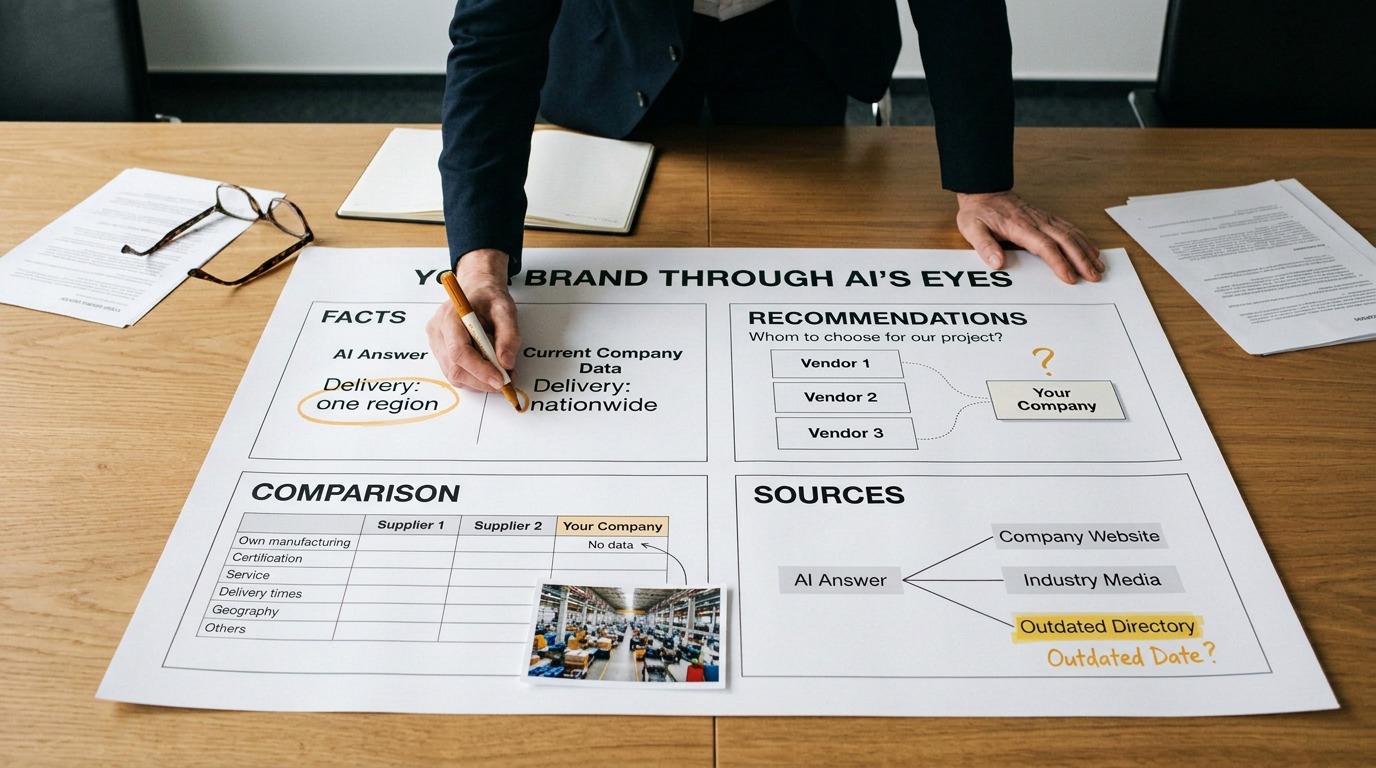
The first step is to test direct branded queries: “What is [Company Name]?” “What services or products does it offer?” “Which regions does it serve, and what are its terms?” [8]
- What to assess. AI models often mix up data from different years, credit a company with services it dropped years ago, or misstate its minimum order size or delivery area.
- What it means for management. If a model distorts the basics of the business, customers reach the sales team with false expectations. Or they drop out while still reading the AI answer, concluding that the company doesn’t serve their region or segment.
2. Presence on Category Shortlists (Non-Branded Queries)
Most buyers begin not with a specific company’s name but with a description of their task: “Recommend a supplier of industrial equipment for…,” “Which companies specialize in…,” “Who can I hire to….” In response, generative models typically produce a short list of three to seven market players [8].
- What to look for. Whether your company makes the list across different phrasings of the task, and which competitors appear at the top of the answer.
- What it tells leaders. Being left out of a recommendation list is a diagnostic signal, not a verdict. It shows that, for the algorithms, the link between your company and a specific customer scenario is weaker than it is for your competitors.
3. How You Compare With Competitors
You can ask an AI tool to compare your company with two or three direct competitors (“Compare [Company A] and [Company B] on lead times, specialization and level of service”). The model will set out the key arguments for and against each one [8].
- What to evaluate. Which of your business’s strengths the AI picks up with confidence, and which distinctive advantages (such as in-house manufacturing, certifications or service support) never make it into the comparison at all.
- What it means for management. This test shows clearly how persuasively the company’s value proposition is articulated in the open digital space.
4. The Sources the Algorithm Relies On
Today’s AI search engines and web-connected assistants show source links to the pages from which they drew the facts in their answers [8].
- What to look for. Where exactly the model gets its information about your company: your official website, industry rankings, trade media, directories or review forums.
- What it means for management. If an AI model forms its view of your brand from an outdated directory or a random online discussion rather than from your website and authoritative industry publications, the information landscape around the company needs systematic attention.
An Important Rule for Interpreting the Results
When analyzing the results, it is important to separate recorded facts from hypotheses. For example, if a company does not appear in an AI answer to a target query, that is a fact, and one that is easy to recheck by repeating the test on different days.
Estimating how many deals the business lost as a result, however, remains a hypothesis without end-to-end analytics. A user leaving a website or ending a search on the AI summary page does not, in itself, prove a lost lead. It points to an area where the company is losing control over its communication with the market.
Anatomy of Blind Spots: Why Algorithms Overlook a Company’s Strengths
When leaders see that an AI model leaves their company out of its recommendations or misrepresents its products, their first instinct is to look for a flaw in the language model itself. In practice, though, the cause almost always lies in how information about the business is organized online.
Alexander Krasnobaev, CEO of DELTA, points to a fundamental difference between how a person perceives a website and what search and language algorithms actually read [4].
To a visitor, a website is its design, an easy-to-use menu, charts and attached price lists. To an automated parser or an AI model, it is first and foremost the underlying HTML code, blocks of text and the links between documents.
That difference gives rise to four common blind spots that keep a strong business invisible to AI:
- Critical information is “hidden” from machines. Automated systems struggle to extract meaning from text inside images, complex interactive scripts, frames and separate attached files. Prices, technical specifications, certifications and delivery terms should be presented as clean, structured text on the website’s pages.
- No structured data or logical hierarchy. Generative models look for clear answers to specific user scenarios. This was confirmed by the international study The 2026 State of AI Search (an AirOps research project led by Kevin Indig, 2026). Pages with a clear heading hierarchy and Schema.org markup receive 2.8 times more citations from AI systems than unstructured documents [5].
- Too little external validation (E-E-A-T: experience, expertise, authoritativeness and trustworthiness). Algorithms judge a company’s reliability not by what it says about itself but by the sum of external signals [4]. These include brand mentions on authoritative industry sites, the verified credentials of content authors, genuine reviews and transparent company details. According to the same AirOps study (2026), 85% of brand mentions in generative AI answers are based on third-party web sources rather than companies’ own domains [5].
- A gap between “catalog language” and “the language of customer tasks.” Corporate websites have traditionally been built around internal product nomenclature or a formal list of services. Users, by contrast, ask AI tools situational questions tied to their industry, budget, facility specifications or region.
From Diagnosis to Practice: How Systematic Work With Data Changes Audience Behavior
Closing the gaps uncovered by the diagnosis takes more than “writing a couple of articles for AI.” In DELTA’s practice, preparing a website’s digital infrastructure is approached as a sequential engineering task. First, the technical barriers that prevent machines from reading the data are removed. Then the structure of the site and its content is rebuilt around customers’ real decision-making scenarios, while external trust signals are strengthened in parallel.
To reduce the time spent on routine checks, DELTA uses proprietary AI-based software modules, which Alexander Krasnobaev describes in his book:
Automated rapid-audit systems covering more than 80 technical and 150 usability parameters, along with a module for clustering search and conversational demand [4].
According to the company’s internal measurements, these tools have cut specialists’ time at the diagnostic stage by an average of 30%. That has made it possible to reallocate project budgets to in-depth analytics and the development of expert content [4].
Two of the agency’s case studies, both from Russia, show how this approach works across different business models: one in a complex B2B segment and the other in a highly regulated medical niche.
Case 1 (B2B, Russia): Reframing a Complex Catalog Around Buyers’ Tasks
Context and challenge. Elektro Tekhnicheskie Resheniya (Electro Technical Solutions), a major Russian integrator of telecommunications and electrical equipment, faced a problem typical of B2B companies. (The project won silver at the Tagline Awards 2025, a Russian digital industry award.) Despite substantial in-house manufacturing capacity, its website struck buyers as an unwieldy product directory [6]. In peak months, the site drew up to 900 visitors from search, and complicated navigation made it hard to quickly find a solution that matched a facility’s specifications.
What the team did. Rather than targeting only formal product names in search, the team rebuilt the site’s section architecture around buyers’ practical scenarios (selection by network parameters, power rating and facility type). It carried out a series of regular technical and UX audits and added an interactive AI advisor to the site. A step-by-step dialogue with the tool helps users pin down the specifics of their task and go straight to the relevant product groups and documentation [6].
Measurable results. According to the project’s web analytics, organic search traffic grew almost fivefold over five months of work, from an initial level of about 900 to 4,223 users per month [6]. Year over year (October 2024 vs. October 2025), monthly leads rose from 117 to 651, a 5.5-fold increase. Returning users grew from 231 to 1,162, and price-list downloads from 10 to 198 [6].
Case 2 (B2C/Healthcare, Russia): Structured Data and E-E-A-T Under Strict Constraints
Context and challenge. Alliance-2007 is a family medical center in Russia. It operates in a niche where algorithms hold information to stricter accuracy standards, and it faces stiff competition from large national aggregators and from clinics in a nearby major city [7].
What the team did. The team completely overhauled the site structure and moved scattered price lists out of downloadable files into a transparent structure of pages for individual specialists and services. It implemented structured data to generate rich results for the clinic’s doctors in search, and set up a process for preparing medical content with mandatory review by the clinic’s practicing physicians [7].
Measurable results. After 18 months of work, search traffic grew from 2,400 to 5,300 visits per month, and 78% of target queries secured positions in the top 10 search results. This made it possible to attract patients not only from the clinic’s home city but also from the nearby larger city [7]. Observations of patient behavior confirmed the working hypothesis: transparent pricing and verified physician credentials directly increase the trust of both algorithms and people.
Executive Summary: An Action Plan for the Next Quarter
Monitoring brand visibility in AI answers does not require an immediate overhaul of all marketing, but it does call for regular management discipline. Business owners and marketing directors need only add four sequential steps to the agenda for the coming quarter:
- Run a baseline audit of AI answers. Draw up a list of 15–20 key questions (branded, category and comparison) and record how the main conversational models and AI search engines answer them.
- Close information gaps on the website. Make sure that key facts about the company, its service area, product specifications, prices and proof of expertise (certifications, case studies, authors) are presented in open, structured text and markup.
- Audit your external reputation footprint. Compare the sources AI models cite against the company’s current situation, and correct outdated information in industry directories, rankings and trade media.
- Make monitoring a regular cycle. Repeat the diagnostic snapshot every quarter. Track how brand mentions in AI answers change over time against real business metrics: the quality of inbound inquiries, the share of branded searches and returning traffic.
AI-generated answers can be turned into a powerful tool for business growth and higher sales. A pragmatic approach lets a company stop guessing how today’s algorithms perceive it and instead manage its digital reputation consistently, based on verifiable data.
Sources
- Google / Alphabet (May 2026). Keynote by Google CEO Sundar Pichai at Google I/O 2026 and the official Google blog: audience data for AI Overviews (more than 2.5 billion monthly active users in 200+ countries) and Google AI Mode (more than 1 billion monthly active users). Official Google blog (Google I/O 2026): https://blog.google/intl/en-ie/products/sundar-pichai-io-2026/
- Pew Research Center (July 2025). “Google users are less likely to click on links when an AI summary appears in the results” (an analysis of the real-world browsing behavior of 900 U.S. adults across 68,879 searches in March 2025; found a drop in clicks on traditional links from 15% to 8%, a 1% click rate on links inside the AI summary, and sessions ending in 26% of cases vs. 16%). URL: Pew Research Center report
- Adobe Digital Insights (April 2026). “Quarterly AI Traffic Report / AI traffic grows but retail sites lag in AI search visibility” (Q1 2026 data for U.S. retail sites: 393% year-over-year growth in referral traffic from AI services; in March 2026, AI traffic converted 42% better than traditional sources). URL: Adobe for Business blog
- Krasnobaev, A. G. (2024). Website Promotion Using Artificial Intelligence (in Russian): how algorithms read HTML content (Ch. 1, Sec. 1.3); the AI “black box” problem (Ch. 2, Sec. 2.3); DELTA’s proprietary AI modules for rapid audits and an average 30% reduction in time spent on routine tasks (Ch. 2, Sec. 2.4; Ch. 3, Sec. 3.2); E-E-A-T credibility criteria (Ch. 5, Sec. 5.3); and the role of Schema.org markup (Ch. 10, Sec. 10.1).
- AirOps / Kevin Indig (2026). “The 2026 State of AI Search” (an analysis of the factors behind brand visibility and citation in generative search engines; found that 85% of brand mentions rely on third-party domains, and that structured markup and a clear content hierarchy make citation 2.8 times more likely). URL: AirOps, The 2026 State of AI Search
- DELTA case study / Tagline Awards (2025). “Comprehensive SEO and AI Modules: Nearly Fivefold Traffic Growth in Five Months in a Highly Competitive B2B Niche on a Limited Budget” (in Russian; project for Elektro Tekhnicheskie Resheniya; web analytics data for five months of SEO work and a year-over-year comparison of October 2024 and October 2025). URL: case study on the Tagline website
- DELTA case study (2024). “Our Proprietary Methods for Using AI to Promote a Medical Center’s Website” (in Russian; project for the Alliance-2007 family medical center; search traffic and ranking data over 18 months of SEO work). URL: case study on the DELTA website
- Editorial methodological summary prepared for this article, based on two sources:
- Item 1. Factual accuracy and up-to-date information. A direct consequence of the “black box” effect described in Alexander Krasnobaev’s book (Ch. 2, Sec. 2.3), which shows that AI can give confident but incorrect answers when its source data is incomplete, together with the book’s recommendations on verifying information about a company online (Ch. 5, Sec. 5.3).
- Item 2. Presence on category shortlists (non-branded queries). Based on the description of DELTA’s GEO (generative engine optimization) service on its website (geo-prodvizhenie.html), which names the key goal as getting a brand into AI’s short recommendation list of three to seven companies for conversational queries (“recommend…,” “who makes…,” “where can I order…”) that do not mention a company name.
- Item 3. Comparison with competitors. A logical extension of the competitive analysis and business-strengths assessment methodology in Alexander Krasnobaev’s book (Ch. 2, Sec. 2.4, and Ch. 4, Sec. 4.1), applied to how conversational AI models work.
- Item 4. The sources the algorithm relies on. Draws on the stages of external reputation management and regular monitoring of mentions across five AI systems (from the description of DELTA’s GEO service on its website), as well as the analysis of external site authority and E-E-A-T signals in Alexander Krasnobaev’s book (Ch. 5, Sec. 5.3).
S
The opinions expressed in this column are those of the author and may not reflect the views of the editorial team.