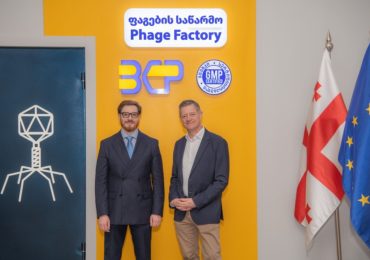

Gia Markoidze, a lawyer from Georgia now practicing in the United States, built his career on a simple principle: work on things bigger than yourself. From shaping institutions in Georgia to navigating complex transactions in the United States, he treats law like architecture, where the strength lies in the unseen foundations.
His career rests on three pillars: government service in Georgia, which taught him how institutions operate, academia, which honed his analytical discipline, and international legal practice in the United States. Together, they shaped a lawyer capable of bridging jurisdictions and building enduring legal structures.
From a very early stage, he was drawn to work that went beyond individual cases. “I wanted to be part of projects that shape institutions, transactions that move markets, and legal structures that outlive the people who build them,” he recalls. For him, lawyers are much like architects: the visible structure is just the surface, while the careful planning, calculations, and unseen work beneath determine whether a system stands the test of time.
His early professional experiences in Georgia reinforced that perspective. Before practicing law in the United States, leading institutional projects in government, and serving as a lecturer and expert for international organization, Mr. Markoidze began his legal journey in far more modest circumstances. One of his first professional experiences was serving as a judicial intern at the Supreme Court of Georgia. He remembers sitting at a small desk in the courtroom and observing how decisions were formed. “That experience placed an important brick in the foundation of my professional path,” he says. It showed him how careful legal reasoning can influence real lives and real institutions.
Later, he joined the Ministry of Internal Affairs, where he worked on multiple institutional projects and led teams responsible for complex legal and compliance initiatives. “Government service teaches you that law is not only about identifying problems; it is about solving them,” he explains. “Many people will say that something cannot be done because of legal obstacles. In reality, most things are possible, but they come with costs, risks, or consequences. The role of a good lawyer, and especially a good manager, is to navigate those obstacles responsibly and minimize that cost for the client while staying within the law.”
Ambition soon pushed his horizon beyond a single jurisdiction. He often reflects that professional rigor needs a bigger arena to reveal its true strength. In a smaller environment, it is possible to stand out quickly, but the real test of discipline and ambition comes when the field becomes larger, more competitive, and more complex. For him, the United States represented that arena — a place where global transactions, regulatory scrutiny, and international markets converge. Entering that environment allowed him to test his abilities on a much broader stage and expand his work beyond the limits.
His career, however, is not defined solely by practice. In Georgia, he learned firsthand how institutions operate and how law is applied in real-world settings. As a lecturer at Tbilisi State University and through teaching, research, and expert consultations, he developed a deep understanding of policy, economics, and regulatory complexity. Private practice in the U.S. then became the space to bring these experiences together, translating insight into actionable solutions for clients.
Ambition again guided his decision to pursue advanced legal studies abroad. Studying at The George Washington University Law School in Washington, D.C., the capital of the United States, offered access to regulatory institutions, international organizations, and policy centers. The LL.M. program in Business and Finance Law allowed him to deepen his expertise in mergers and acquisitions, international business transactions, and corporate finance. He also graduated with Highest Honors and published a research article in Concurrences, analyzing algorithmic pricing, which was later recognized among the top articles of the year.
Passing the New York Bar marked another turning point. “I view my career in two phases: before passing the New York Bar and after,” he says. The intense preparation required both knowledge and endurance, but passing the exam expanded his credibility with global clients and allowed him to participate fully in international transactions.
Today, his work in a Washington, D.C.-based law firm spans domestic and international legal matters, from corporate structuring and mergers to regulatory compliance, often linking multiple financial centers like New York and Miami. One recent project involved assisting a client in uplisting a company to NASDAQ, requiring coordination across jurisdictions and regulatory agencies. He sees such work as emblematic of the modern lawyer’s role as a strategic architect navigating regulatory, business, and financial landscapes simultaneously.
Mr. Markoidze thinks that the real opportunity for Georgian companies lies in scaling through access to international markets. He points to the financial sector as proof of what that can achieve. “When Georgian companies gain access to major international markets, their growth potential changes dramatically,” he says. He notes that the international listing of Bank of Georgia helped enable major growth and later regional expansion, including the acquisition of Ameriabank in Armenia. In his view, international capital markets are not only a source of funding but also a path to scale and global visibility. Likewise, Georgian wine businesses, with strong cultural and commercial identities, could achieve significant international success with careful corporate structuring. Some are already exploring expansion in the United States.
For building an international legal career, he emphasizes character above all. “Clients, colleagues, and institutions must be able to trust the lawyer they work with. They need to see rigor in your thinking, reliability in your judgment, and consistency in how you approach complex problems.” Discipline, a strong academic foundation, comparative thinking, communication, and adaptability are also critical. Early responsibility played a pivotal role: by 25, he had already led university courses and held managerial roles in law enforcement. These experiences taught him that professional growth often begins when one accepts responsibility earlier than expected and treats each opportunity as a chance to develop competence and leadership.
His long-term vision is to continue shaping complex cross-border transactions while remaining connected to academia. He sees his role as a bridge between legal systems and business environments, helping companies expand responsibly while ensuring their legal foundations remain strong. “International lawyers increasingly act not only as technical advisors but as strategic architects,” he observes. His goal is to keep helping businesses move confidently across borders, designing frameworks that endure as much as the law itself.

Editor, Forbes Georgia.