Vara Imandi
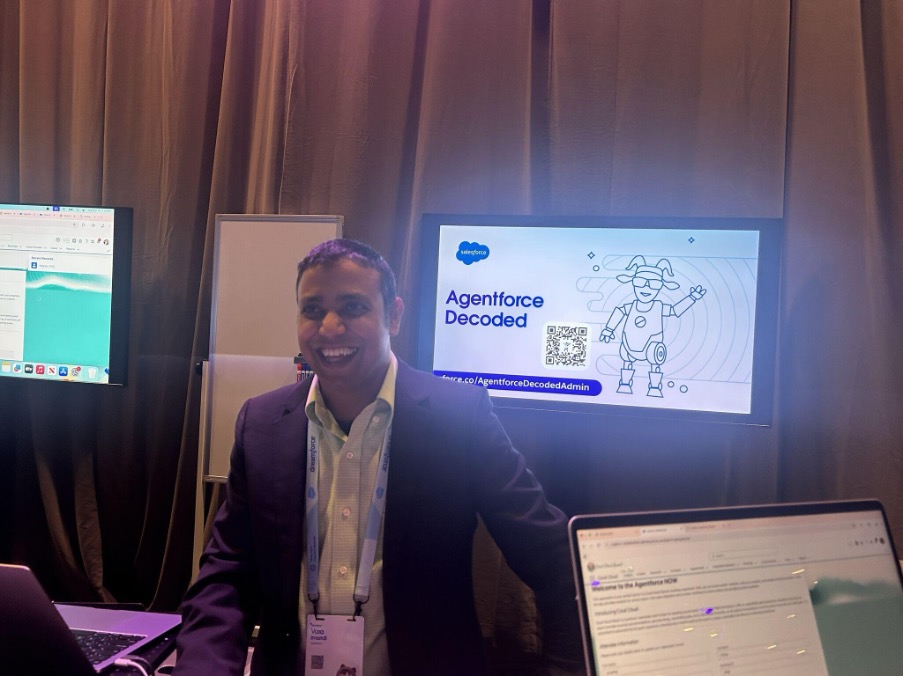
On a chilly Thursday evening in early 2025, 150 developers congregate in a San Francisco Salesforce conference room, their laptops glowing like fireflies in the dark. They had gathered to tackle a pressing challenge plaguing healthcare: How do you modernize systems built on 40-year-old code so they can harness AI? At the front of the room stood Vara Imandi, a Salesforce leader whose quiet intensity cut through the buzz.
“Legacy systems aren’t relics,” Imandi told the crowd. “They’re libraries. Our job is to teach them new languages.” By night’s end, teams under his guidance had built AI agents that could parse Medicare claims written in COBOL—a feat once deemed impossible. For Imandi, it was not a miracle; it was methodology.
This scene captures Imandi’s dual legacy: a technologist bridging Silicon Valley’s AI future with the enterprise past, and a community architect nurturing the next wave of connectivity innovators. Over two decades, he has become the unseen force behind a global movement where platforms and people evolve in lockstep.
Legacy Code Meets Its Match in MuleSoft Accelerators
Healthcare and financial systems worldwide are built on fragile foundations. This is not hyperbole; it’s a documented crisis. Much of their critical infrastructure still relies on outdated software, creating costly inefficiencies and stalling innovation. As of 2025, an estimated 70% of global banks still rely on legacy systems, while the average cost of a single healthcare data breach—a risk amplified by un-patchable software—has soared to $9.77 million. For startups, these legacy barriers are more than just technical hurdles—they can be a matter of survival. Many promising ventures struggle to scale or even launch due to the incompatibility of modern tools with archaic systems.
Imandi’s answer to this challenge is the MuleSoft Industry Accelerators—ready-made toolkits that transform obsolete code into modern, API-compatible formats. Described by Imandi as “digital Rosetta Stones,” these accelerators have significantly simplified system integration for major partners, turning what was once a bottleneck into a springboard for growth. By championing the principle of reusable APIs, Imandi has helped financial firms like RBC Wealth Management deliver projects three times faster, while global asset manager Invesco cut development time by 92%.
Imandi’s advocacy for these accelerators addresses a demographic time bomb in the tech workforce: the average COBOL programmer is now over 55 years old. “We are running out of translators,” Imandi notes. “We have to build systems that translate themselves.”
The Boston Blueprint
Imandi’s influence is deeply rooted in Boston, where he is a prominent voice in Boston’s MuleSoft community, frequently sharing his firsthand experiences and insights from the front lines. What began as casual monthly gatherings has evolved into a thriving hub for innovation, sparking hundreds of AI and connectivity projects.
At a recent session, Imandi led a masterclass on one of AI’s most critical applications: pharmacovigilance. He demonstrated how AI agents could automate the analysis and reporting of adverse drug events, cutting timelines from days to minutes. This focus aligns strictly with the demand for responsible, transparent AI outlined in the EU’s landmark 2024 AI Act and the FDA’s January 2025 guidance on AI in drug development.
The group’s ethos is classic Imandi: collaboration over competition. “This isn’t just meetup culture,” says Sravan Lingam, a solution architect at Caelius and Salesforce’s Golden Hoodie winner. “It’s a meritocracy where the best idea wins, no matter who you are. Vara ensures that.”
The Advisor Playbook
Imandi’s advisory role extends far beyond Salesforce, where he has mentored over 15 startups through accelerators like Salesforce Ventures and his own partner network, emphasizing a critical insight: Integration isn’t a feature—it’s the foundation for AI.
Consider the case of a prominent stealth healthtech venture (anonymized here as ‘PriorAuthAI’ for confidentiality). Despite cutting-edge algorithms, the firm floundered for months, unable to bridge the gap between modern AI tools and insurers’ legacy systems. Imandi’s intervention was surgical:
- Diagnose: He identified that delays stemmed from mismatched data formats between provider EHRs and payer systems, not the AI model itself.
- Prescribe: He guided the deployment of the MuleSoft Accelerator for Healthcare, to act as a universal translator, standardizing data exchange via FHIR API standards.
- Scale: He empowered the team to build AI agents on this stable foundation to automate the submission and tracking process, providing real-time status updates, compliance checks, and data exchange to clinicians.
The outcome? The venture successfully processed over 100,000 authorizations in its first post-integration quarter, cutting the average decision turnaround time by 90%. As the founders noted: “Vara doesn’t just give us tools. He gives us a perspective to see and break down the invisible barriers holding us back.”
Breeding Grounds for Disruption
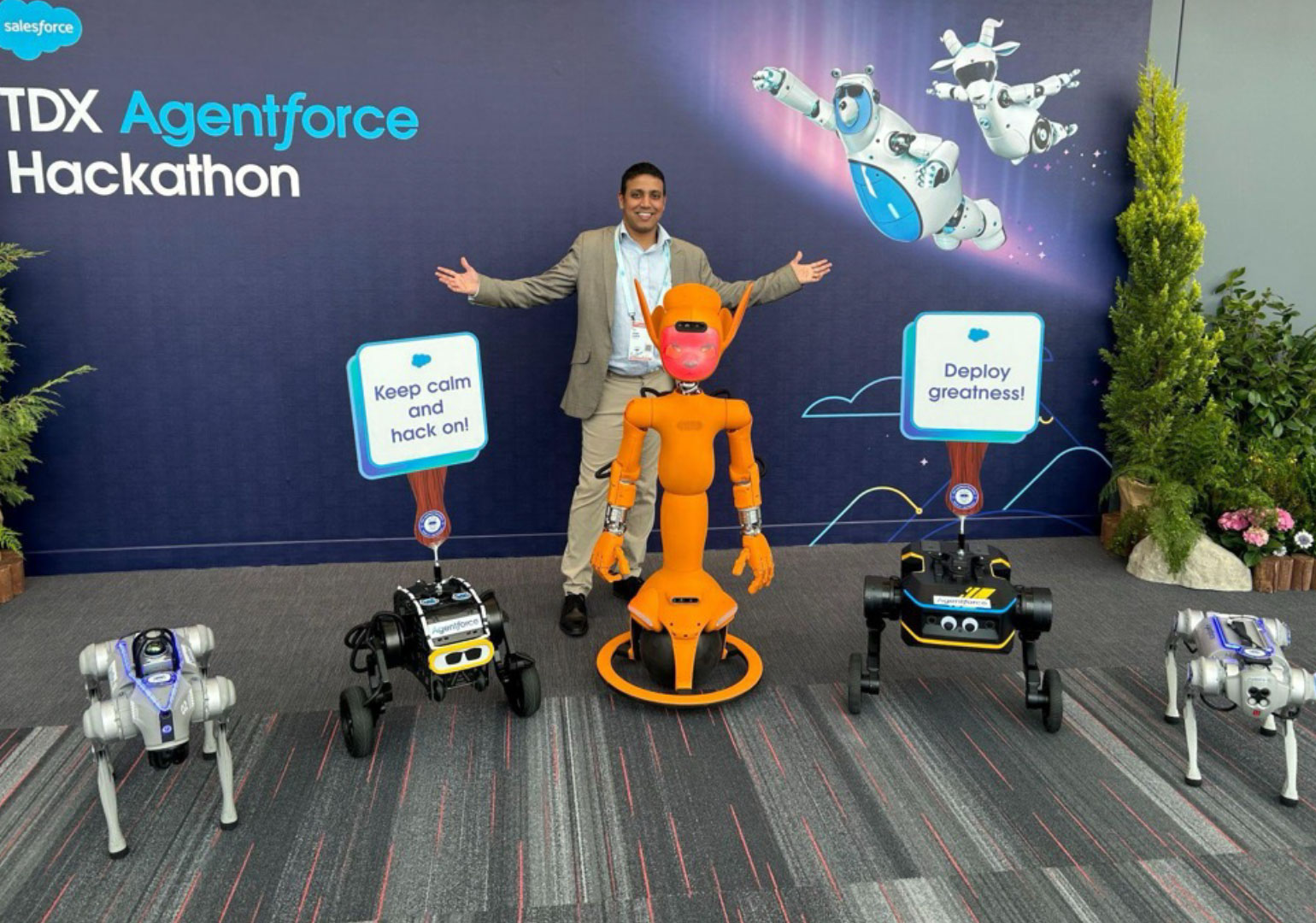
Imandi champions large-scale innovation events like the TDX Agentforce Hackathon 2025, not as mere competitions, but as high-pressure incubators for real-world solutions.He sees them as opportunities where developers compete to solve industry Gordian knots, rapidly moving them from ‘whiteboard sketches’ into ‘smart, repeatable routines that businesses can trust. At the March 2025 event, where Imandi served as a judge, winning projects reflected this urgency. “Team Agent Halo”, developed a multi-agent network to coordinate emergency services and insurance claims after a car accident—a powerful demonstration of AI solving complex, real-world problems. Another team from Lagos built an AI agent to coordinate clinical trials across 30 African villages—no broadband required. Another team from Mumbai automated fraud detection for micro-insurance claims.
While direct financial metrics for hackathon-born ventures are notoriously difficult to track, the qualitative impact is clear: hackathon-born startups have reached a collective valuation in the billions, with a survival rate past Series B that far outpaces the industry average.
Spin-off workshops have trained a global community of thousands of developers, turning what began as coding challenges into launchpads for real-world impact. “These aren’t coding competitions,” Imandi insists. “They’re auditions for the future.”
The Human Algorithm
Beneath the technical triumphs lies Imandi’s core philosophy: Technology scales, but communities endure. When Salesforce acquired MuleSoft in 2018, skeptics feared the developer community would become bogged down by corporate bureaucracy. Instead, leaders like Imandi have engineered their renaissance with their expertise in partner solutions engineering since 2020:
MuleSoft’s community model is built on decentralized leadership. Local chapters are now active across dozens of countries, each customizing tools to meet regional needs, such as Swahili-language API documentation in Nairobi. Governance is meritocratic, allowing top contributors to earn positions on advisory boards and play a direct role in shaping product roadmaps.
The spirit of open-source altruism runs deep, with hundreds of accelerators and API templates made freely available to nonprofits. The impact is clear: Community-driven contributions now fuel a significant share of platform innovation, powering everything from GDPR-compliant data masking to low-code AI agents.
Democratizing the Future
As AI continues to reshape entire industries, Imandi’s focus is on expanding access. His 100×100 Initiative is intended to equip underserved regions with the connectivity tools needed to participate in the digital economy. Early pilots are already showing encouraging signs. In California, Blue Shield of California is making Prior Authorization as simple as using a credit card, using AI agents built with Imandi’s frameworks have significantly reduced delays in prior authorizations.
In Lagos, Nigeria, a developer collective—trained entirely via virtual sessions—now manages integrations for a growing number of local fintech companies. Still, Imandi acknowledges that the most significant challenges ahead aren’t purely technical. “The next frontier isn’t technical—it’s cultural,” he says. “How do we convince a hospital CIO that modernizing isn’t a cost, but an act of care?”
Teaching the World to See the Terrain
In a climate of AI hype and tech bro bravado, Vara Imandi’s work offers a masterclass in pragmatism.He is a leader who measures success not in patents or profits but in the capability of the ecosystems he helps create. His playbook is deceptively simple: Build platforms that empower, communities that endure, and watch the future assemble itself.
The reforms he champions—from open APIs to shared ethical AI frameworks—are not just technical upgrades. They’re the blueprint for a world where innovation is distributed, not hoarded. As one Boston developer put it: “Vara didn’t give us a map. He taught us to see the terrain.” That terrain is the complex, interconnected landscape of the next decade—where technology, regulation, and human collaboration are inseparable.
Ultimately, his goal appears to be a form of planned obsolescence for his own guidance— to cultivate a generation of builders so adept at navigating the complexities of integration and AI that they can chart their own course. In an industry focused on building dependencies, his greatest innovation may be architecting independence. While some leaders draw maps, the greatest teach us how to navigate the stars.