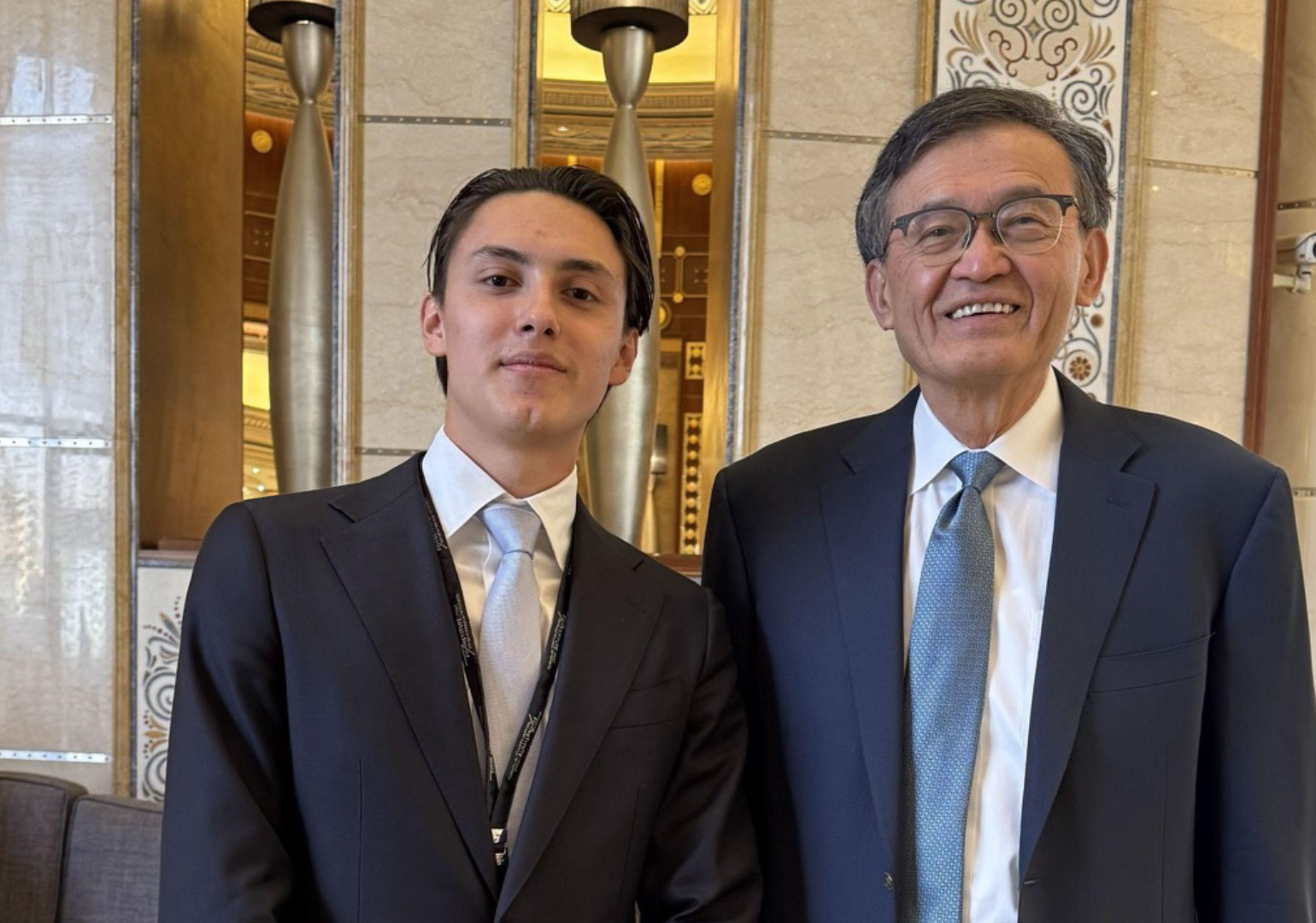
Carlos Cadena Rico and Lip-Bu Tan (CEO at Intel Corp.) Saudi Arabia, Riyadh
Photo Credit: Deeana Zaji
Each year, the Future Investment Initiative (FII) draws a global cohort of capital allocators to Riyadh to debate the trajectory of the world economy. The 2025 summit’s flagship panel, “Board of Changemakers: Geoeconomics,” featuring a stage of CEOs who collectively manage trillions of dollars: BlackRock’s Larry Fink, JPMorgan’s Jamie Dimon, Blackstone’s Stephen A. Schwarzman, Goldman Sachs’ David Solomon, and Pershing Square’s Bill Ackman. In a session beyond the financial agenda, Crown Prince Mohammed bin Salman and Syrian President Ahmad Al-Sharaa, discussed Syria’s reconstruction, reflecting Saudi Arabia’s expanding role as a broker in regional stability and investment.
Amid the usual delegates of C-suite executives and fund managers, the FII Institute is making space for a different kind of member. This year, that included Carlos Cadena Rico, a 20-year-old who, unlike his peers at college, spent his midterm week in Saudi Arabia.
His presence as a full member, a status granted after a multi-week vetting process and typically reserved for senior executives, raised questions about how a university student secured such access. After reaching out to Cadena for commentary, a more detailed picture emerged of a young investor deliberately positioning himself at the intersection of technology and global finance.
At 16, Cadena founded Virtus Bit Kapital, a Bitcoin mining operation in Mexico that grew to over 100 rigs. To stay competitive in the Bitcoin mining business, he designed custom immersion cooling systems, a technique typically used by industrial scale operations to reduce power costs. A year later, at 17, he attended the Bitcoin Conference in Miami, where he met early crypto pioneers including Brock Pierce and the Winklevoss twins. The experience provided a practical education in the digital asset ecosystem, informing his subsequent work on stablecoin frameworks.
A Seat at the Table: Conversations with Larry Fink and Lip-Bu Tan

Cadena’s time at FII was not spent merely observing. In a brief conversation with BlackRock CEO Larry Fink, he discussed the sustainability of the current AI capital expenditure cycle and its concentration risk within the S&P 500. The discussion then shifted to Mexico’s interest rate trajectory and its implications for foreign investment, before touching on Fink’s remarks from the “Board of Changemakers” panel about the tokenization of real-world assets. The exchange moved beyond finance into more personal territory, though Cadena declined to elaborate on those details.
In another notable exchange, Cadena spoke with Lip-Bu Tan, the CEO of Intel Corporation. Their conversation centered on Intel’s strategic turnaround, particularly Tan’s navigation of a complex political landscape. Cadena asked Tan about Intel’s role in the CHIPS Act, particularly how the company positioned itself to benefit from the U.S. government’s renewed focus on domestic semiconductor manufacturing. Tan’s ability to turn a national security imperative into a strategic advantage for Intel, Cadena noted, showcased the intersection of corporate strategy and public policy.
Beyond Riyadh: A Dual-Track Strategy in Tech and Capital
FII is not the only place where Cadena has sought proximity to major decision makers. A few weeks before leaving for Riyadh, Cadena was in San Francisco for SF Tech Week, attending events at Andreessen Horowitz’s headquarters. He contributed to the firm’s ‘Speedrun’ program, reviewing over 30 early-stage AI companies alongside a16z partners and investors. The contrast was deliberate: in Saudi Arabia, capital allocation discussions centered on sovereign funds and infrastructure; in San Francisco, the focus was on which AI startups would define the next decade.
A Low-Profile Approach to a High-Visibility Career
Despite the visibility that comes with FII membership and invitations to events at leading venture firms, Cadena keeps a low profile online. He does not flood social media with content or personal branding campaigns. Instead, he focuses on speaking directly with founders, fund managers, and asset allocators, building a network through direct engagement rather than public pronouncements.
Longer term, his ambitions are expansive. He aims to invest in AI infrastructure, fintech, and technology-driven financial systems. Recently, Carlos has deployed capital into leading private technology companies across AI infrastructure and fintech through a series of special-purpose entities. When asked about specifics, he declined to comment, citing confidentiality agreements. Carlos Cadena Rico is consolidating investments across the AI ecosystem, building a track record in the sector he believes will define the next decade of finance.