Photo Courtesy of Charles Edelman
Charles Edelman’s art begins with attention. Whether moving through New York streets, studying works inside Parisian museums, or returning to the shoreline of the Long Island Sound, he treats each environment as a site of sustained looking rather than fleeting inspiration. Observation, for Edelman, is not passive. It is an active discipline, one shaped by time, repetition, and restraint. Gesture, shadow, and expression become materials as essential as paint or clay.
Across decades and multiple media, Edelman’s practice follows a consistent logic: what is seen attentively is carried forward. Collectors across the United States and South America respond not only to subject matter but to the discipline behind each piece. Ordinary moments—children moving, birds pausing, light shifting through trees—become compositional seeds, sparking works that breathe with life and insist that viewers see the world as Edelman does.
Observation as Practice
Edelman’s discipline took shape early. He was one of thirty students selected from hundreds for Yale University’s summer art program, an experience that reinforced the value of working directly from life. He later earned a Master of Fine Arts from Queens College in New York, where he also served as a teaching assistant, before continuing his studies at the New York Studio School. There, sustained critique and dialogue sharpened his ability to translate observation into form.
Teaching followed naturally. Edelman went on to teach at Parsons School of Design and Dartmouth College, roles that allowed him to guide students while remaining committed to his own studio practice. Curiosity, he has said, remains his driving force. Rather than chasing novelty, he returns repeatedly to close looking, studying how light shifts across a surface or how movement alters expression.
He reflects with humor on the artists who inspire him, noting comparisons to Van Gogh—and joking that perhaps he even influenced him. He studies under a mentor he calls “Leonardo,” revisiting lessons missed in high school, and imagines that his great-great-grandfather Rembrandt would approve of his pursuit of knowledge.
A memorable studio visit with a master printmaker who had worked with Picasso and befriended Dali further reinforced Edelman’s commitment to dialogue across generations. When asked what Picasso might think of his paintings of fish and aquariums, the printmaker paused, then replied, “He would love them.”
Edelman’s focus extends beyond the studio. Over nearly a decade, he drew and sculpted gorillas at a Midwestern zoo, producing more than one hundred studies entirely from life. He learned to anticipate gestures, capturing fleeting interactions with empathy and precision. One encounter stands out: a female gorilla he had drawn as an infant was later relocated to the Philadelphia Zoo. During a visit years later, she recognized him across the enclosure, approaching the glass in what he describes as a moment of mutual recognition. For Edelman, it affirmed a core belief: sustained attention leaves enduring impressions—on both subject and artist.
The Ethics of Attention
Edelman channels his attention into action beyond the studio. A significant portion of sales from his paintings and illustrated book supports children with cancer through the Tom Coughlin Jay Fund, with additional proceeds benefiting the Audubon Society’s wildlife and conservation efforts.
“It’s not just about creating art,” Edelman explains. “It’s about giving something meaningful back to life itself.” He cites personal experience, including the loss of a brother to cancer before his birth, as motivation to direct his work toward causes that matter.
Giving, for Edelman, feels inseparable from seeing. The same care that shapes a line, a shadow, or a gesture also guides where his work lands in the world. Attention, in this sense, becomes generous, an act that moves outward rather than inward. Collectors don’t just acquire an object; they step into a current of intention that extends beyond the frame.
Enduring Lessons in Observation
Charles Edelman’s work resists easy categorization, not because it avoids meaning, but because it continues to expand it. After decades of observing the world at close range, his attention has turned toward scale—toward a monumental panel series that carries his philosophy into shared space.
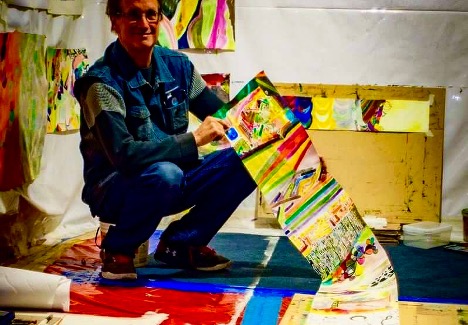
Now his focus rests on A Mural Premier of Love, Beauty, and Hope, a 30- to 50-foot series conceived as a counterpoint to Picasso’s Guernica, which Edelman studied closely while it was displayed at the Museum of Modern Art. Where Guernica confronts devastation, Edelman’s panels respond with humanity, nature, travel, abstraction—and, most importantly, love. Love sits at the center of the abstraction, acting as both subject and force.
The panels may be acquired individually or as a unified installation, making the work adaptable for corporations, collectors, institutions, or anyone seeking to bring joy and curiosity into daily life. Edelman describes the series as a ten-year meditation that has now become his full creative focus for the year ahead.
That spirit—open, generous, quietly spiritual—runs through everything he creates. Edelman speaks of painting seascapes on deserted beaches where seagulls linger only feet away, or of working in Florence’s Boboli Gardens with the feeling that artistic history was close at hand. These moments are not performances, but private affirmations that art, at its best, is a lived exchange with the world.
For those who want to experience that exchange firsthand, Edelman shares his work through CharlesEdelmanMasterpieces.com, where paintings, panels, and ongoing projects are available to view and acquire.
And if there is one note he hopes lingers, it is this: art, even at its most rigorous, should leave room for joy. “I paint because it’s fun,” Edelman says. “And because the world could always use more smiles.”