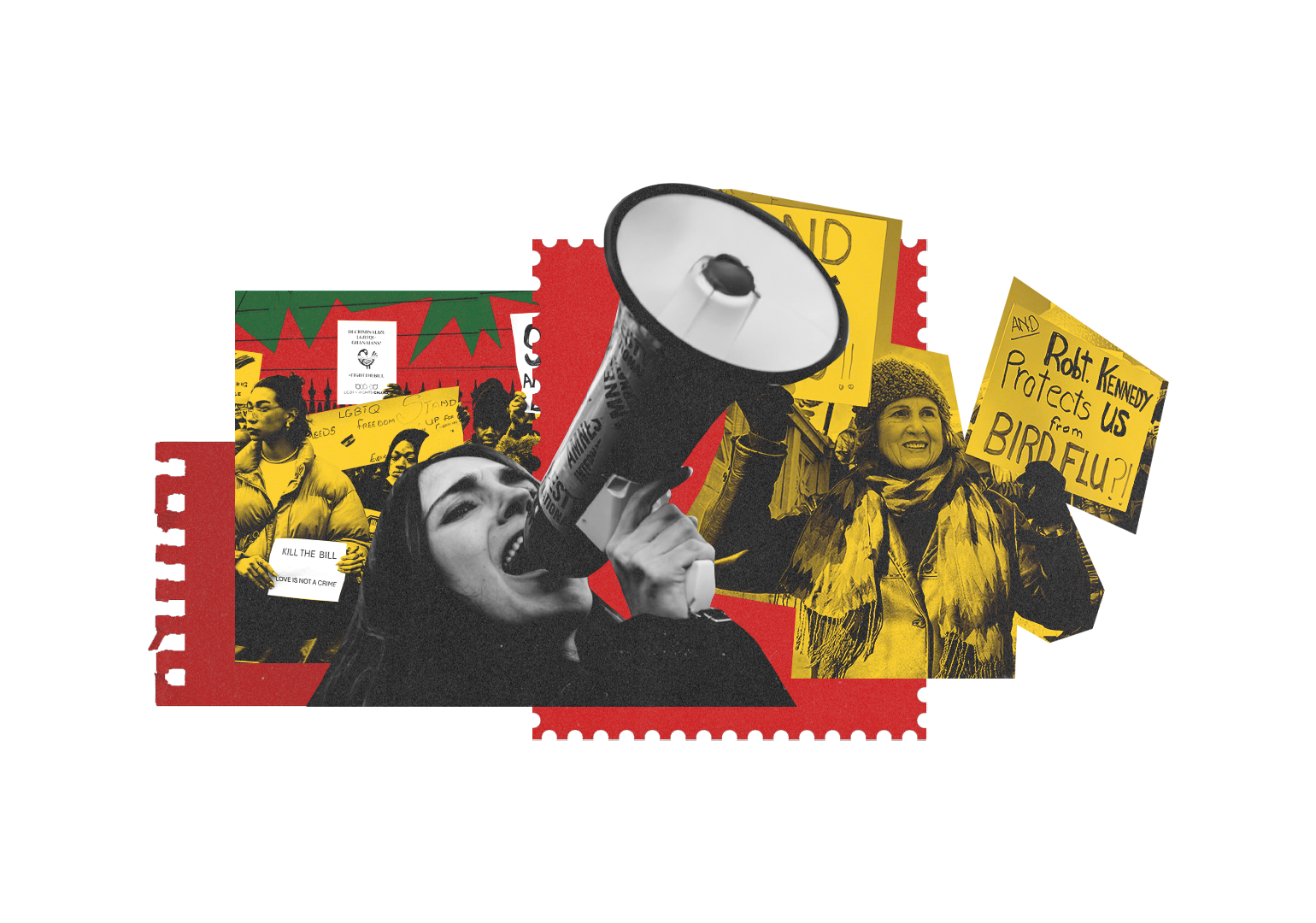
Protest is not just a human right — it is a powerful tool for positive change. Governments are supposed to respect this right, but they often perceive protest as a threat to their power and respond with repression or violence. This is reflected in the fact that in 2022, excessive force against peaceful demonstrators was recorded in 86 out of 156 countries.
This article analyzes available data on international protest movements — statistics, causes, targets, methods of repression, and more. The goal is to identify the most widely used methods of effective protest and examine government responses, so that activists can equip themselves with appropriate defensive mechanisms.
Key General Statistics
Although statistical data on protest is relatively scarce and methodologies vary, some organizations provide enough information to draw meaningful conclusions.
One of them is the Global Protest Tracker, which shows that from 2017 through the end of January 2025, more than 800 significant anti-government protests took place in over 150 countries worldwide. Of those, only 18% lasted longer than three months.
As for 2024 specifically, the same organization recorded 160 significant anti-government protests globally. One notable trend stood out: because an unusually high number of elections were held last year, dissatisfaction with results and other political factors rose considerably.
The Geography of Protest
The Armed Conflict Location and Event Data project (ACLED) gives us a way to analyze the geography of protest. It is an NGO that collects various data globally, including on demonstrations, drawing on traditional and new media, local partners, and reports.
It is worth noting that ACLED provides granular data. For example, the pro-European protest that has now been ongoing in Georgia for three months is counted not as a single event, but according to the number of individual demonstrations. This is one reason its figures differ significantly from other sources.
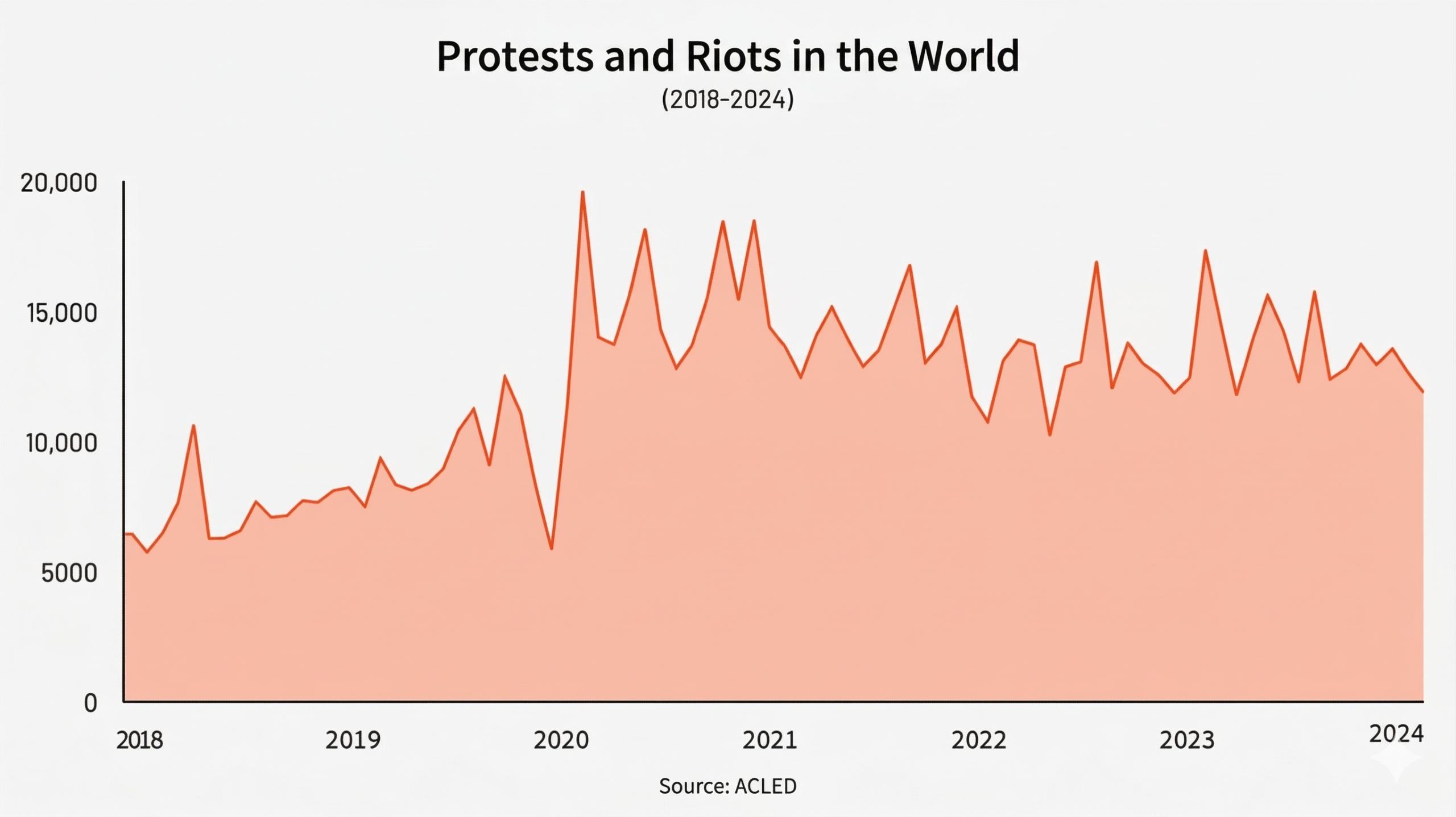
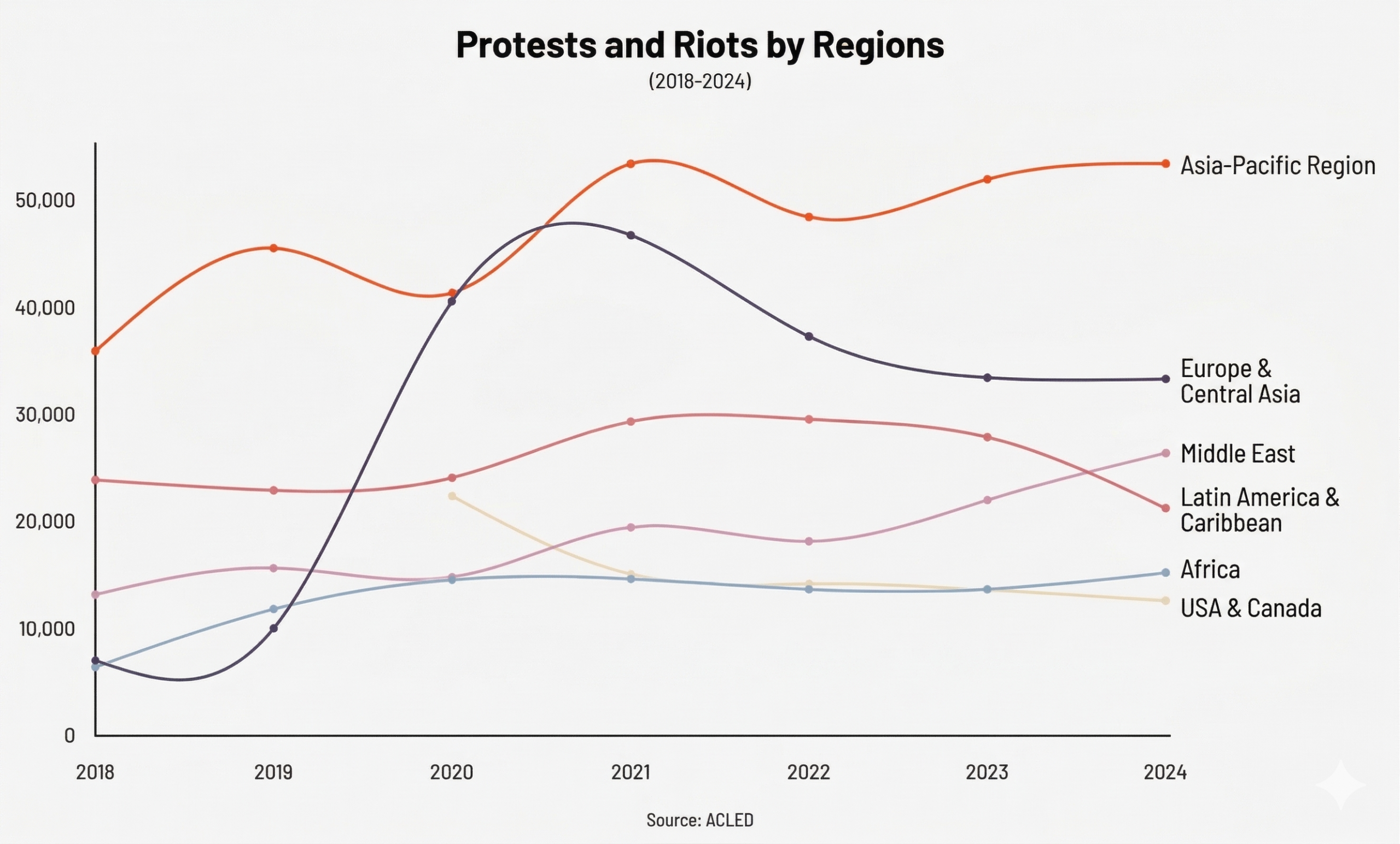
According to ACLED, between 2018 and 2024, a total of 1,017,860 protests and uprisings were recorded worldwide. It should be noted that the organization began tracking data from 2018, except for the US and Canada, where tracking only started in 2020.
Even so, the data clearly shows that social unrest peaked in 2020 — a direct result of COVID-19 lockdowns, which severely restricted the right to protest by banning public gatherings. Some governments also used the pandemic as an opportunity to lay the groundwork for even tighter restrictions on the freedom of assembly going forward.
Which regions stand out for protest frequency? The data shows that the Asia-Pacific region leads by number of protests, followed by Europe and Central Asia, and then Latin America and the Caribbean.
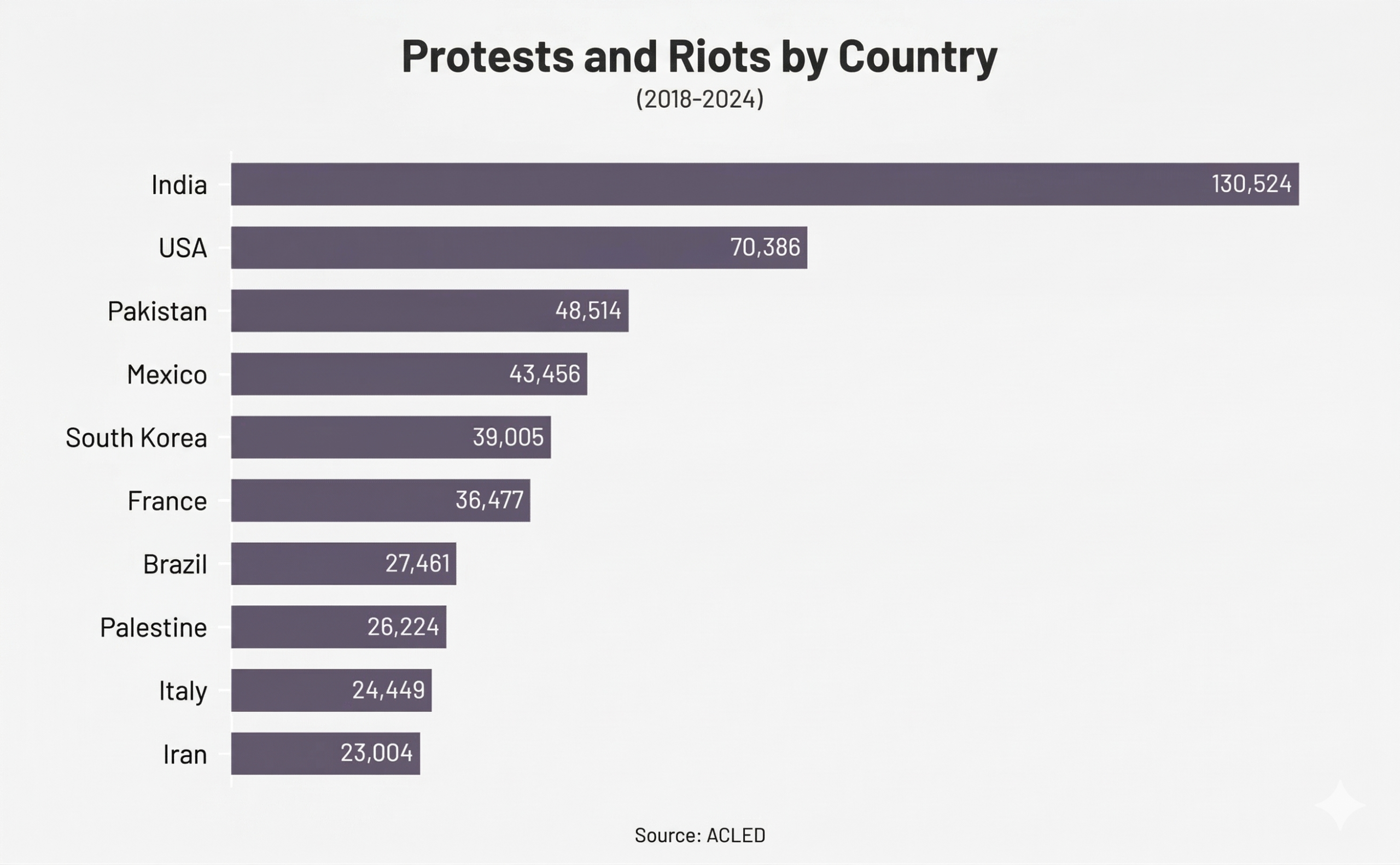
At the country level, ACLED data for 2018–2024 puts India, the United States, and Pakistan in the top three.
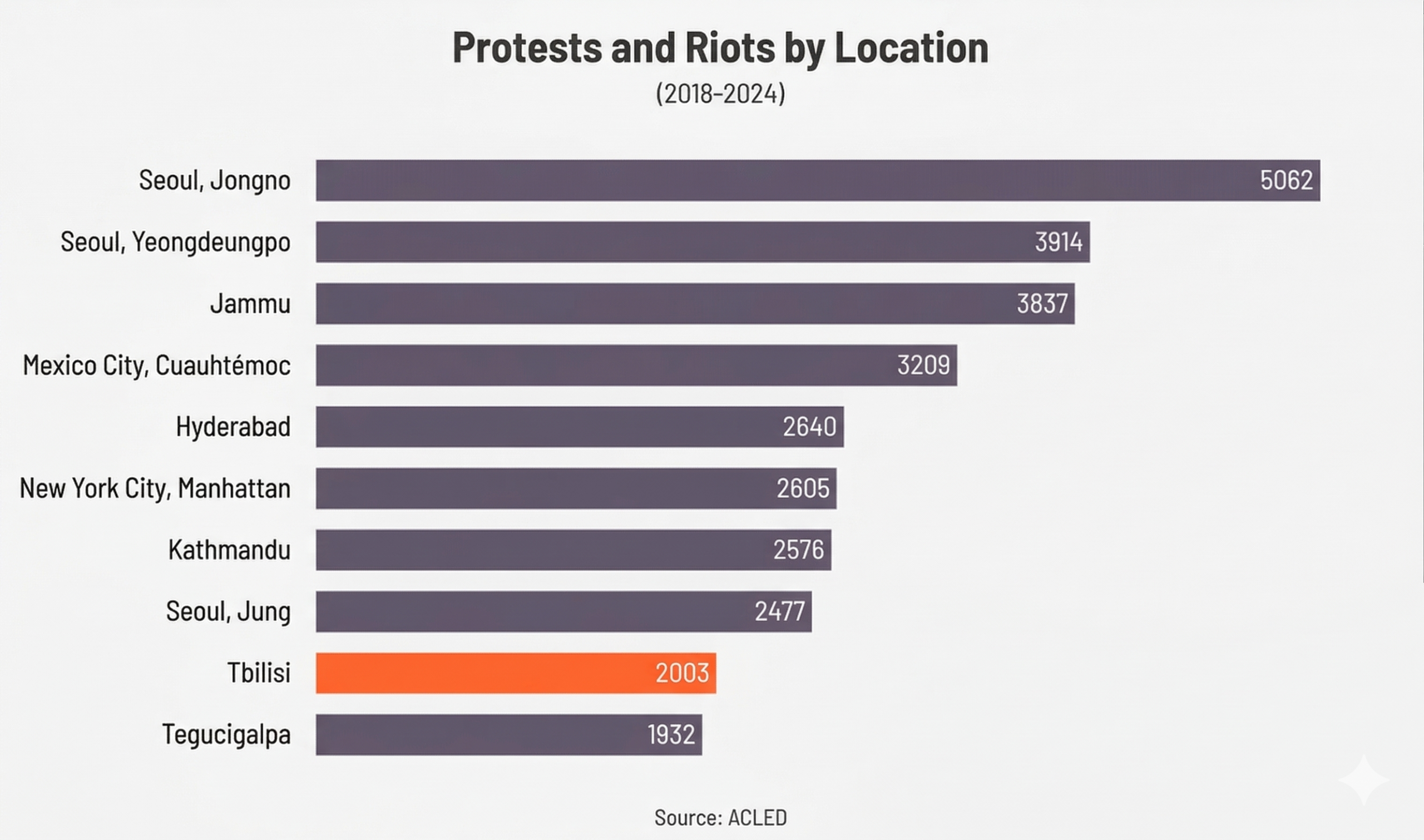
It is also worth highlighting that the ACLED platform allows protest data to be broken down by location. Seoul, South Korea, takes the top two spots. Third is the city of Jammu in India. And of particular interest: Tbilisi ranks ninth on that list, with 2,003 protests recorded between 2018 and 2024.
What explains why the Asia-Pacific region sees the most protests? Or why India, the United States, and Pakistan top the country rankings? This is where the social dimension of protest comes in. In these regions and countries, protest is driven by political repression, economic pressures, religious and ethnic tensions, population size and composition, and a host of other factors — all of which are explored in the next section.
The Sociology of Protest
For a closer look at the causes, methods, and other details of protest, Worldprotests.org offers a useful resource. Unlike ACLED, it focuses not on every protest but on major ones.
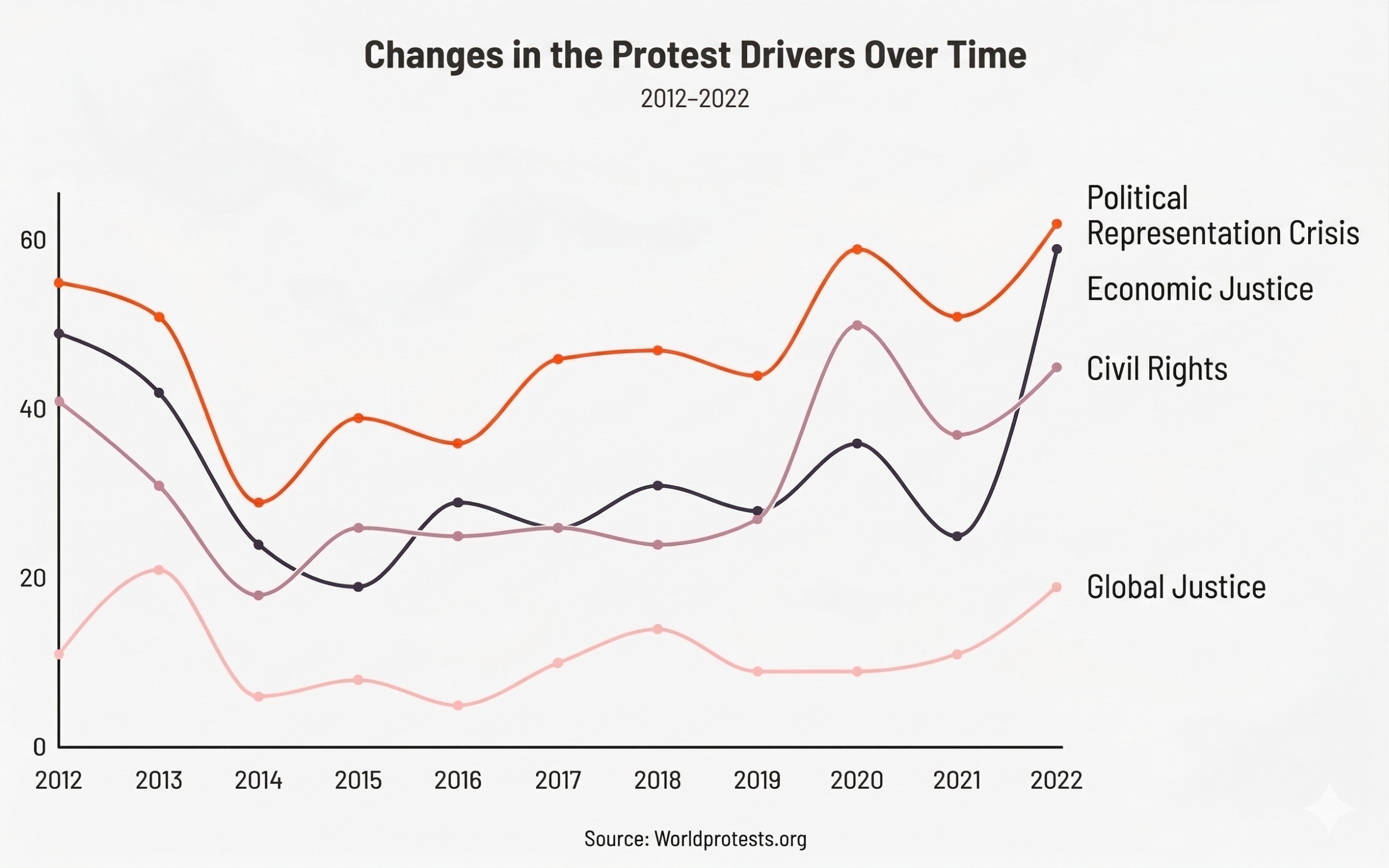
To track how protest causes have shifted over time, data from 2012 to 2022 was analyzed. Over that period, the leading driver of protest was the failure of political representation, followed by economic justice, civil rights, and global justice.
What do “failure of political representation” or “economic justice” actually mean in practice? Breaking them into subcategories, the core grievances include demands for real democracy, rule of law, anti-corruption, opposition to oligarchy, better wages, higher living standards, and reduced inequality — all broadly political and economic in nature.
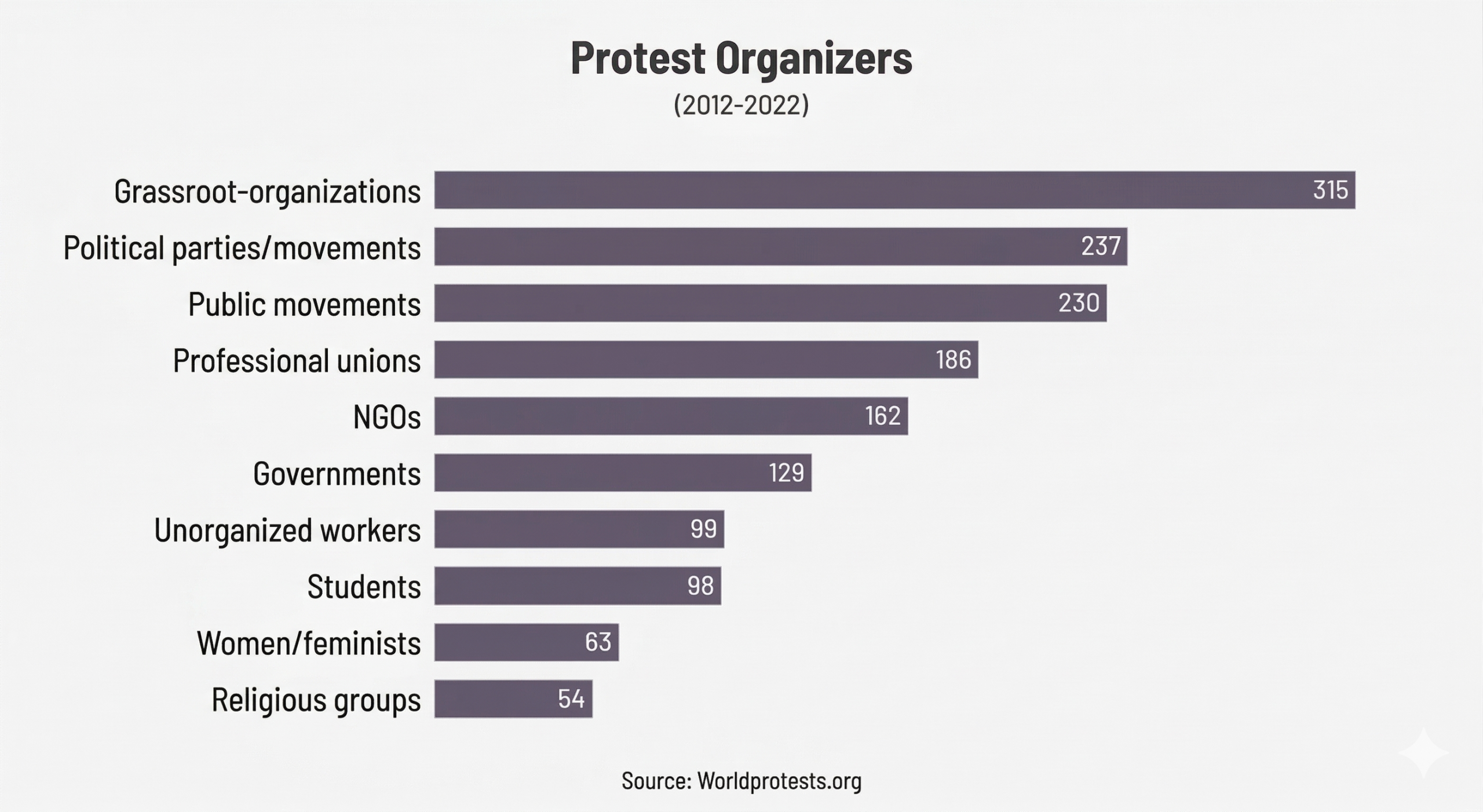
The profile of demonstrators shows that beyond activists, NGOs, and trade unions, the most active participants are grassroots organizations, students, workers, and women. This signals growing discontent with the existing political and economic system among the middle class.
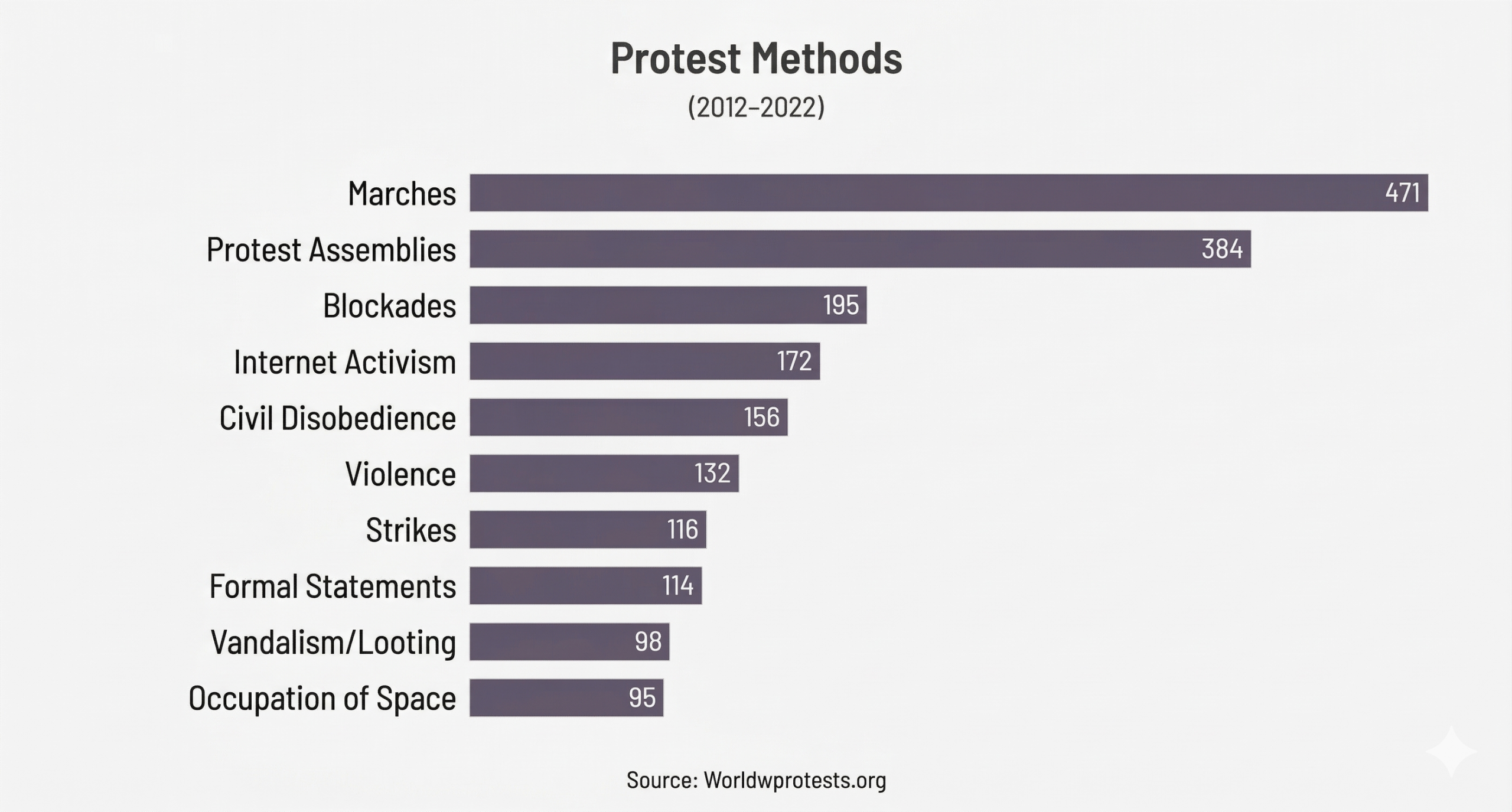
Protesters use a range of tactics, with marches, rallies, and blockades being the most common. Online activism comes next — a sign of civil disobedience entering a new, digital era. Violence and vandalism account for a comparatively small share.
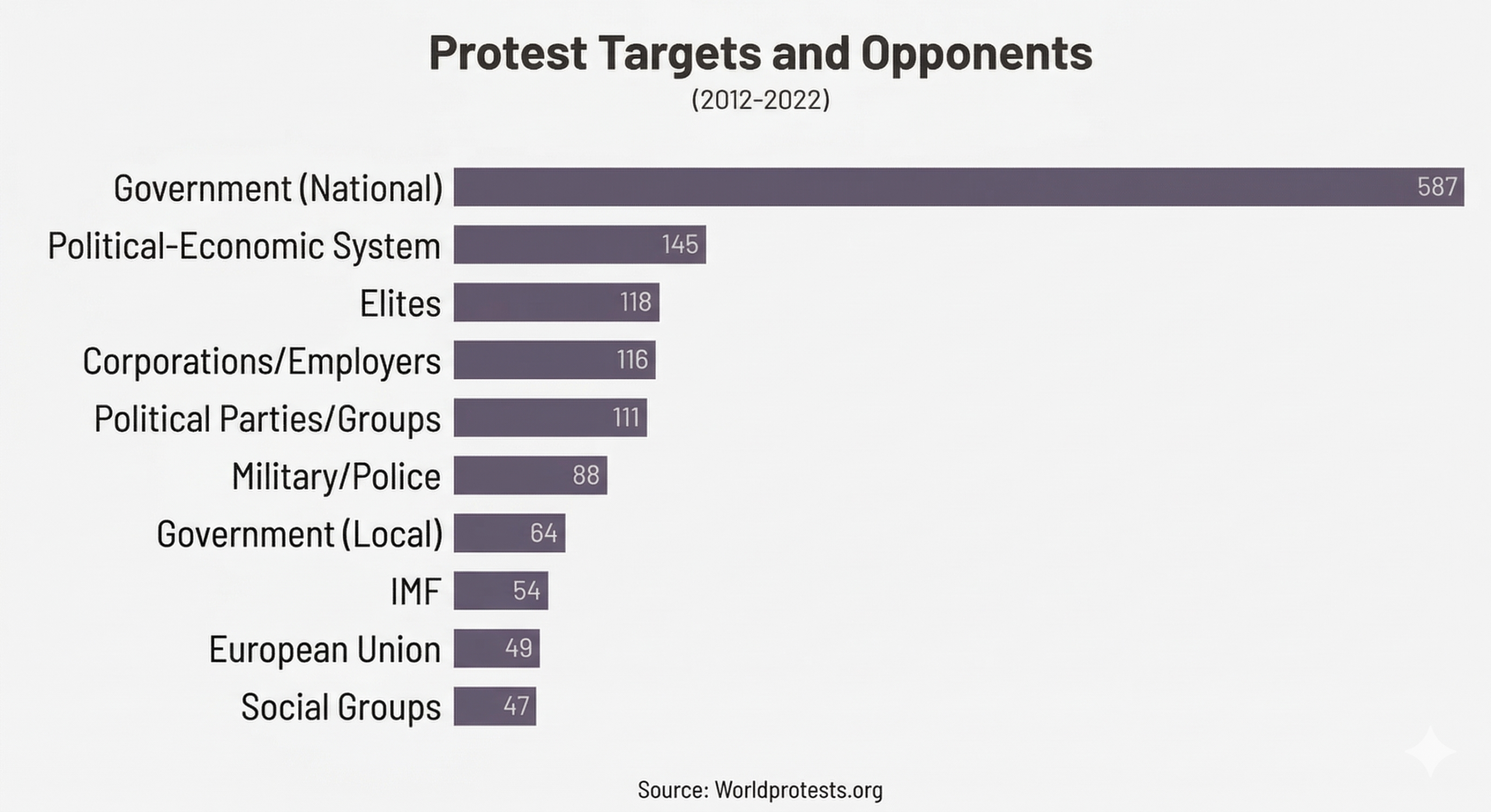
The biggest target of protest, by a wide margin, is the national government. Beyond that, demonstrators frequently push back against the broader political and economic system, elites, corporations, and employers.
Repression most commonly takes the form of arrests, police violence, and various types of physical harm — including, in some cases, death. Other familiar and well-tested tools include tear gas, harassment, and legal action.
Conclusion
What does protest actually achieve? A study titled World Protest: A Study of Key Protest Issues in the 21st Century, which analyzed data from 101 countries between 2006 and 2020, offers a partial answer.
According to the study, 42% of the protests examined achieved some form of success. This includes not just one-off demonstrations, but also sustained campaigns lasting years with specific demands.
Protests with concrete, targeted demands — such as wage increases, restoration of subsidies, or halting infrastructure projects — have a better chance of success than those calling for systemic change. The more structural the problem and the more diffuse the opponent, the lower the odds of winning. Protests directed at governments, religious authorities, and employers also tend to fare better.
The same study found that by the end of the decade, anti-authoritarian left-wing populist protest had been largely displaced by right-wing populist protest. The defining features of right-wing populist protest include condemnation of the political system, a focus on corruption and the “deep state,” and the claim that shadowy forces are threatening the economic security of the middle class.
While protest can be a rational response to a political system failing to meet people’s needs, the side effect of this populist wave is that the right, while demanding its own rights, frequently disregards the equal rights and status of other groups — immigrants, for example — whom they blame for threatening their jobs. And these movements often encourage violence as well.
The study’s conclusions were drawn five years ago, but they remain relevant today, as the rise of right-wing populist politics continues to demonstrate. A clear example is Germany’s most recent election, in which the far-right Alternative for Germany (AfD) doubled its previous result, taking 20.8% of the vote. But that is far from an isolated case — right-wing sentiment has grown across Europe as a whole since 2020.