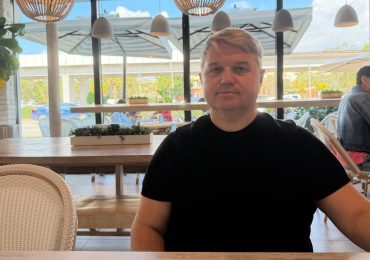

Photo courtesy of Kameron Katsch
Kameron Katsch has secured provisional patents for what he calls a marine industrial organism that could reshape how the world extracts critical minerals and generates energy. His company, Project Kontrast, is developing closed-loop offshore platforms designed to operate in international waters, extracting resources from seawater while producing everything from advanced nuclear fuel to rocket propellant.
The ambition is staggering. Katsch claims his technology could capture 70% of the blue economy market by deploying modular floating platforms in unregulated ocean zones. With the global deep sea mining market projected to reach $16.3 billion by 2033 and marine mining overall expected to hit $65.56 billion by 2034, the timing aligns with surging demand for the materials that power electric vehicles, renewable energy systems, and advanced reactors.
Katsch attributes his drive to personal tragedy. Catastrophic events in his life forced him to develop what he describes as a crystal clear vision for addressing global resource scarcity.
“When you lose everything, you gain perspective on what actually matters,” Katsch said. “I realized we’re looking at resource scarcity all wrong. We’ve been mining land for centuries while ignoring 71% of the planet.“
The Technology
Project Kontrast’s core innovation is a five layer ocean hose system called Konnectivity. The hose integrates power transmission, data connectivity, and resource extraction into a single apparatus. One layer uses layered double hydroxide to extract uranium, lithium, and rare earth elements from seawater. Another layer captures plastics and pollutants.
The platforms are modular with three configurations. The K1 generates coastal revenue with wind turbines and data centers. The K2 serves as an equatorial rocket launch platform. The K3 is a deep ocean factory that processes raw materials into finished products, including HALEU, a high assay low enriched uranium fuel critical for advanced nuclear reactors. HALEU demand is climbing, with the U.S. Department of Energy estimating annual demand will reach 8 to 12 metric tons by the mid 2020s. Currently sourced almost exclusively from the United States and Russia, supply chain vulnerabilities create opportunities for alternative extraction methods.
“We’re not just mining. We’re creating a self replicating system,” Katsch said. “The first few platforms will generate enough materials to build the next ones without relying on third party vendors.“
Challenges Ahead
Deep sea mining remains contentious. Environmental groups have raised concerns about sediment plumes and biodiversity loss. The International Seabed Authority is still developing its Mining Code, and commercial extraction has yet to begin at scale.
“People think regulations are barriers. I see them as design constraints that force better solutions,” Katsch said. “Our platforms are built to exceed environmental standards before they even exist.“
The company has not yet deployed a full scale prototype, though Katsch says the first unit is scheduled for Q4 2026. He has filed 10 provisional patents and reserved NYSE tickers KTRS and GSCC, signaling public market ambitions.
At 23, Katsch is attempting to solve problems that have stymied governments and corporations for years. The next 18 months will determine whether his ocean platforms can deliver on their promise.