

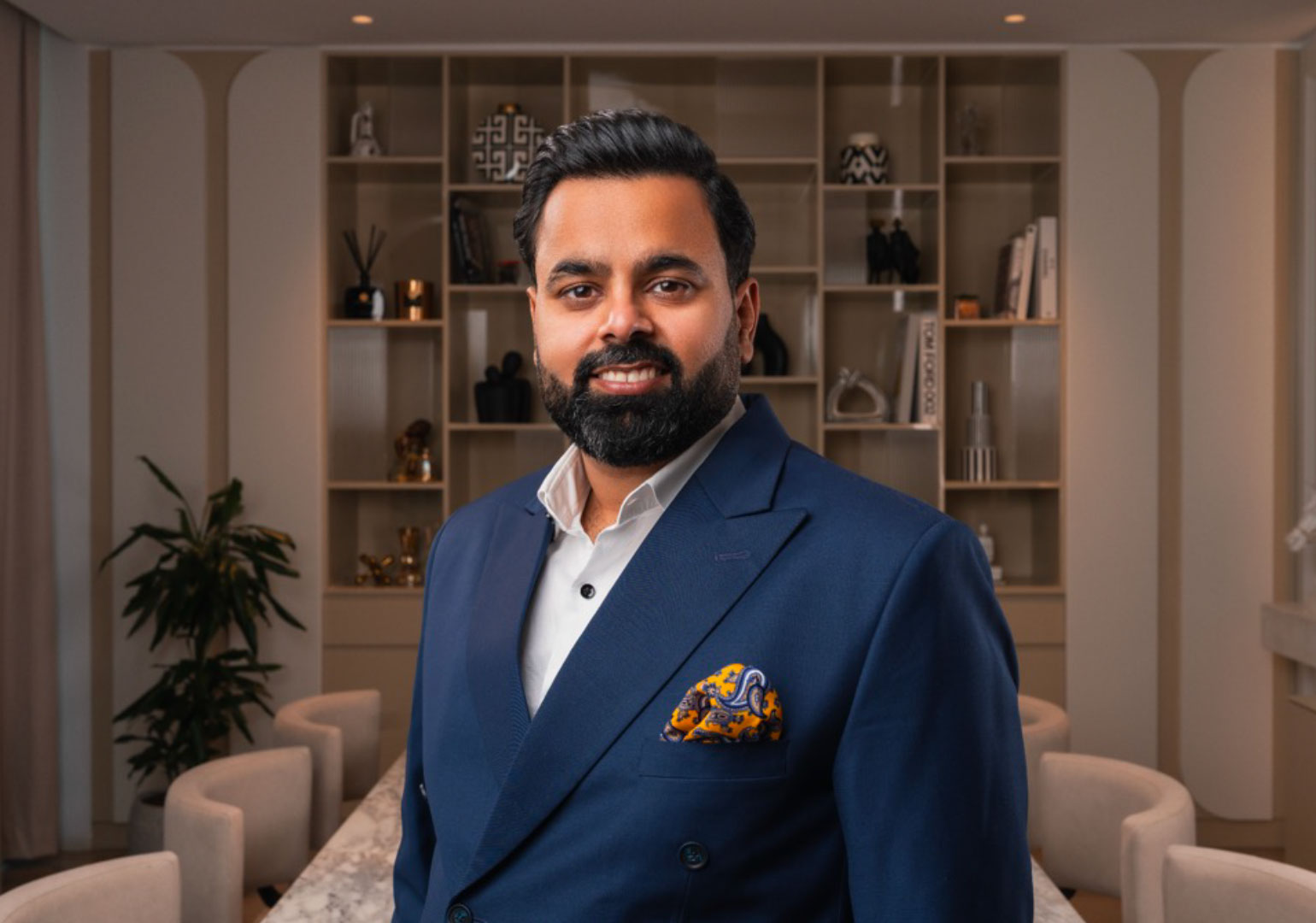
Photo Courtesy of Chetan Sehgal
Oil wealth and rapid infrastructure booms have long defined the Gulf’s growth story. Alongside it, a different kind of progress has been taking shape, built on textbooks, teacher training, and the systems that shape how children learn. Chetan Sehgal, an entrepreneur largely unknown outside education circles, sits at the center of that progress.
Sehgal co-founded Panworld Education in 2009. Over the seventeen years since, the company has grown into McGraw Hill’s largest distribution partner Globally, a scale he built slowly and, by his own account, without ever taking outside money.
From a Single Office to Three Countries
Sehgal did not build a regional powerhouse overnight. He built the company as a modest operation working the margins of an education sector. Seventeen years later, the operation spans the UAE, Saudi Arabia, and Egypt, a footprint across Asia , built one contract and one ministry relationship at a time, without external financing.
A Global Publishing Partnership
The single most consequential decision in Sehgal’s career was pursuing a partnership with McGraw Hill, the American publishing giant whose textbooks anchor classrooms across the world. Building that relationship fell almost entirely to Sehgal himself, by his own account, convincing a legacy Western publisher that the Middle East deserved to be treated as central markets rather than peripheral ones.
The bet paid off. McGraw Hill now counts the company as its largest partner globally. “Because in education, the real challenge isn’t access. It’s alignment,” Sehgal has said, describing why he focuses on connecting curriculum, technology, and classroom practice instead of treating them as separate efforts.
Saudi Arabia: Driving the Region’s Next Transformation
Of the markets where Sehgal’s companies operate, Saudi Arabia has become the center of gravity for what comes next. The kingdom’s Vision 2030 reforms tie curricula, teacher training, and workforce needs together in a way that aligns with the model Sehgal has spent 17 years building elsewhere. It is no longer just another market on Panworld and KODEIT’s list; it is where Sehgal has chosen to focus the next phase of growth.
Building Without a Safety Net
What distinguishes Sehgal’s rise from that of many of his Gulf-region contemporaries is the absence of venture capital throughout the story. He kept the company co-founder-led and profitable at every stage, by his own account, choosing a bootstrapped model in an industry where scale is usually purchased with outside investment.
That discipline has forced a different kind of institution-building, oriented toward long-term contracts with ministries and public-sector bodies rather than the growth-at-all-costs metrics that venture-backed education-technology firms have chased and, in many cases, failed to sustain.
A Second Company, a Bigger Ambition
Around the world, education is entering a period of profound transformation. Governments are redesigning national curricula to prepare learners for an AI-driven economy. Employers are demanding graduates equipped with digital, analytical, and problem-solving skills rather than rote knowledge. As technology reshapes every industry, curriculum has become more than an academic framework—it is increasingly viewed as strategic national infrastructure.
It was against this backdrop that Sehgal co-founded KODEIT, a curriculum and learning technology company built for the next generation of education. Its ambition extends beyond publishing textbooks: to develop comprehensive K–12 learning ecosystems spanning ICT / Computer Science, Kindergarten, and Social Studies, supported by intelligent assessment and learning technologies that help schools measure competency, not just achievement.
The vision is both commercial and strategic. For decades, many of the world’s most influential education programs have originated in North America and Europe before being adapted elsewhere. KODEIT seeks to reverse that model by creating globally relevant learning solutions that can be adopted across diverse education systems while addressing the changing needs of learners, educators, and governments alike.
As nations compete to build knowledge economies and future-ready workforces, Sehgal is pursuing a larger ambition: to demonstrate that globally respected educational innovation can emerge from new centers of excellence and help shape how the next generation learns, regardless of geography.
Teacher-First: How KODEIT Approaches AI
Sehgal’s second company, KODEIT, has taken a deliberately more sensible route into artificial intelligence than much of the education technology industry. Rather than adding AI features to chase a trend, KODEIT built its tools around one test: does a feature make a teacher’s job easier, or does it just make a demo look impressive? That approach shows up in what the company has chosen not to build as much as in what it has shipped. Its AI tools center on lesson-planning support, assessment feedback, and administrative relief, rather than applications aimed at replacing instruction altogether.
That approach runs against the current mood in education technology, where AI is often marketed as a solution before anyone asks what problem it solves in an actual classroom.
A Mission Larger than Either Company
A broader ambition seems to motivate Sehgal more than any single product: proving that education companies with global reputations can rise from the Middle East, on Middle Eastern terms.
“Every challenge over the past 17 years has reinforced one belief: when your purpose is improving education, resilience becomes your greatest competitive advantage.” Sehgal said.
Whether that ambition outlives the two companies he built to pursue it remains a question the next decade will answer.