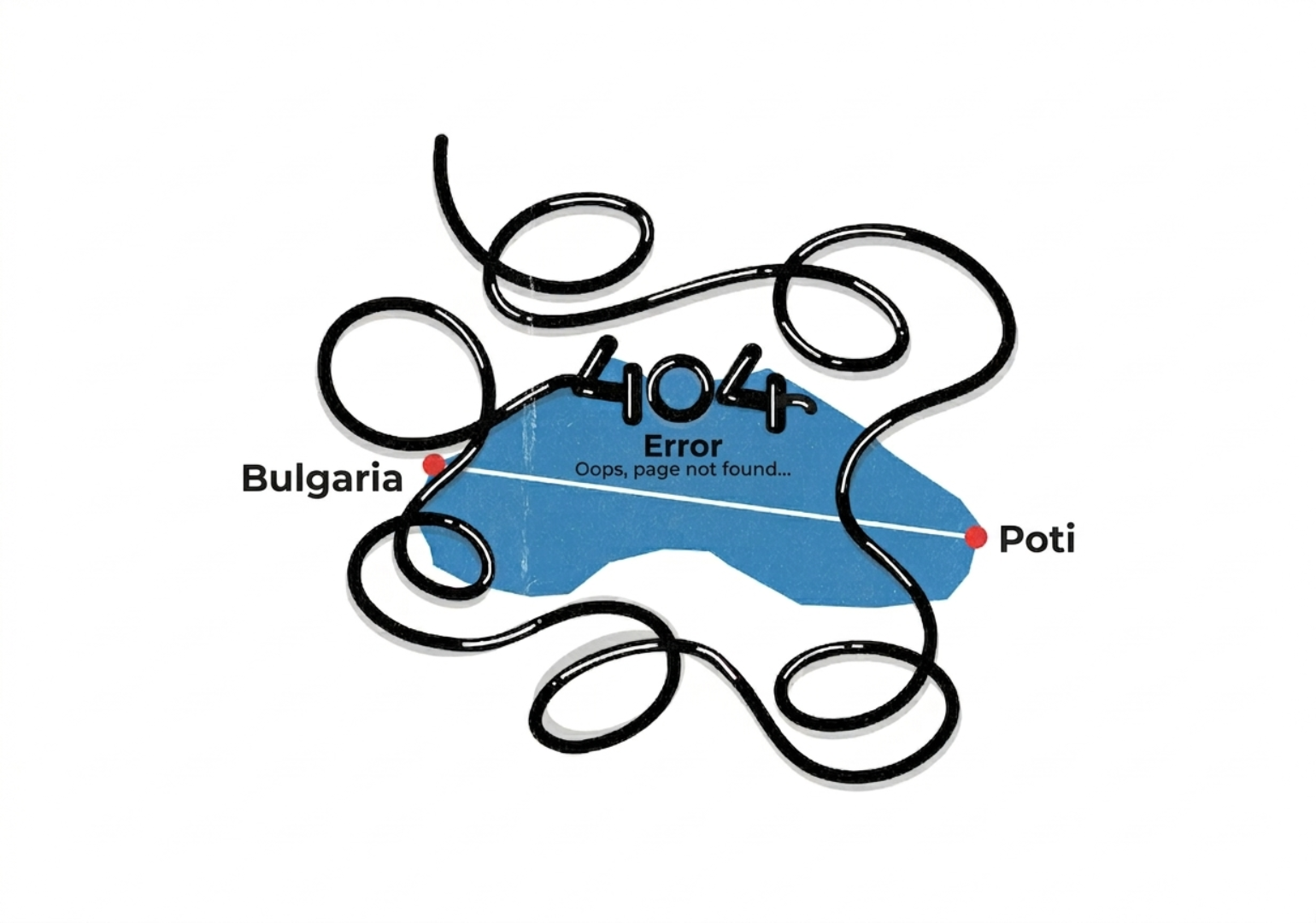
On January 27, internet service went down across Georgia — an outage Magticom attributed to network damage in Georgia and Turkey. Georgia actually has the ability to receive internet directly from Europe: a 1,200-kilometer cable bypassing both Turkey and Russia connects us to Bulgaria. So why aren’t we using it?
The Black Sea internet cable has existed since 2008 and is strategically significant, but it has never operated at full capacity for Georgia. This article explains why.
How the Black Sea Cable Was Built
The story of Georgia’s European internet cable begins with Caucasus Online. The company was originally founded under the name Caucasus Network, later merging with Georgia Online, Sanet, and Telenet to form Caucasus Online.
To lay the cable, the company invested $40 million, of which $35 million was raised from the EBRD. The total project cost was estimated at $76 million. Caucasus became the cable’s sole owner.
The company also owns Georgian Railway Telecom (GRT) and its infrastructure — 600 km of fiber-optic cable and railway trunk lines connecting partner networks in Azerbaijan, Armenia, and Turkey, as well as the Varna-Poti undersea cable.
Weighed down by accumulated liabilities, Caucasus decided in 2016 to sell its retail segment. There were suspicions that selling the cable itself was also being considered — specifically to Beeline, a subsidiary of Russia’s VimpelCom. Caucasus denied this, stating that negotiations with VimpelCom concerned only the retail segment. Those assets were later acquired by Magticom.
The then-chair of the Communications Commission (ComCom), Vato Abashidze, said at the time that the Black Sea cable was “important for the country’s security, safety, and the competitiveness of the telecommunications market,” and that any sale would require ComCom’s approval.
Until 2019, Caucasus was owned by businessman Khvicha Maqatsaria through a company registered in the offshore British Virgin Islands. In 2019, the ownership structure changed — and it was at that point that a prolonged dispute between the Communications Commission and Caucasus Online began.
The Communications Commission vs. Caucasus Online
The ownership change was followed by a transfer of the cable, which triggered years of legal battles with the Communications Commission and disrupted the cable’s operation.
In 2019, Azerbaijan’s Neqsol Holding and its owner Nasib Hasanov acquired a 49% stake in Caucasus from Khvicha Maqatsaria for $61 million — without notifying the Communications Commission. Georgian law required Caucasus to inform the Commission of any share transfer. The deal was declared unlawful and proceedings were opened.
A year later, Hasanov purchased the remaining 51% of Caucasus — again without notifying the Commission. ComCom ordered Caucasus to restore the shareholding to its original state, citing the need to preserve a competitive environment in the country and the risk of damage to Georgia’s regional competitiveness.
Between 2019 and 2020, the Communications Commission fined Caucasus five times for the unauthorized share transfers, totaling 930,000 GEL.
Caucasus CEO Rezo Kopaladze argued that the Commission was demanding something beyond his control — that compliance depended on Nasib Hasanov, who was the ultimate beneficiary of the transaction.
Hasanov, for his part, framed the acquisition of Caucasus as part of the Digital Silk Road project, which aimed to connect Asia and Europe through fiber-optic infrastructure.
In 2020, a new law came into force giving the Commission and its new chair, Kakha Bekauri, the authority to appoint a special manager at Caucasus. Over two years, that manager changed three times. Today the position is held by Tamta Tepnadze.
The special manager was granted the power to dismiss Caucasus’s director and supervisory board members, and to legally challenge decisions made within the company over the preceding year.
Caucasus viewed the Commission’s decision as tantamount to a forcible seizure of property. In response, Nasib Hasanov filed a claim in international arbitration in 2020. The dispute is still ongoing.
The Venice Commission responded negatively to the appointment of a special manager, stating that the amendments to the Electronic Communications Law would have a negative impact on press freedom, property rights, and the right to a fair trial.
Where Things Stand Today
According to Communications Commission data, by November 2024, more than 5.6 million subscribers were using mobile internet in Georgia.
Market share breaks down as follows:
- Magticom – 41.5%
- Silknet – 35%
- Cellfie – 23.3%
- Other – 0.2%
From 2016 to 2021, Magticom used the Black Sea infrastructure to deliver internet to its customers. In 2021, Magticom did not renew its partnership with Caucasus and no longer imports internet through the Black Sea system. Caucasus has also stopped supplying internet to Silknet.
It is known that Caucasus Online supplies internet to Cellfie. Based on this, we can estimate that somewhere between 10 and 20% of mobile internet in the country arrives via the Black Sea cable — a far smaller share than in Armenia and Azerbaijan, where the proportion is significantly higher.
What explains this? According to Ucha Seturi, head of the Association of Small and Medium Operators, one of the main reasons is simply that the alternatives are cheaper. Internet providers use Turkey’s network because it costs less.
Seturi also confirms that Georgia has network connections with Russia, Turkey, Armenia, and Azerbaijan — internet enters the country through all of these routes and the transit networks are used based on demand.
“Blocking the cable’s sale on security grounds has, in practice, made Georgia dependent on the Turkish — and potentially Russian — route, which represents a far greater threat to internet infrastructure,” says software engineer Giorgi Lubaretsi.
Lubaretsi adds: “The appointment of a special manager sent investors a clear signal that if they don’t behave the way Kakha Bekauri wants, their investment will be left hanging in the air and their property will be taken away.”
Import data is not publicly available. Forbes Georgia contacted the Communications Commission with questions on this data and on the Black Sea cable more broadly, but received no response.
It is also possible that cost and bandwidth constraints are affecting network quality — and this may well be connected to the disruption recorded on January 27.
Ukrainian outlet NV, citing Azerbaijani investigative journalist Hafiz Babali, reports that Nasib Hasanov is considered a figure controlled by Beylar Eyyubov, head of Ilham Aliyev’s security service, and that the ultimate beneficiary of Neqsol Holding is the ruling family — Azerbaijan’s President Ilham Aliyev.
Are There Potential Information Security Risks?
Giorgi Lubaretsi believes such risks exist, but are significantly overstated. Before data reaches its destination, it already passes through a vast number of different infrastructure points — and owning one specific link does not mean having full control over information flows.
“The vast majority of internet traffic today is encrypted, which means the owner of physical infrastructure has quite limited access to the data being transmitted. They can see who is connecting to whom, but not what they are sending. Theoretically, a few potential risks exist, but in practice they are far less alarming,” he explains.
Internet Quality and Price in Georgia
To answer this question, the statistics speak for themselves.
According to data from the National Statistics Office of Georgia from June 2024, 91.5% of households in the country have internet access.
The World Bank’s 2023 Digital Progress and Trends Report puts Georgia’s median mobile internet download speed at 30.5 Mbps — well behind Qatar, which tops the global list at 160.3 Mbps. The median fixed internet download speed is even lower, at 25 Mbps.
Different figures come from the Speedtest Global Index, which as of December 2024 ranks Georgia tenth out of 110 countries for mobile internet download speed, with a score of 140.8 Mbps. Fixed — or home — internet tells a different story: at 42 Mbps, Georgia ranks 111th out of 154 countries.
On pricing, according to World Population Review, Georgia’s average monthly internet cost in 2024 was $17.6, placing the country 75th out of 98.
The Communications Commission’s own research found that low-volume mobile packages for individual users are 1% more expensive than the European average, while high-volume packages — 10 GB of internet and 1,795 minutes — cost 35% more than the average across 24 European countries.
Magticom disputes this conclusion, arguing that the Communications Commission “continues to mislead the public — stubbornly attempting in its statements to portray telecommunications service prices in Georgia as alarmingly high.”
What Comes Next
Despite its strategic advantages, the Varna-Poti cable is not being used effectively in the country’s interest today — the result of a clash between private and public interests that has never been resolved.
The government failed to prevent the transfer of what it itself described as a geostrategically significant asset without its consent. The appointment of a special manager produced yet another lengthy arbitration dispute. Georgia shifted to alternative internet routes. And the Varna-Poti cable never became the key link in a Digital Silk Road.
At the same time, discussions have begun around a new transmission cable connecting the Caucasus and Europe — a project whose urgency grew after Russia’s invasion of Ukraine and the EU’s push to route trade around Russia, through which one of the key data transmission corridors between Europe and Asia currently runs.
The new project is a European Commission initiative and serves as an alternative to the Digital Silk Road. The cable will stretch 1,555 kilometers and cost 45 million euros, with construction set to be completed by 2030. Plans include both a power transmission line and a fiber-optic cable.
The new Black Sea cable offers Georgia the chance to become a digital hub and key node on the Europe-Asia corridor. But whether Georgia will be able to realize that potential — whether the new project moves forward or fades along with its European course — only time will tell.