

Medical dermopigmentation expert Tatiana Vostrikov explained why aesthetic camouflage has become one of the fastest-growing areas in cosmetology in recent years, how to turn this service into a large international business, and why specialists from around the world seek training in this practice.
The Goal Is to Restore the Appearance to What It Was Before
According to the International Society of Aesthetic Plastic Surgery, approximately 35 million aesthetic procedures are performed worldwide each year, with non-surgical interventions showing the fastest growth in demand. One of the popular requests is aesthetic camouflage (or medical dermopigmentation), which is used to mask scars after surgeries and injuries, the consequences of burns, post-acne marks, vitiligo, pronounced dark circles under the eyes, and areas of alopecia.
“Aesthetic camouflage has a medical foundation. In such procedures, pigment is used as a tool for visual reconstruction. People want to restore their usual appearance. The most frequent request I receive is: ‘Doctor, I want it to be the way it was before,’” says Tatiana Vostrikov, founder and head of a clinic and educational projects in the field of medical dermopigmentation.
The Scale of the Problem
According to international research published in PubMed Central, nearly 48% of adults have at least one scar on their body. At the same time, for a significant portion of respondents, scars become a cause of psychological discomfort.
“This is not a niche request but a mass phenomenon. For example, cesarean sections are performed in approximately one out of five childbirths. Visually removing a defect means healing not only the body but also psychological constraints,” says Tatiana.
Vostrikov emphasizes that working with such cases requires a medical approach. For example, she herself received medical education and has been working in the field of aesthetic medicine for more than two decades. During this time, she has completed extensive international certification in medical dermopigmentation and aesthetic techniques.
Camouflage as a Separate Market
According to the analytical company Fortune Business Insights, the global permanent makeup market in 2025 was valued at approximately $162.9 million. At the same time, the overwhelming majority of clinics in this industry focus on decorative procedures—eyebrows, lips, and lash-line enhancement. Medical dermopigmentation remains a narrower specialization.
One of the significant players in this market is Geneva Med Spa, founded by Tatiana Vostrikov. The main focus of the center is dermopigmentation and aesthetic camouflage. The clinic’s profile has created stable demand—the average workload of the center reaches up to 100 clients per month. According to internal statistics, about 80% of clients return over several years for scheduled corrections.
This clinic became one of the first where specialists began working according to Tatiana Vostrikov’s proprietary method, created specifically for complex cases—pronounced scars (including postoperative) and traumatized skin. This fundamentally distinguishes the operational model of Geneva Med Spa from a typical salon model. In most beauty clinics, camouflage and permanent makeup are reduced to working with color and shape, assuming that the skin is healthy and even. However, this approach cannot mask pronounced defects. Therefore, the center accepts patients for whom standard cosmetology procedures are not suitable.
According to the clinic’s internal management statistics, the main share of requests for aesthetic camouflage comes from clients after surgical interventions—about 45%. Another 20% of requests are for camouflage of scars after various injuries and burns. About 15% of clients come with requests for correction of dark circles and visual changes in various areas.
Requests related to post-acne and cicatricial skin changes account for approximately 10%, and cases related to pigmentation disorders and alopecia also make up about 10%.
Optical Reconstruction as an Alternative to Surgery
While developing the field of medical dermopigmentation, Tatiana Vostrikov expanded its application beyond scar camouflage. Her professional focus is visual reconstruction. Pigment here is used for anatomical correction.
This is how the proprietary Smoky Powder Eyeliner technique appeared. The technique is based on layered implantation of pigment and soft gradient shading with precise control of insertion depth. By working with light, shadow, and midtones, optical correction of the eyelid shape is achieved—visually reducing the severity of hooded lids, smoothing asymmetry, and enhancing the effect of an open gaze.
According to the expert, in some cases this technology allows surgery in the eye area to be postponed, as it provides a noticeable lifting effect without surgical intervention. This forms a separate market segment—non-surgical reconstruction.
This development secured Tatiana’s status as an expert in aesthetic correction of the periorbital zone. Therefore, in 2025 she was invited to join the jury of the international championship World Series of Permanent Makeup in the “Eyeliner” category (Master division). At such events, the jury evaluates the quality of work by well-known masters from different countries.
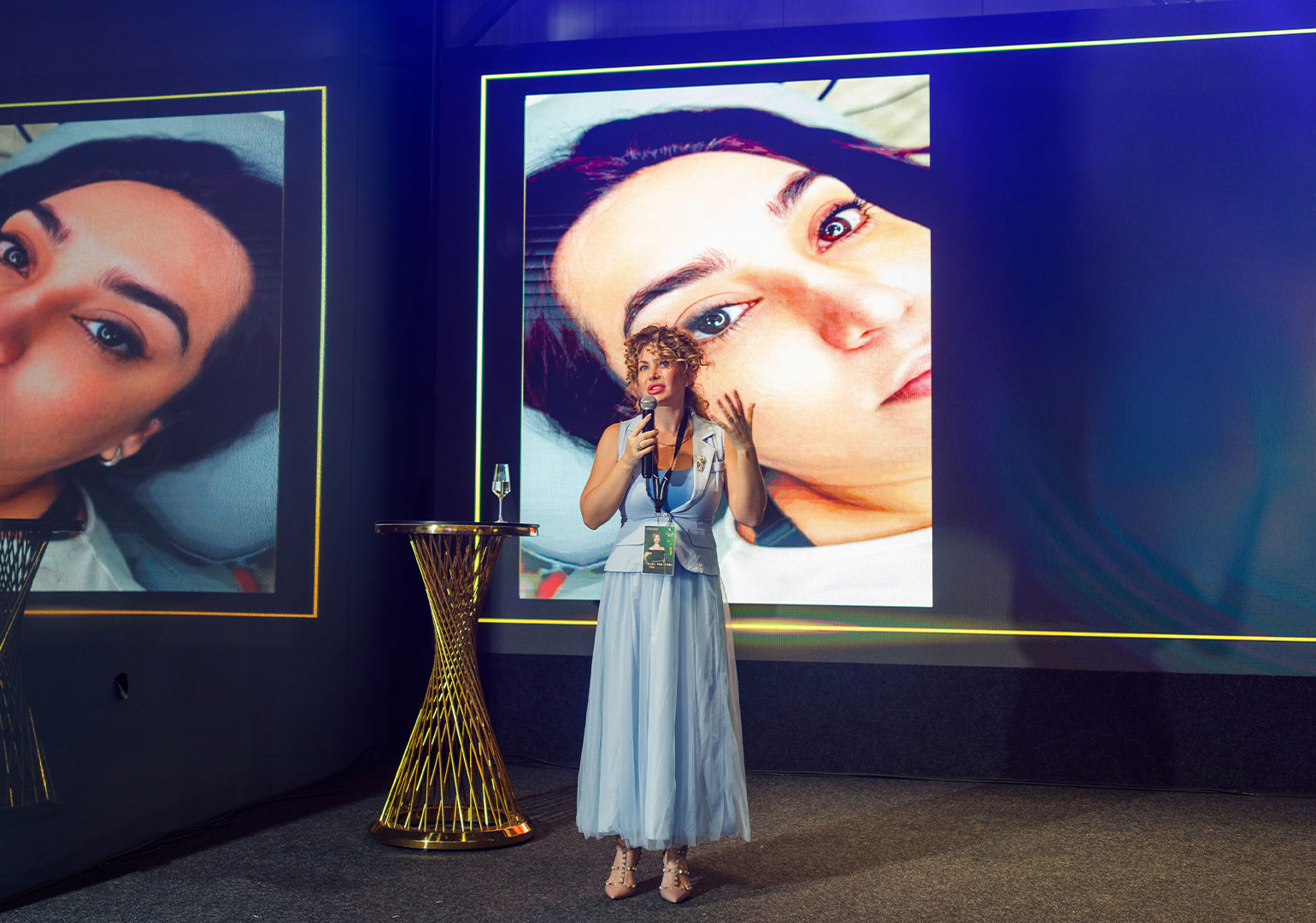
This year Tatiana will also speak in Georgia as part of the professional event World Universal League of Permanent Makeup—the largest international organization and championship uniting professionals in the field of permanent makeup. The event is significant for the industry in the country, as in recent years Georgia has strengthened its position as a regional hub of aesthetic medicine and beauty education for the countries of the Caucasus and Eastern Europe.
It is worth noting that this is not Tatiana’s first collaboration with WULOP. In different years she has already been involved as a judge and speaker in Canada (twice, in 2024 and 2025), as well as in the USA, Moldova, where she presented her proprietary technique, and in Turkey in 2025.
Interest from the Professional Community
Demand for aesthetic camouflage is also growing among specialists.
“It is impossible to perform such a procedure if you are a regular permanent makeup artist,” says Tatiana. “An error in selecting the shade or depth of pigment insertion may not hide the defect but, on the contrary, emphasize it. Specialized training is required here.” According to her, understanding anatomy and having a medical background are important.
The growing interest in such procedures is also reflected in the educational sector. However, there are only a few specialized educational institutions in the world working specifically with medical dermopigmentation, for example, the Paramedical Micropigmentation Institute in New York.
Another example is the Geneva Aesthetic Academy in the USA, founded by Vostrikov, which annually trains more than 50 specialists, including international students. Graduates of the academy apply Vostrikov’s methodology in their practice, including in clinics in different countries around the world.
Separately, Vostrikov emphasizes the difference between aesthetic camouflage and tattooing. Tattooing is designed for a long-lasting result that does not take into account age-related skin changes. Aesthetic camouflage, on the contrary, is selected taking into account the optical properties of the skin and implies the possibility of renewal. “The pigment gradually lightens, and a repeat procedure may be required in one to three years, which makes the method safer,” concludes Vostrikov.