


Photo by Daria Zaytseva
Today, AI is widely seen as a tool that is changing the investment landscape. It helps investors analyze strategies, spot market trends, and improve forecasts. Some even believe it can reduce risks or lead to fully automated trading.
But how effective is AI in reality? And is it safe to trust it with your money?
To explore these questions, we spoke with financial analyst Kirill Kuchinsky.
Kirill, how effective is AI in trading? Can investors really trust it with their money?
AI has become much more efficient in recent years, mainly thanks to increased computing power. Computers are faster, more accessible, and continue to improve. At the same time, the underlying algorithms are constantly evolving.
What tools like ChatGPT can do today – especially in natural language processing – would have seemed out of reach for most people just five years ago.
We’re also seeing growing use of AI systems in trading. These systems scan the market, look for inefficiencies, and try to profit from them.
But there’s an important point here: if all inefficiencies disappeared, the market would stop generating profits. Investors would stop making money – or even start losing it. That hasn’t happened, which tells us that current AI models still can’t analyze every factor or guarantee profits.
In short, you can’t treat AI as a “black box” – a system where you just feed in data and expect it to make money for you.
How does trading with neural networks actually work?
When you rely on a “black box” model trained on raw data, you often run into a problem called overfitting.
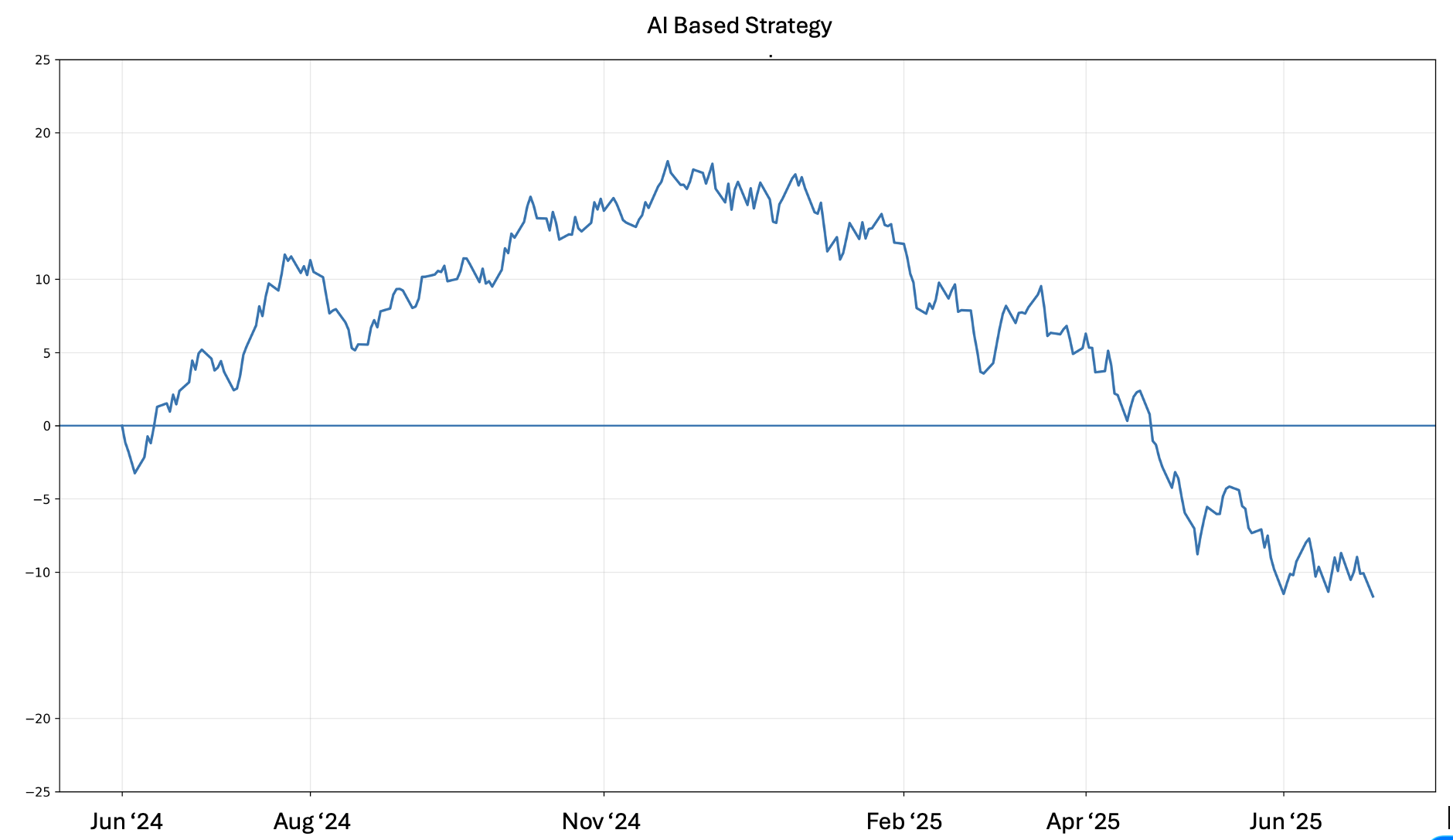
I’ve seen this firsthand. One model performed extremely well for about six months – returns were growing steadily, and the strategy seemed consistently profitable. But then performance started to decline just as steadily.
This shows that the model picked up certain patterns, but didn’t truly understand how the market works.
So the key question is: are you ready to trust your money to a system that works today, but might stop working tomorrow? That’s the risk when relying only on neural networks without additional models or safeguards.
So where is AI actually useful in practice?
AI works best when it supports a clear, tested strategy.
For example, you might have a rule to sell an asset once it reaches a certain level of growth. In this case, AI can help optimize the strategy by identifying complex patterns that are hard to capture with traditional models.
In other words, when you give AI clear direction, it becomes a powerful tool for fine-tuning decisions – often more effective than simple linear models.
Which AI bots are the most effective?
You often see rankings in the media comparing different AI tools – claiming that one made a certain profit, while others like ChatGPT or Gemini performed differently.
But these comparisons don’t mean much. They usually ignore key factors: which model was used, how it was trained, what data it had access to, and who was operating it. These details are rarely disclosed.
In reality, there is no “best AI bot.” Effectiveness always depends on the task, the data, the setup, and the user’s experience. These are tools – not universal solutions.

How realistic is fully autonomous AI trading?
I’d compare AI to tools like a laser level or a rangefinder.
On a construction site, these tools can greatly improve precision and efficiency. But on their own – without a skilled engineer or a solid plan – they are useless, and can even increase costs.
AI works the same way. It’s a tool, not an independent decision-maker.
That’s why the idea that it can run completely on its own – or be available to anyone for a small monthly fee – is very unlikely.
And even if someone did create a fully autonomous, highly profitable system, it would never be publicly available. It would be kept private.
There simply aren’t enough market opportunities for everyone to profit at the same time. That’s just how markets work.
Are there downsides to using AI?
Yes. For example, we ran into an issue we call “overcoding” while using AI in software development.
We work on a complex product where the code is critical – it needs to be fast, reliable, and error-free. In this context, appearance doesn’t matter as much as performance.
AI handles simple tasks well. But when things get more complex, it often produces overly complicated solutions – writing four pages of code where one would be enough.
These solutions are usually less efficient and increase both development time and costs.
Conclusion
AI is already improving many processes. It speeds up data analysis, helps find useful information, and makes simple tasks easier. It’s especially strong in statistics and quick fact-checking.
However, the idea that AI can trade and generate profits entirely on its own is still a myth.
If making money were as easy as pressing a button, markets would no longer function the way they do.
After all, the market is a zero-sum game: if one person gains, someone else loses. And so far, no system has made it possible for everyone to win at the same time.