

Organizations spend a lot of time teaching people how to communicate. Leaders are trained to “manage up,” to give feedback “the right way,” to handle conflict without triggering defensiveness, to speak with clarity, and to listen with empathy. They learn frameworks, attend workshops, and collect tools the way a carpenter collects drills and levels. And yet, in the moments that matter most, a stubborn gap persists. Many capable leaders can describe exactly what a difficult conversation requires, and still find themselves unable to start it, unable to stay steady inside it, or unable to land it without regret.
In Omar Khan’s experience, this is not a failure of intellect. It is a failure of access. “People know what to do,” says Khan, founder of 3S Catalyst Consulting, whose work has taken him across leadership teams and cultures in more than 50 countries. “But when pressure rises, the part of them that needs to show up does not always show up. That’s not a technique problem. That’s an architecture problem.”
Khan’s argument is simple enough to be uncomfortable. Communication training, as most organizations deliver it, focuses heavily on the external mechanics of dialogue, what to say, when to say it, how to phrase it. It often underestimates the internal conditions required to use those mechanics reliably, especially when emotion, power, fear of consequences, or attachment to a relationship is involved. In other words, the tools are real, but the person holding them is not always resourced to use them when the stakes are high.
Two Frameworks That Changed The Conversation About Conversations
Modern corporate communication owes a great deal to two bodies of work. One is the methodology popularized by Crucial Conversations, developed by Kerry Patterson, Joseph Grenny, Ron McMillan and Al Switzler. The other is Fierce Conversations, created by leadership coach Susan Scott.
Khan has taught, used, and revisited both for years. He admires them not because they are fashionable, but because they are practical in the way that real systems are practical: they explain what tends to happen under stress, and they offer repeatable ways to change what happens next.
Crucial Conversations gives leaders a map of breakdown. When people feel unsafe, dialogue narrows. Some retreat into silence, withholding information, withholding disagreement, withholding the truth. Others move toward aggression, pushing harder, blaming faster, escalating tension until productivity collapses. The framework teaches leaders to recognize these patterns and to restore the conditions for dialogue by reestablishing mutual respect and mutual purpose. For managers who have watched meetings derail while feeling helpless, it can be a revelation to realize that the problem is often not the topic, but the loss of safety around the topic.
Fierce Conversations operates from a different starting point. Scott’s premise that “the conversation is the relationship” is not a slogan, it is a challenge to leadership theater. It asks people to stop hiding behind politeness, deflection, and corporate language that sounds collaborative while saying nothing. It demands presence, truth, and the kind of clarity that makes leaders slightly nervous, because it cannot be outsourced to a script. Many leaders respond to it the way they respond to a mirror. They recognize themselves.
Khan credits both frameworks with elevating the standards of professional dialogue. He also believes they encounter the same ceiling, not because they are flawed, but because they assume something about the human being using them.
The Gap Between Knowing And Doing
Khan says he first noticed the ceiling in himself. Early in his career, the Fierce Conversations message made immediate sense: say the thing that needs to be said, and say it with courage. Yet when the moment arrived to have that conversation, particularly with someone he respected or feared disappointing, his body reacted as if the conversation were a threat. He could see what to do, but he could not consistently do it.
He had a similar experience with Crucial Conversations. He understood the instruction to “make it safe,” to pause when dialogue becomes dangerous, to restore shared purpose, to rebuild mutual respect. In many settings, he could do it. In others, especially when he felt personally activated, he found his access to the framework unreliable. The tool was there, but his ability to use it was inconsistent.
Over time, he began to see the pattern in executives and founders, in senior managers and high-potential leaders. The reason many conversations fail is not that people lack vocabulary. It is that, under pressure, their nervous system defaults to protection. People become cautious, performative, defensive, or sharp. They either minimize what they want to say, or say it with an edge that lands like a verdict. The difference between an effective conversation and a damaging one often has less to do with the words chosen and more to do with the internal state driving those words.
“The frameworks are right,” Khan says. “But the person using them needs a foundation. Otherwise the same leader who can facilitate beautifully in one meeting can freeze, overreact, or avoid in another.”
The Mortar Between The Bricks
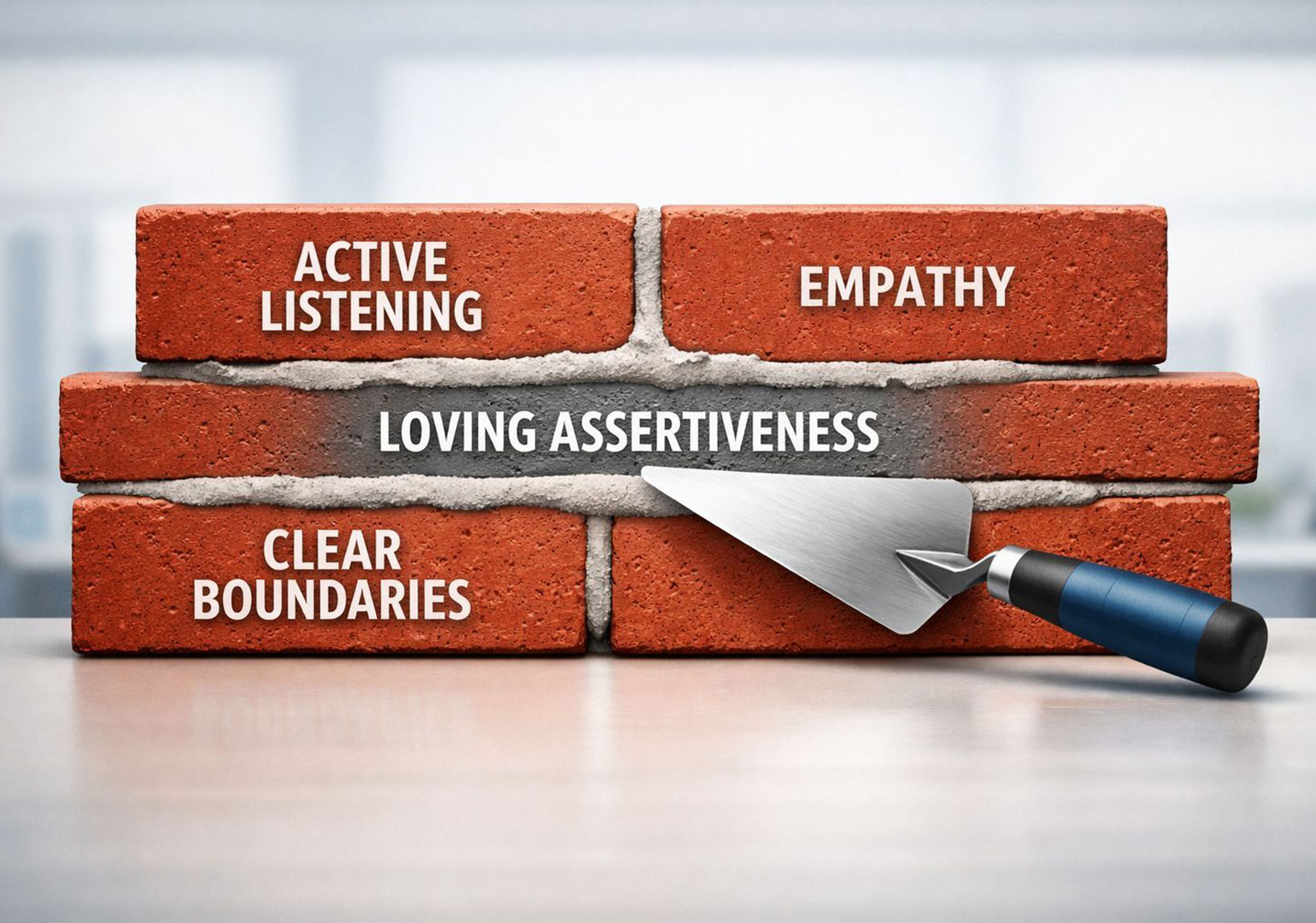
Khan often explains it with a construction metaphor. Communication frameworks are bricks. They are engineered. They create structure. They can bear weight. But bricks alone do not hold. What holds them is mortar.
For Khan, that missing layer is something he calls Loving Assertiveness. He describes it as an internal operating system that supports consistent truth-telling without turning truth into punishment, and supports compassion without turning compassion into avoidance. It is not a replacement for existing models. It is what allows those models to work when the room is tense, the relationship is complicated, and the leader’s own emotions are in motion.
The phrase can sound soft if you hear it as sentiment. Khan insists it is not sentiment. It is discipline. Loving Assertiveness means developing the internal capacity to stay connected to care while being direct, and to stay direct while remaining connected to care. It is the difference between honesty that builds trust and honesty that burns trust. And it is the difference between empathy that strengthens accountability and empathy that excuses dysfunction.
Why “Make It Safe” Starts With The Person Leading
Crucial Conversations teaches that when safety disappears, people stop thinking clearly. They protect themselves. Dialogue becomes dangerous. The leader’s job is to restore safety so truth can reenter the room. Khan agrees with the principle. He also believes many leaders underestimate what it demands.
People do not only process words. They read signals: tone, pace, posture, facial tension, the emotional temperature someone brings into the room. A leader can use every correct line and still communicate anxiety, judgment, or contempt through subtle cues. This is why a scripted “I just want to understand” can feel manipulative when it is delivered by someone who is internally braced for a fight.
When leaders develop a more stable internal state, the techniques work better because they stop feeling like techniques. Safety becomes something that is felt, not something that is manufactured. It becomes presence.
Fierce Honesty Needs A Container
Fierce Conversations pushes leaders toward authenticity, toward what Scott calls “coming out from behind yourself.” Many leaders want that. They also fear the consequences of it. In modern organizations, “be authentic” is often celebrated in principle and punished in practice.
Khan argues that authenticity without structure is fragile. Directness without care can turn into aggression. Openness without boundaries can turn into emotional flooding. When leaders try to be honest but have no internal container, they either retreat into politeness or explode into bluntness, then regret it later. Loving Assertiveness is meant to build that container: a way of holding the emotional charge of honesty without collapsing into either avoidance or attack.
The False Tradeoff Leaders Keep Making
In Khan’s view, one of the most persistent misconceptions in leadership communication is the belief that honesty and kindness compete. Many people believe that if they say the truth clearly, they will damage the relationship. So they soften the truth, delay it, bury it in qualifiers, or package it as feedback that sounds polite and changes nothing. Others believe that if they care too much about how the other person feels, they will never hold standards, so they become sharper, more forceful, more absolute, then wonder why trust erodes.
The alternative is not a compromise. It is integration. Khan’s claim is that the best form of assertion is a form of care. It respects the other person enough to tell the truth. It respects the relationship enough to tell it well. It is not “nice.” It is clean.
Why “Soft Skills” Are Misnamed
Khan also challenges how organizations talk about communication. Calling it a “soft skill” implies it is secondary to technical capability. Yet in most leadership roles, communication is not a side skill. It is the medium through which every other capability is expressed. Strategy, execution, culture, retention, performance, trust, all of it moves through conversation.
If communication tools are the applications, then the leader’s internal development is the operating system. Many organizations try to install applications on unstable systems. The result is predictable: the training works in calm conditions and fails in crisis conditions, which is exactly when leaders need it most.
A Different Way To Think About Leadership Development
For learning and development teams, Khan’s message is not to discard the classic frameworks. He believes they are foundational. His argument is that organizations often stop at the tool level and call the work complete. They teach the steps, the phrases, the sequence, then wonder why leaders still avoid the hardest conversations.
When communication training plateaus, it may not be because the framework is weak. It may be because the organization is asking a method to solve a deeper human problem. That deeper problem is not solved by memorization. It is solved by internal work that strengthens self-awareness, emotional regulation, and the ability to remain present when discomfort rises. Coaching, reflective practice, and deeper development work take longer than workshops, but they build the conditions under which workshops actually pay off.
Khan’s view is that Loving Assertiveness is that internal condition. It is the mortar that helps the bricks hold.
Central to Khan’s approach is an insight built from Marshall Rosenberg, the creator of Nonviolent Communication (a key source for Loving Assertiveness): that organizational conflict does not occur at the level of needs, which are universal, but at the level of strategies for meeting those needs. When leaders learn to speak and listen and process from needs rather than positions, the conversation shifts from defended negotiation to genuine exploration. That shift, Khan argues, is not a technique. It is what becomes available when this inner translation has been done. Energies shift and so does our essential equilibrium.
The Conversations Leaders Keep Hoping For
The promise here is practical. When leaders develop the internal foundation, frameworks like Crucial Conversations and Fierce Conversations stop feeling like tools they have to remember under stress. They become expressions of how the leader naturally shows up. And when that happens, the conversations organizations have been trying to create for years become more likely: honest conversations that do not rupture relationships, direct conversations that do not diminish dignity, and clear conversations that do not require someone to lose face for the truth to be spoken.
In Khan’s framing, the point is not to romanticize conversation. The point is to recognize that organizations do not rise or fall on strategies alone. They rise or fall on what people can say to each other when it is risky to say it. The best leaders are not the ones who have memorized the best frameworks. They are the ones who have built the internal capacity to use them when it counts.
Khan’s work was inspired by these innovators and he hopes their communities of practitioners may avail of Loving Assertiveness as a way to fulfill the potential of these seminal toolboxes.