
How Lion Finance Group turned two emerging markets into one of the highest-returning franchises on the London Stock Exchange
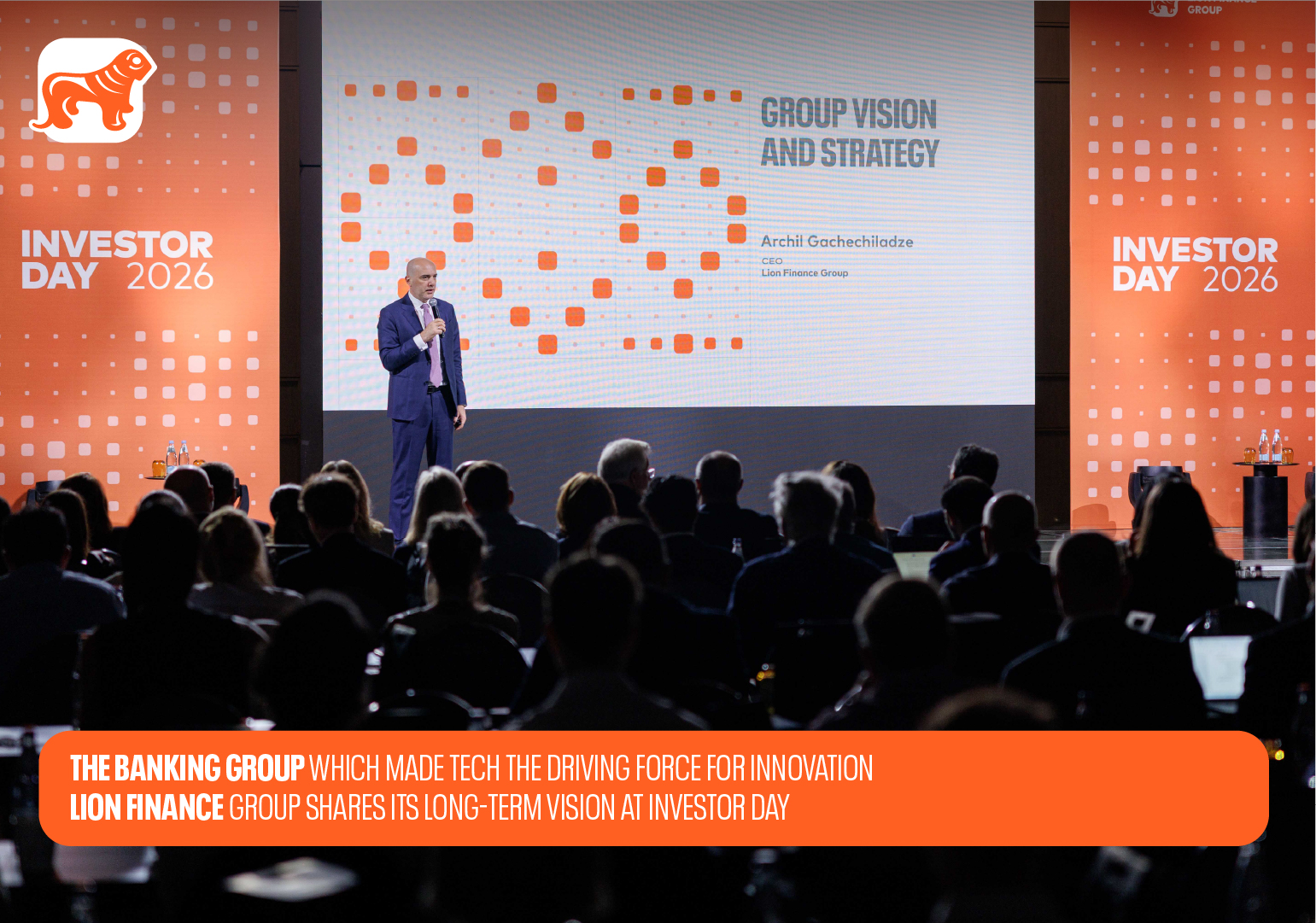
Lion Finance Group hosted its first in-person Annual Investor Day in Georgia since 2020, welcoming nearly 100 international investors and analysts, including representatives from Firebird, M&G Investments, Morgan Stanley, and JPMorgan Chase. Alongside management from Bank of Georgia and Ameriabank, Lion Finance Group’s Executive Director, Archil Gachechiladze, laid out the Group’s long-term strategic vision, emphasizing that future growth will be driven not only by expansion into new markets but also by reinforcing its leadership and deepening its presence in the markets where it already excels – A message he expanded on in a series of follow-up conversations about the bank’s operating model, its use of AI, and where future growth will come from.
The Case for Consistency
Some of Lion Finance Group’s success reflects the strength of its home markets. Georgia and Armenia have both seen GDP per capita rise roughly tenfold since the early 2000s, from around $1,000 to approximately $10,000 today — a trajectory that places them among the fastest-growing economies in Europe. But the Group does not let the macro tailwind carry the whole story. “It is built on a profitable, well-capitalized FTSE 100 banking group with technology at its core, market-leading customer franchises in both of our home markets, prudent risk management, and the highest standards of governance.” It is this combination of structural strengths that has enabled the Group to translate favorable market dynamics into consistent, compounding returns over time.
Looking ahead, Lion Finance Group intends to deepen its presence in both Georgia and Armenia while gradually expanding into carefully selected international markets.
“We are interested in having a leading franchise in a smaller market where we believe we can genuinely add value.”- Gachechiladze said.
Potential expansion opportunities include selected countries across the Baltics, the Balkans, and Central Asia, with particular emphasis on institutions that combine strong market positions with prudent risk management.
“But we don’t have to rush,” he said, discussing future acquisitions. “We want to find the right match.”
At the same time, the Group sees significant untapped opportunities within its existing markets. Future priorities in both Georgia and Armenia include expanding wealth management capabilities, developing insurance marketplace solutions, enhancing brokerage services, and continuing to strengthen digital retail banking.
Not Just a Digital Bank. Not Just a Traditional Bank. A Strong Hybrid.
Ask Gachechiladze what sets Lion Finance Group apart, and he points not to a choice between traditional banking and fintech, but to a deliberate combination of the two. The strategy emerged from observing how financial services were evolving. “We were looking at developments in the global financial sector and saw that fintechs were becoming an integral part of our customers’ everyday lives,” he said. “At the same time, the businesses making the biggest strides were those with the institutional strength to support that growth. We thought: why don’t we become a fintech with that kind of foundation? To do that, there were certain things we had to fundamentally change.”
Here is where the Group’s approach to technology comes in. Rather than relying heavily on external vendors, Lion Finance Group has invested in developing most of its technology internally. Its digital platforms — including mobile banking, internet banking, business banking solutions, sCoolApp, and other core banking systems — are largely built in-house, enabling significantly faster product development and greater flexibility.
The digital side of that transformation shows up in hard numbers, several of which the Group presented in detail to investors on the day. One metric Gachechiladze returned to was the Net Promoter Score (NPS), where the bank has reached 76 — a level he described as exceptional not only for banking, but for any consumer-facing business. “An NPS above 70 makes you a true love brand. We approach that rigorously, measuring every channel and every customer touchpoint.”
That customer focus has translated into tangible business outcomes. The Group increased its market share from 35.7% to 38%, while continuing to expand digital engagement across its customer base. Today, Lion Finance Group serves 2.7 million monthly active customers, with digital monthly active retail users growing 45.3% year-on-year to 336,000 and now accounting for 70% of all monthly active retail customers, up from 65% a year earlier.
The acquisition of Armenia’s Ameriabank is the clearest proof point of the strategy exported: a franchise with the same ingredients – local trust, an underpenetrated market, room to add digital capability – that the Group believed it could scale the way it had at home.
AI, Quantified
This technological foundation increasingly extends into artificial intelligence. From AI-assisted lending decisions and automated processes to intelligent customer support and personalized product recommendations, automation is becoming deeply integrated into the Group’s operations. According to Gachechiladze, AI is not viewed simply as a tool for efficiency, but as a way to improve customer experience while freeing employees to focus on higher-value work.
Ask where artificial intelligence actually shows up in business, and Gachechiladze doesn’t reach for buzzwords—he reaches for adoption curves, a theme he flagged as a growing priority for the Group at Investor Day. AI is becoming one of the Group’s most important tools for reshaping both customer experience and internal processes. Gachechiladze highlighted the shift from using technology simply to automate tasks toward using AI to make banking more intuitive and personalized, including through “next best offer” capabilities that help identify what customers need—sometimes before they have even expressed that need themselves.
Another key example is the Group’s next-generation GenAI chatbot, designed to handle customer interactions with greater context and accuracy than traditional automated solutions. Today, around two-thirds of customer interactions are completed within the chatbot itself, with customer satisfaction levels exceeding 90%.
AI is also transforming lending processes. The Group has significantly expanded automation in credit decisioning, including the automation of mortgage processes. So, across the organization, AI adoption has expanded rapidly, with usage increasing from 10% to 55% of processes and reaching 80% within back-office functions.
As AI becomes more deeply embedded across the business, however, he believes its success will depend as much on people as on the technology itself. Like any major technological transformation, the adoption of AI brings social considerations and requires careful attention to how employees adapt to new ways of working. That makes preparing employees for the shift just as much a priority as building the technology behind it.
Where Future Growth Will Come From
For a bank the main investor question – and one that Investor Day was explicitly convened to address – is durability. “At the heart of our strategy is a simple but powerful ambition: to be the primary financial partner in our customers’ daily lives,” he said. In that context, market share is not the destination but the foundation. The real opportunity lies in increasing wallet share and expanding customers’ use of higher-value services such as wealth management, business banking, and SME banking. “We are investing ahead of demand,” he said, “in segments where structural growth in these economies will reward early movers.” Lion Finance Group’s answer is to compete on the same integrated platform logic it has already proven at home – “anticipating their needs rather than just reacting to them,” as he put it – across an entire financial journey rather than isolated product silos.
Lion Finance Group’s bet — that trust and market leadership, built patiently over two decades, compound into something competitors can’t easily replicate — is no longer theoretical. The growth, the margins, and the expanding AI infrastructure are the evidence. The question now is not whether the model works, but how far it can travel.
S