
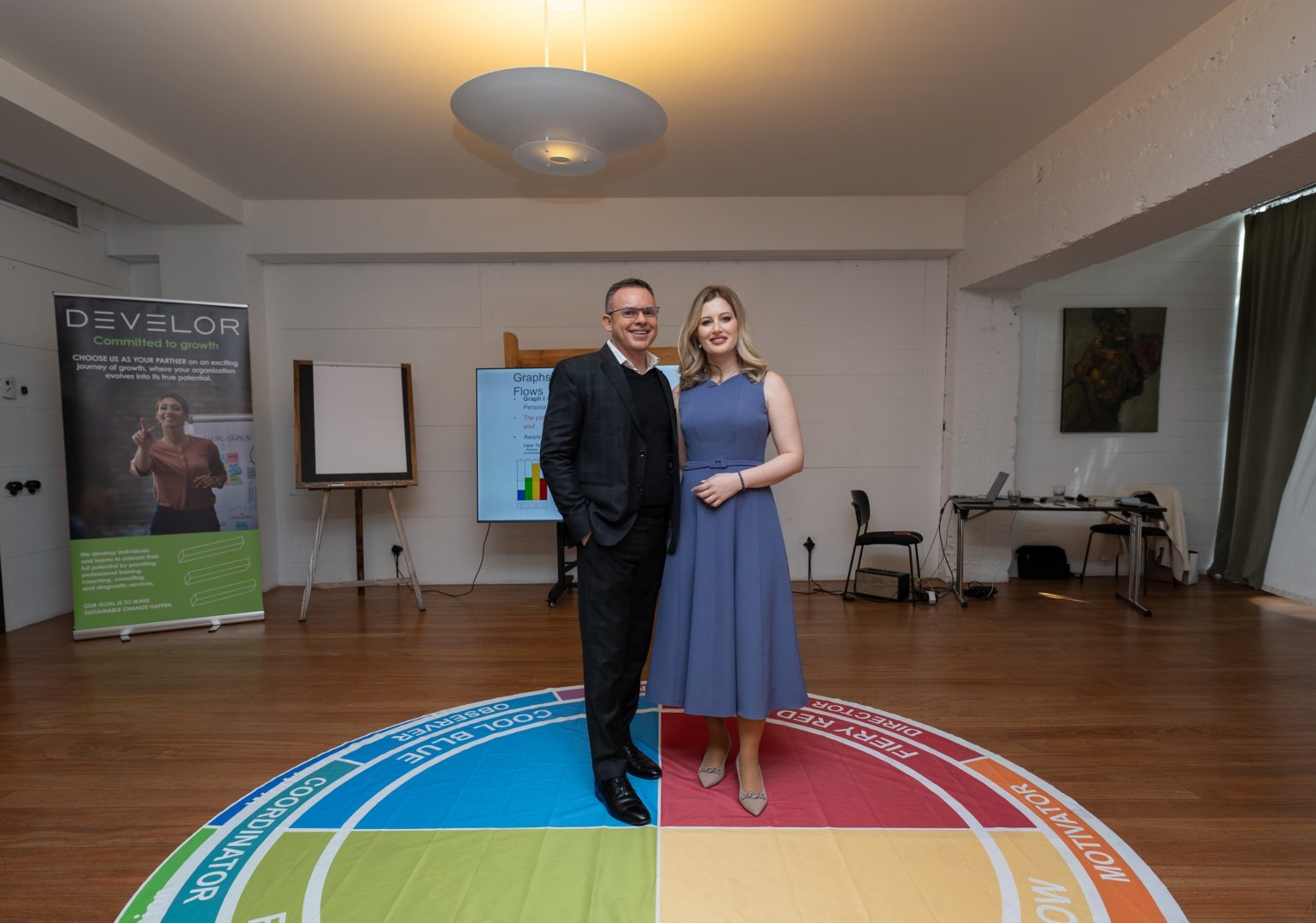
Unlocking human potential, driving organizational transformation, and developing strong leaders lie at the heart of the strategic partnership between DEVELOR and Insights. In an era of increasingly complex business challenges, effective corporate learning goes beyond acquiring new skills, placing greater emphasis on self-awareness, collaboration, and translating knowledge into practical results. By combining international expertise with a deep understanding of local business needs, the partnership aims to help organizations develop their people and strengthen leadership capabilities. Mark Leisegang, Global Alliances Executive at Insights, and Mariam Dulskienė, Managing Director & Partner at DEVELOR Georgia & Lithuania, discuss the significance of this collaboration, the value of the Insights Discovery methodology, and the future of leadership development.
How do you see the partnership between DEVELOR and Insights, and what makes this partnership valuable?
Mark Leisegang: I see the partnership between DEVELOR and Insights as much more than a traditional commercial relationship. At the heart of it is a shared belief in the potential of people and in creating positive change through greater understanding.
At Insights, our purpose is to create a world where people truly understand themselves and others, and are inspired to make a positive difference in everything they do. For me, that purpose is not simply a statement. It shapes the organisations we want to partner with and the kind of impact we want to create together.
That is one of the reasons our relationship with DEVELOR is so valuable. There is a real alignment between our organisations around people, development and meaningful, lasting change. Insights brings a globally recognised methodology and a powerful common language that helps people understand themselves and others. DEVELOR combines this with deep market knowledge, strong client relationships and the ability to translate that learning into the realities and challenges organisations face every day.
Georgia is a particularly strong example of this partnership for me. Having spent time working alongside the DEVELOR Georgia team and engaging with their clients, I’ve seen the energy, ambition and genuine commitment they bring to developing people. They don’t simply deliver Insights Discovery as a methodology. They bring its purpose to life by helping people understand themselves more deeply, recognise and value differences in others, and use that awareness to communicate, collaborate and lead more effectively.
And that is where I think the real power of the partnership lies. Our ambition is not simply to deliver programmes or profiles. It is to create moments of understanding that can change conversations, relationships, teams and ultimately organisations.
The best partnerships are built on more than commercial opportunities. They are built on shared purpose, trust and a belief that by bringing together different strengths, we can create a greater positive impact than either organisation could create alone. For me, DEVELOR and Insights is very much that kind of partnership.
In your view, what is the key value for clients who use the Insights Discovery methodology?
Mark Leisegang: For me, the key value of Insights Discovery is awareness. It starts with helping people understand themselves more deeply, their preferences, strengths, how they communicate, how they make decisions and the impact they can have on others. But the real value comes when we take that self-awareness and turn it outwards, developing a greater awareness and appreciation of the people around us.
That combination of awareness of self and awareness of others can have a profound impact. At an individual level, it can lead to moments of self-realisation, helping people recognise not only what they naturally bring, but also where their preferences may be limiting them and where they have an opportunity to adapt, stretch and grow.
In teams, that awareness helps us move beyond simply recognising that people are different to actually valuing those differences. When people better understand why colleagues may communicate, contribute, challenge or approach problems differently, it can create stronger connections, greater trust and more effective collaboration. Difference becomes something to harness rather than something to overcome.
I think it is equally powerful for leadership. Greater self-awareness helps leaders understand the impact they have on the people around them, while awareness of others enables them to adapt how they communicate, motivate, challenge and support different people. Leadership becomes less about expecting others to adapt to us and more about asking, ‘What does this person or this team need from me right now?’
And increasingly, I see an important connection with critical thinking. Understanding our own preferences can help us recognise that the way we naturally gather information, interpret a situation or make a decision is not the only way. It encourages us to pause, seek different perspectives, challenge our assumptions and become more intentional about how we think and decide.
That is why I see Insights Discovery as much more than a profile. The profile can create the initial moment of insight, but the real value is what happens next. When people continue to apply that awareness to how they lead, think, communicate and work together, it becomes a foundation for individual growth, more effective teams and ultimately healthier, higher-performing organisations.
From DEVELOR’s perspective, how does the partnership with Insights help organisations address today’s leadership and business challenges?
Mariam Dulskienė: One thing I have learned from working with organisations over the years is that many business challenges are, at their core, people challenges.
We often talk about strategy, transformation, performance and growth. But behind all of these are people who need to work together, make decisions, manage uncertainty and sometimes find a way to understand colleagues who see the world very differently from them.
And I think this is where our partnership with Insights becomes particularly meaningful.
At DEVELOR, we have always believed that developing people should ultimately make a difference to the organisation. Training is important, of course, but what really matters is what happens afterwards. Do managers communicate differently with their teams? Are people more willing to collaborate? Can leaders handle difficult conversations more effectively? Does anything actually change in the way the organisation works?
For me, these are the questions that matter.
What I appreciate about Insights Discovery is that it gives us a very practical starting point. People begin to recognise their own preferences and understand why others may approach the same situation differently. Sometimes something as simple as that can completely change the way a team communicates.
But we don’t want that understanding to stay in the training room. Our role at DEVELOR is to take it further and connect it with the challenges our clients are actually facing, whether that is leadership development, managing change, improving sales performance or building stronger collaboration between departments.
In Georgia, we have worked with organisations at different stages of development, and I have seen how much expectations around corporate learning have changed. Clients are no longer interested only in whether participants enjoyed a workshop. They want to understand what people will do differently afterwards and how that will support their business.
Now, with DEVELOR’s expansion into Lithuania, I have the opportunity to look at these questions from another market perspective as well. Of course, the business environment and the way people communicate are not exactly the same in Georgia and Lithuania. And I think recognising those differences is important. What works well in one market cannot always be introduced in exactly the same way in another.
But the underlying challenges are often surprisingly similar. Leaders want more engaged teams, organisations want better collaboration, and people want to feel understood and valued.
For me, the strength of this partnership is that we can bring together the international experience and methodology of Insights with DEVELOR’s understanding of local business realities. And rather than offering the same solution everywhere, we can make it relevant to the people and organisations we work with.
Ultimately, I don’t think clients are looking for another methodology or another training programme. They are looking for something that helps them solve real problems. And that is what I believe we can achieve together.
Looking ahead, how do you see the future of leadership development, and what role will methodologies like Insights Discovery play in preparing leaders for the challenges of tomorrow?
Mariam Dulskienė: I think we are at a very interesting point in how we understand leadership.
For a long time, we have focused on developing leaders who can make good decisions, manage performance, set clear goals and deliver results. And of course, none of that is becoming less important.
But when I look at what leaders are dealing with today, I think the expectations have become much more complex.
We are talking about artificial intelligence changing the way we work, organisations going through constant transformation, different generations working together, and employees expecting much more from their leaders than simply direction and feedback.
And in the middle of all this, leaders are still human beings, working with other human beings.
I sometimes think we spend so much time discussing new technologies and new management approaches that we forget how important the basics of human relationships remain.
Can you really listen to someone whose opinion is completely different from yours? Can you recognise when your usual leadership style is not working? Can you create an environment where people feel comfortable challenging your ideas? And perhaps most importantly, are you willing to question your own assumptions?
For me, these are becoming some of the most important leadership questions.
This is also why I believe methodologies like Insights Discovery will continue to be relevant. Not because a personality profile can give us all the answers, but because it can help us ask better questions about ourselves and the people around us.
And I think this is particularly important when we talk about critical thinking. We all have our natural preferences. We tend to trust certain types of information, approach problems in familiar ways and sometimes make assumptions without even noticing. Understanding those preferences gives us an opportunity to challenge ourselves and consider perspectives we might otherwise overlook.
At the same time, I believe we need to rethink how leadership development actually happens.
I have been working in learning and development for years, and one thing I feel strongly about is that people don’t become better leaders simply because they attended a good training programme.
They develop when they have the opportunity to practise, make mistakes, receive feedback, reflect and try again.
This is one of the reasons I am particularly interested in combining methodologies like Insights Discovery with business simulations, coaching and AI-supported learning experiences. Technology gives us new opportunities to create realistic situations where leaders can practise difficult conversations, experience the consequences of their decisions and explore different approaches in a safe environment.
But I don’t see technology replacing the human side of development. Quite the opposite. I think it can give us more opportunities to develop the human capabilities that matter most.
And perhaps this is where I see the biggest change in the future of leadership.
I don’t believe there is one ideal leadership style that everyone should try to follow. Different people and different situations require different approaches. What matters is whether a leader understands themselves well enough to recognise when they need to adapt.
If we can help leaders become more aware of their impact, more open to different perspectives and more intentional in how they work with people, I believe we are already making a meaningful difference.
And for me, that is what leadership development should ultimately be about. Not simply learning something new, but becoming more effective in the way we lead, work with others and contribute to the organisations we are part of.
S