

At 25, Marie-Claude Marson and Marta Imeneo are betting on Georgia — the Caucasian nation that may hold the oldest winemaking tradition on Earth — to become the defining wine story of the next decade.
In the wine world, disruption rarely looks like two women in their mid-twenties arriving in the Caucasus with little more than a business idea, a shared passion for culture, and an appetite for risk. But that is precisely the story of Ambrosia Winery and it may be one of the most compelling entrepreneurial bets in the global drinks industry right now.
Marie-Claude Marson, French-Colombian, Marta Imeneo, Italian, and Maria Pangalos, American met in Paris while studying. They were 22 years old when they made the decision that would define their early careers: to leave Europe and build a wine brand in Georgia not the American state, but the ancient Caucasian nation that sits at the crossroads of Europe and Asia, and that archaeologists now widely recognize as the birthplace of wine itself.
Three years later, at 25, they are running a growing winery, exporting to distributors across Europe, presenting at international sommelier associations, and harvesting tens of tonnes of Saperavi from one of the most consequential wine regions on Earth.
A COUNTRY BEFORE ITS TIME
Georgia’s wine story predates France’s by thousands of years. The country’s indigenous qvevri tradition — fermenting and aging wine in large clay vessels buried underground — has been practiced for over 8,000 years and is recognized by UNESCO as an intangible cultural heritage. Yet for decades, Georgian wine remained largely invisible to international markets, overshadowed by the dominant narratives of Bordeaux, Burgundy, and Tuscany.
That invisibility, Marson and Imeneo recognized, was not a liability. It was an opportunity.
“Georgia has everything the modern wine consumer is looking for,” Marson explains. “Ancient heritage, indigenous grape varieties no one else has, terroir that is genuinely unique, and a winemaking culture that is deeply human. The only missing piece was a brand that could translate that story for a global audience.”
Ambrosia was conceived as exactly that bridge: an internationally minded winery, rooted in Georgian tradition, built to meet the expectations of the world’s most discerning wine markets. The founding team — which also includes a third co-founder bringing complementary expertise — brought together Italian, French, Colombian, and American sensibilities, united by a conviction that Georgian wine deserved a place at the same table as the world’s great wine regions.

THE ENTREPRENEURIAL BET
Neither Marson nor Imeneo came from the wine industry. They came from entrepreneurship. Both had accumulated early business experience before graduating, and both shared a restlessness that made a conventional career path feel inadequate. When the opportunity to build something original in Georgia presented itself, they moved quickly.
The early months were defined by immersion. They traveled across Georgia’s wine regions, learning the language of the terroir: the difference between Kakheti’s ancient valley soils and the elevated vineyards of other regions, the particular character of indigenous grape varieties like Saperavi, Rkatsiteli, Mtsvane, and Kisi, and the profound philosophy behind qvevri winemaking, a method that demands patience, attentiveness, and deep respect for natural process.
They partnered with local winemaker Olga Akulashvili, whose technical mastery of Georgian traditions became the backbone of Ambrosia’s production philosophy. The combination of international commercial vision and local winemaking authenticity is, according to those who have observed their model, precisely what gives Ambrosia its distinctiveness.
Equally central to Ambrosia’s winemaking is their partnership with David Machavariani, one of Georgia’s most respected winemakers. His deep expertise and intimate knowledge of the country’s vineyards and grape varieties have proven indispensable, a collaboration the founders describe as foundational to what Ambrosia is able to produce. “Without David, this would not be possible,” Marson says plainly. “His understanding of Georgia’s terroir and his commitment to quality are woven into everything we make.”
For Imeneo, that local rootedness is inseparable from the brand’s identity. “You cannot parachute into a winemaking culture as old as Georgia’s and expect shortcuts,” she says. “We spent months understanding the people, the soil, the seasons. That investment is in every bottle we make. It’s not marketing — it’s the actual product.”
The global market is an open playground for Georgian wine, and I’m committed to driving its expansion with the resources and structure to deliver.
— Marie-Claude Marson, Co-Founder, Ambrosia Winery
In 2025, Ambrosia’s first full harvest season coincided with what Georgian authorities reported as a record-breaking year for national grape production the largest in three decades, with approximately 336,000 tonnes processed across the country. Ambrosia harvested 20 tonnes of Saperavi, navigating persistent rains and unpredictable sugar levels that challenged producers across Kakheti. The team worked through the night for consecutive days to salvage quality. The experience, Imeneo notes, was formative.
“You learn more in one harvest than you do in a year of planning,” she says. “Georgia doesn’t let you be passive. It demands everything from you, and in return it gives you something you can’t manufacture anywhere else.”
BUILDING THE INTERNATIONAL CASE
Ambrosia’s commercial strategy has been deliberate and internationally focused from the outset. In the months following their second production, the founders took their wines to Spain, presenting to the Granada Sommeliers Association in Andalucía, one of Europe’s most wine-educated regions. The reception confirmed something they had long believed: European wine professionals are hungry for new narratives, and Georgian wine, presented with craft and context, is capable of capturing serious attention.
At the Gurjaani Wine Festival in Georgia’s Kakheti heartland, Ambrosia stood out as one of the only foreign-owned winery in attendance, a distinction that opened conversations with distributors from Greece, Germany, Ukraine, and Bulgaria, and underscored the positioning the founders have carved out: neither purely local nor purely foreign, but genuinely both.
“Being one of the only foreign-owned wineries at Gurjaani wasn’t something we planned as a strategy,” Marson recalls. “But it became a conversation starter with every producer and visitor we met. People were curious. That curiosity is a door and we’ve learned to walk through every one of them.”
The winery has also cultivated an unconventional brand presence, collaborating with specialty coffee roaster Shavi Roaster, presenting at the Italian Chamber of Commerce, and sponsoring the Tbilisi Padel Tournament, touchpoints that position Ambrosia within the lifestyle and cultural fabric of modern Tbilisi, where an influx of international entrepreneurs and creatives has transformed the city into one of Europe’s most dynamic emerging capitals.
THE VISION: GEORGIA ON THE GLOBAL WINE MAP
What Marson and Imeneo are building is bigger than a winery. Their ambition is to participate in the repositioning of an entire country’s wine identity on the global stage, a project with both commercial and cultural dimensions.
Georgia currently exports wine to over 50 countries, with Russia historically its dominant market. But a new generation of Georgian producers and international investors are diversifying that export base, targeting Western Europe, the United States, and Asia. Ambrosia sees itself as part of this structural shift, a proof of concept that Georgian wine, produced to international standards and communicated with global fluency, can compete in premium markets.
Their portfolio spanning Saperavi, Cabernet Franc, Mtsvane-Rkatsiteli, and Kisi-Chardonnay and currently producing more varieties is designed to serve both the adventurous sommelier and the curious consumer. The qvevri wines honor Georgia’s UNESCO-recognized heritage; the blended offerings provide entry points for palates less familiar with the amber wine tradition.
Sustainability and local partnership are central to their operating model. Every harvest deepens their relationship with Kakheti’s farming communities, and every bottle carries what Marson describes as “the soul of a country that has been making wine longer than anyone — it just hasn’t had the world listening yet.”
WHAT COMES NEXT: FROM PARIS TO THE WORLD
If 2025 was the year Ambrosia proved it could produce, 2026 is the year it intends to distribute at scale, and on its own terms.
The founders’ first move was to take Ambrosia to Vinexpo Paris, one of the wine industry’s most prestigious trade fairs and a bellwether for what the global market is paying attention to. Presenting alongside established names from France, Italy, and Spain, Ambrosia arrived as something the fair rarely sees: a foreign-owned, internationally operated winery bringing Georgian wine to the highest table in the European trade calendar. The response, they report, exceeded expectations.
Vinexpo confirmed that the conversation around Georgian wine has fundamentally changed. Buyers aren’t asking ‘where is Georgia?’ anymore. They’re asking ‘how do I get it?’
— Marta Imeneo, Co-Founder, Ambrosia Winery
From Paris, the roadmap extends across five markets the founders have identified as priority destinations for active distribution: the United States, the United Kingdom, Switzerland, Italy, and Spain. Each represents a distinct opportunity. The U.S. market — the world’s largest wine consumer by value — offers scale and a premium on narrative-driven brands. The UK’s sophisticated on-trade sector is already showing appetite for natural and qvevri-style wines. Switzerland’s affluent, internationally minded consumer base aligns with Ambrosia’s positioning. And Italy and Spain, as major wine-producing nations, represent a prestige test: if Georgian wine can win shelf space and restaurant lists in Tuscany and Rioja country, it can win them anywhere.
“We are not waiting for distributors to discover us,” Marson says. “We are going to them, bottle in hand, story ready. That is how you build a wine brand in 2026 — you show up.”
The approach is methodical but personal. Rather than working through intermediaries, Marson and Imeneo are conducting the international push themselves — meeting importers, presenting to buyers, building relationships with the sommeliers and restaurateurs who shape what discerning consumers drink. It is a labor-intensive model, but one that reflects their conviction that Georgian wine’s best ambassador is a direct conversation.
For Imeneo, the Italian leg of the tour carries particular personal resonance. “Italy has one of the most educated wine cultures in the world,” she says. “Italians are proud of their own traditions and rightly so. But that same depth of knowledge makes them genuinely curious about a tradition that predates their own. That is the conversation I most look forward to having.”
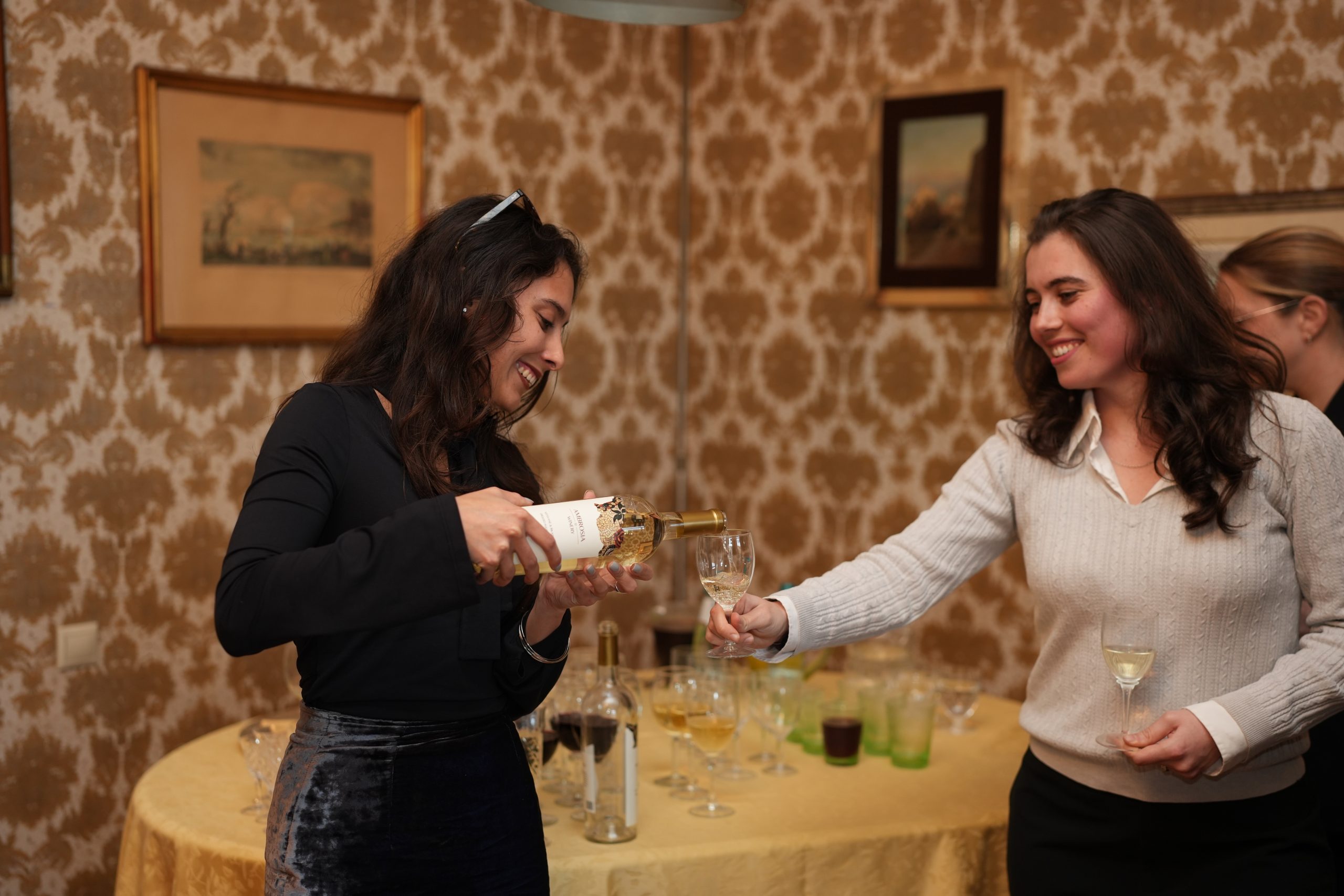
A NEW FRONTIER IN SPAIN: THE SOMMELIERS OF ARAGÓN
The Spanish chapter of Ambrosia’s international push has deepened significantly. In April 2026, the founders were invited to present their wines to the Asociación de Sumilleres de Aragón, one of Spain’s oldest and most respected sommelier associations, founded in 1994 alongside those of Asturias, Cataluña, and Castilla León.
Aragón is no ordinary wine region. With four Denominations of Origin — Somontano, Cariñena, Calatayud, and Campo de Borja — and a winemaking tradition stretching back to Roman times, the region has produced some of Spain’s finest wine professionals. Presenting to that audience, Imeneo acknowledges, carried a particular weight.
“Some invitations carry more weight than others,” she says. “We were not speaking to casual wine lovers, we were speaking to people with the training, the palate, and the passion to truly understand what Georgian wine represents.”
The response was everything they had hoped for. The sommeliers engaged with every detail of the tasting, their questions thoughtful, their observations precise, their enthusiasm genuine. For Imeneo, the moment when an experienced sommelier pauses mid-glass and reaches for another pour is a validation that no marketing metric can replicate.
The Aragón event reflects a deliberate expansion of Ambrosia’s Spanish strategy beyond Andalucía, where the Granada tasting had opened the first doors. Spain’s sommelier network, region by region, is becoming one of the winery’s most important platforms for word-of-mouth credibility among the professionals who shape what fine-dining restaurants actually pour.
CROSSING THE ATLANTIC: VINEXPO AMERICAS, MIAMI
Then came Miami — and with it, America.
In late April 2026, Ambrosia participated in Vinexpo Americas at the Miami Beach Convention Center, marking the trade event’s inaugural edition in the city. The fair brought together over 250 exhibitors from 25 countries and more than 2,000 visitors from 40 nations — the most concentrated gathering of wine and spirits buyers in the Western Hemisphere, now relocated from New York to a city that sits at the gateway to both North and Latin America.
For Ambrosia, it was a first real step into the United States, the world’s largest wine market by value, and one undergoing a decisive structural shift. Volume across the industry has contracted, but the story beneath the numbers is one of opportunity: American consumers are drinking less but spending more, with wines in the $15–50 range consistently outperforming the broader market. The buyers who matter are increasingly drawn to imports with genuine story, distinct terroir, and a character unavailable on a supermarket shelf.
“The American market is ready for Georgian wine,” Marson says. “We arrived in Miami with our wines and our story. We left with something even better: the confidence that we were right.”
The fair gave Ambrosia access to importers, distributors, sommeliers, and hospitality buyers from across the U.S. and Latin America, the kind of concentrated, high-quality audience that would ordinarily take years to reach. Florida’s weight in the luxury and hospitality sectors, from fine dining to cruise lines and resort chains, makes it a particularly attractive entry point into the broader American market. And Miami’s position as the gateway to Latin America opened conversations far beyond the United States, with professionals from across the Caribbean, Central America, and South America, all showing a growing appetite for wines that offer authenticity, quality, and a compelling origin story.
For a winery that arrived in Georgia at 22 with nothing but conviction, walking the floor of a hemisphere-defining trade fair three years later represents something more than commercial progress. It is proof of a thesis.
WHY IT MATTERS
The rise of Ambrosia Winery is a story about more than wine. It is a story about where the next generation of entrepreneurs is choosing to build and why emerging markets with deep cultural capital and underexplored commercial potential are attracting young, globally minded founders who might once have defaulted to Silicon Valley or London.
Georgia, with its low cost of entry, extraordinary natural assets, growing international community, and eight millennia of winemaking heritage, offers precisely the kind of asymmetric opportunity that defines the best early-stage bets. Marson, Imeneo and Pangalos saw it at 22. At 25, they are already proving the thesis.
The global wine industry should be paying attention. So should anyone watching where the next generation of entrepreneurs is quietly doing remarkable things.