
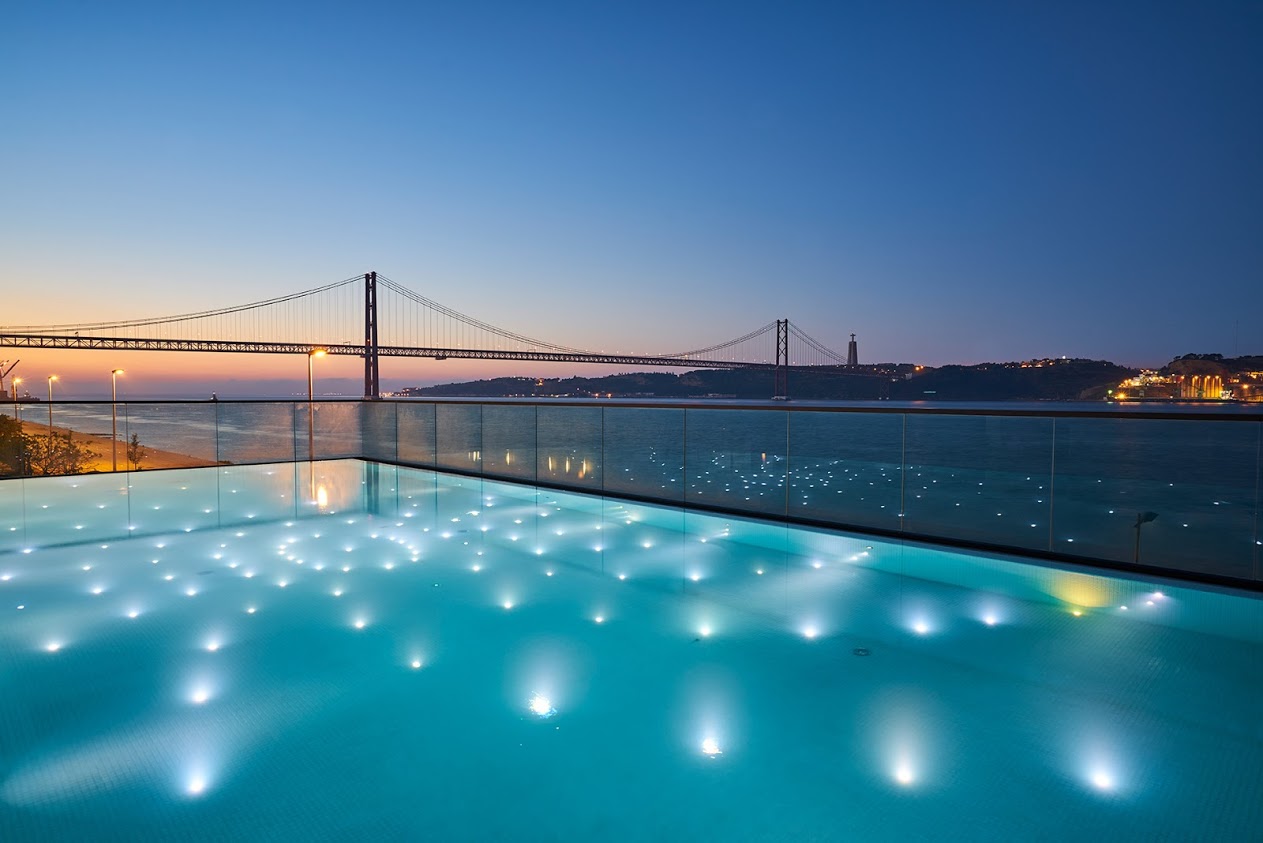
The pool at SUD Lisboa overlooking the Tagus. The venue marked its ninth anniversary on July 11, 2026.
From a 32-seat gastrobar in Baixa to Portugal’s tallest building, from an Italian trattoria to SUD Lisboa on the Tagus, five SANA addresses reveal contemporary Lisbon not as a checklist of sights but through five distinct rhythms. The route’s most exuberant stop, SUD Lisboa, marked its ninth anniversary on July 11.
Lisbon cannot be contained in a single postcard. The city moves from ceramic façades in the morning to red-lit interiors at night; from the narrow streets of its historic center to the glass horizon rising in the east. The Atlantic breeze enters from one side. On the other is the Tagus, continually redrawing the city’s scale.
That is why Lisbon is easy to see as a list of landmarks and much harder to feel as a whole. The latter requires a different kind of itinerary: not necessarily the shortest, or even the most geographically logical, but one that reveals the city at a succession of tempos.
Five SANA Hotels addresses create precisely that route. The Portuguese group now operates 17 hotels across four countries, yet its Lisbon portfolio does not feel like a single formula multiplied across the city. Each space has a different role: one quiets Lisbon; another turns up its energy; a third reveals it from above; and a fourth brings the visitor back to river level. The fifth—SUD Lisboa—compresses all of those ideas into one exuberant statement.
SUD Lisboa: Hospitality Without Hotel Rooms
On July 11, 2017, SANA did something hotel groups rarely do: it opened a property with no rooms.
SUD Lisboa took its place on Avenida Brasília in Belém, facing the Tagus and the 25 de Abril Bridge. By day, water is its defining surface—the river and the terrace pool appear to extend into one another. At night, the architecture changes register: interior light replaces the sun in the glass, the music rises, and a tranquil panorama becomes a social stage. The Terrazza restaurant, outdoor areas and SUD Lisboa Hall serve different purposes, but all are organized around the same view.
SUD Lisboa was the SANA Group’s first venture outside the traditional hotel format. Nine years on, its significance is even clearer: it moved the group’s idea of hospitality beyond the guest room. The product here is not an overnight stay but a carefully composed passage of time—a lunch, a sunset, a concert, a dinner or an event with Lisbon itself as the backdrop.
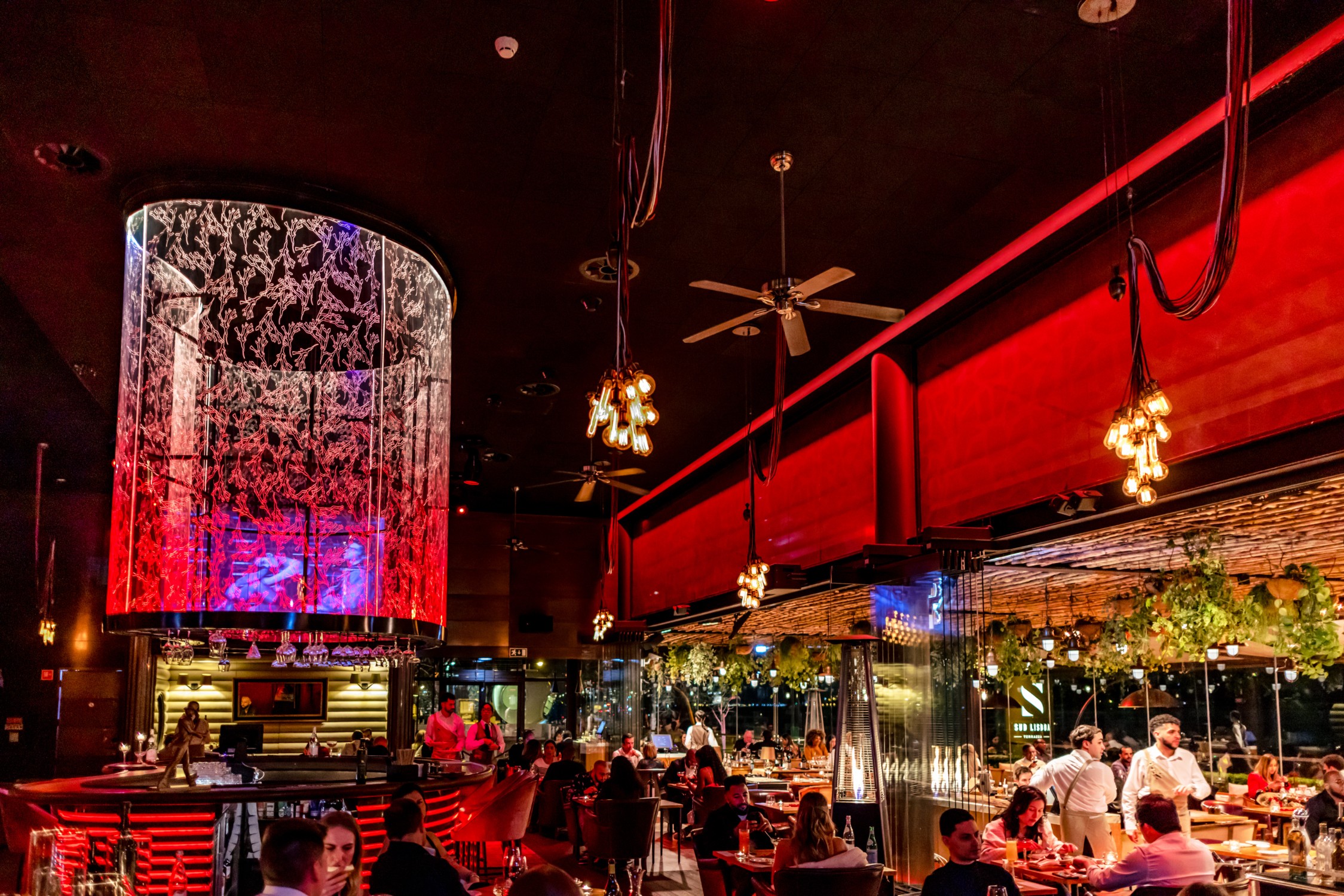
Behind SUD’s appeal is a simple principle, executed with unusual precision: the city is one of the experience’s principal ingredients. SANA’s other Lisbon addresses repeat that idea in very different registers.
BLACK MOON: Quieting the City
Baixa is not known for silence. Movement along Rua do Ouro is almost constant, and the streets fold into one another so tightly that the city rarely seems to pause for breath. Inside an 18th-century Pombaline building, MYTHIC SANA Downtown Suites creates the opposite scale: a hotel of 48 rooms and suites built around personalized service, with the 32-seat BLACK MOON Gastrobar tucked inside.
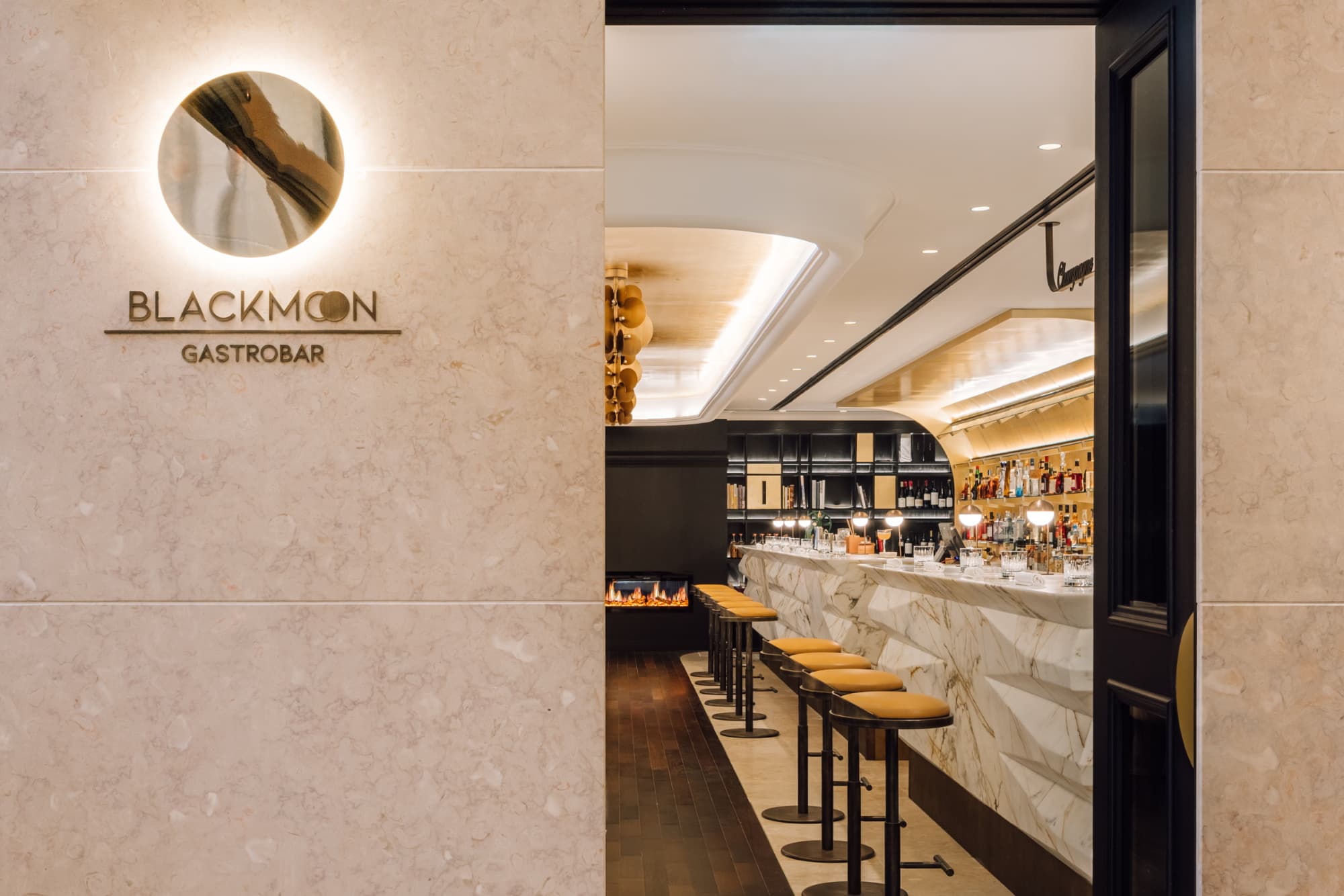
At BLACK MOON, the city seems to contract. White marble, black surfaces and restrained touches of gold do not disperse light; they hold it over specific details—the bar, a glass, a plate. With so few seats, the kitchen and the guest cannot remain distant from one another. Detail is the measure of the entire experience here.
Chef Luís Ortiz builds his menu around contrasts: raw and fire, delicacy and intensity. Portuguese ingredients meet Mexican flavors drawn from memory and accents from across Asia. The result is neither conventional fine dining nor an ordinary hotel bar. BLACK MOON is a more intimate gastronomic room, one in which time naturally stretches into the night and food, wine, champagne and cocktails settle into the same unhurried rhythm.
Where SUD Lisboa opens its architecture out toward the city, BLACK MOON deliberately closes it in. One turns Lisbon into a panorama, the other reduces the energy of the street to a handful of tables.
Allora: Luxury That Likes Conversation
BLACK MOON speaks in a whisper. Allora turns up the volume.
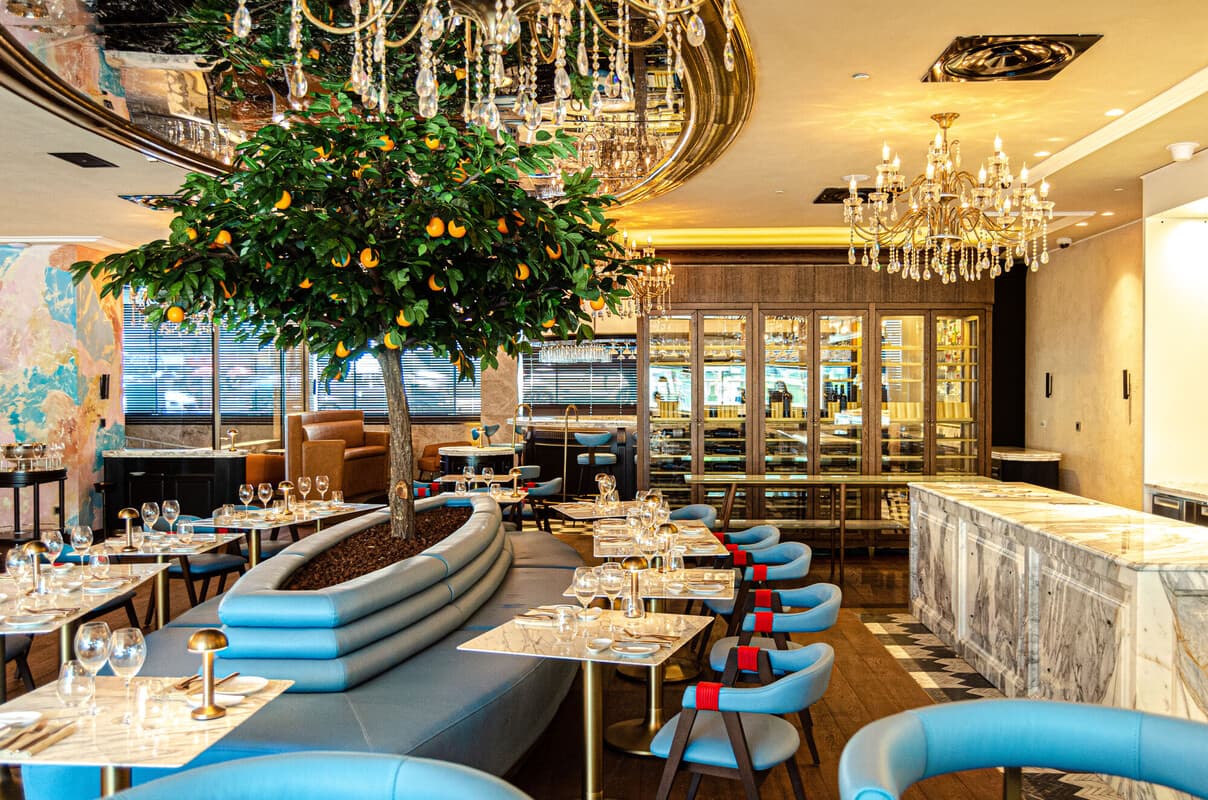
The Italian restaurant at EPIC SANA Marquês rejects the idea of a closed, formal dining room from the outset. The space is designed around movement: an open kitchen, an antipasti counter, a bar, handmade pasta, meat and fish from the charcoal grill, and finally a station devoted to gelato and desserts. Guests see more than a finished plate. They see how it comes into being.
Warm timber, pale marble, green and blue tones prevent the large interior from reading as one undivided room. Instead, it breaks into smaller scenes: lunch at the bar, a long dinner at the table, a conversation on the terrace. Luxury here is not isolation but carefully managed social energy.
Allora kitchen comes with the Italian accent—pasta made on site, ingredients drawn from different regions of Italy, the Josper grill and dishes composed for sharing. This is the logic of a trattoria translated into a more polished urban setting: serious cooking that feels no need to advertise its seriousness.
Vasco da Gama Tower: The City From 145 Meters
Lisbon changes radically when seen from 145 meters above the ground.
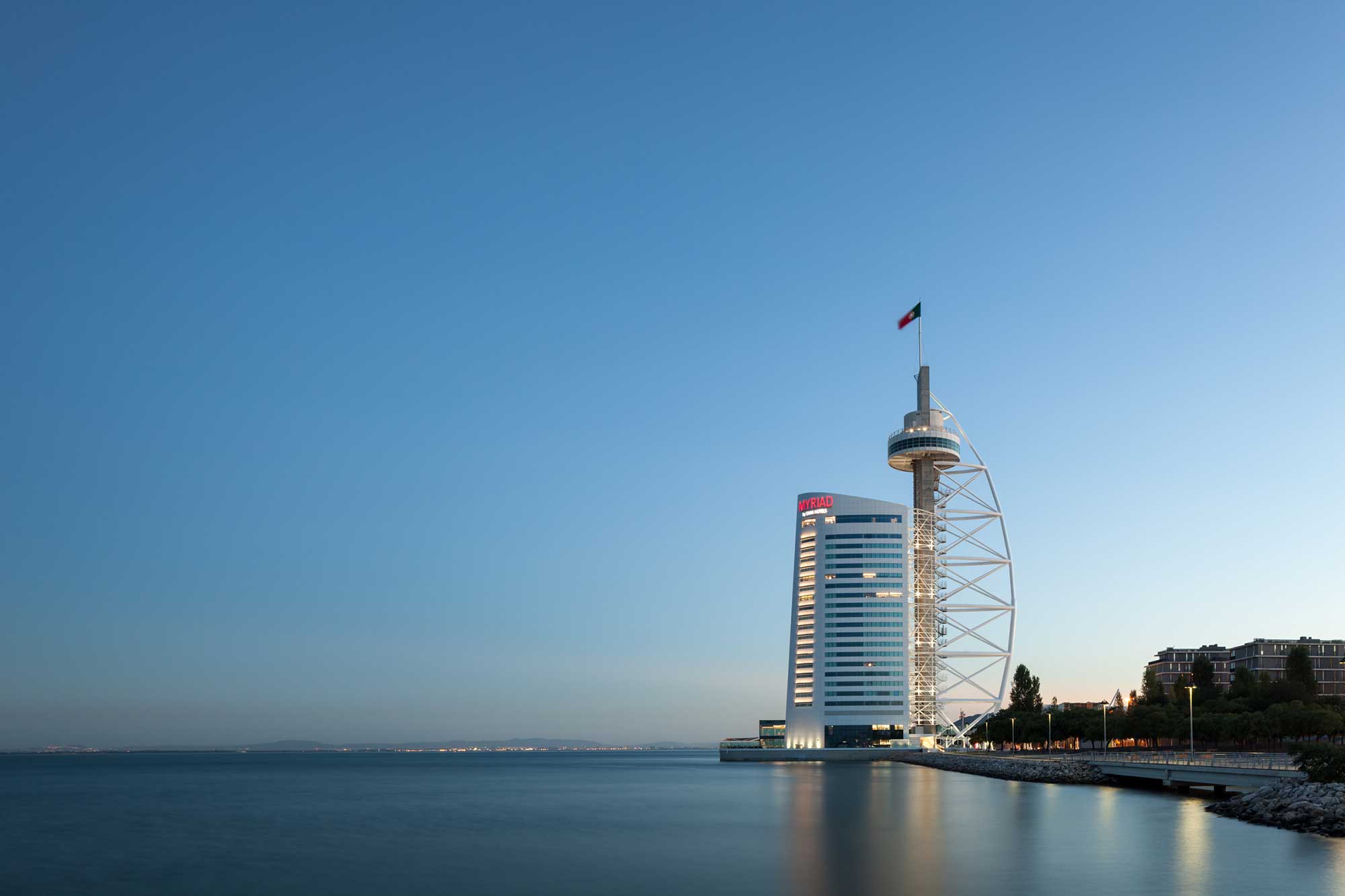
Vasco da Gama Tower stands in Parque das Nações, where glass, steel and wide-open space replace much of the stone and tile associated with historic Lisbon. From the top of Portugal’s tallest building, the Tagus ceases to feel like a feature at the city’s edge. It becomes the city’s organizing axis. The historic center extends in one direction; the modern east and Vasco da Gama Bridge in the other.
The 360-degree panorama makes Lisbon’s geography immediately legible: why the city grew along the river, where the old urban fabric gives way, and how an entirely new center emerged after Expo ’98. It places two different Lisbons inside the same frame.
The tower is integrated into the architecture of MYRIAD by SANA. At 120 meters sits Fifty Seconds, the restaurant awarded two Michelin stars, at the top are the viewpoint and BABYLON 360º. Height is the principle organizing the entire complex. From the hotel rooms to the restaurants, almost every space brings the city inside instead of shutting it out.
River Lounge: Back at Water Level
After 145 meters, the right ending is a return to zero elevation.
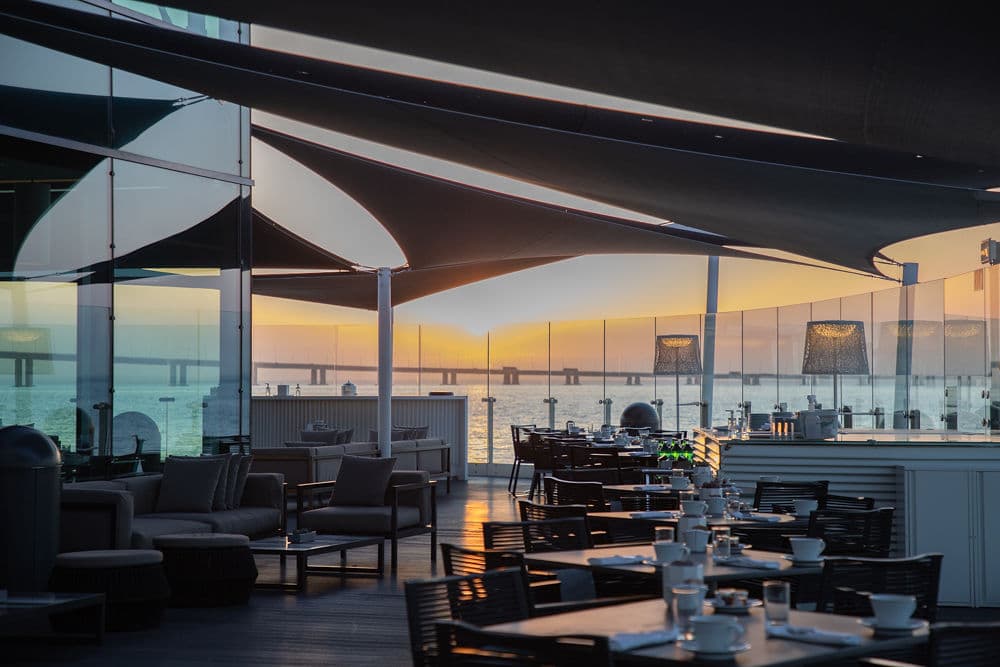
The River Lounge at MYRIAD by SANA sits almost directly on the Tagus. Glass walls and an outdoor deck make the water feel like a continuation of the interior. The most important change throughout the day is not in the décor but in the light. In the morning, the river expands the room;,at sunset, the glass turns from a window into a mirror.
The kitchen follows a Mediterranean and Atlantic logic—seasonal produce, fish and seafood, clean flavors and plates that do not attempt to compete with the view. Service keeps the same restrained rhythm. At River Lounge, the most valuable resource is space: the distance between tables, the horizon beyond the glass, and the time the river appears to slow.
If BLACK MOON controls the light, River Lounge yields to it. If Allora turns guests toward one another, every gaze here travels outward. The coherence of the route lies precisely in those differences.
One City, Five Tempos
These five addresses are not united by one design language, one cuisine or one mood—and that is their shared idea. The simplest strategy for a hospitality brand would be to reproduce a successful formula. SANA’s Lisbon portfolio does the opposite: it divides one city into several tempos.
BLACK MOON is intimate, Allora is social. Vasco da Gama Tower supplies scale, River Lounge offers stillness. SUD Lisboa combines all four elements: architecture, gastronomy, a commanding view and the energy of a crowd.
That is why SUD’s ninth anniversary is more than the birthday of a popular venue. It also marks the moment a hotel group decided that the guest room did not always need to be hospitality’s principal product. Sometimes the product can be a 32-seat bar, a lively room filled with handmade pasta, an ascent of 145 meters, or one quiet table beside the Tagus.
Lisbon does not appear along this route as a catalog of attractions. It unfolds as a well-directed day—from darkness into light, from street level into the sky, and from height back down to the water. In the end, that is also what contemporary luxury has become: not the accumulation of more, but the precise distribution of time, space and attention.