

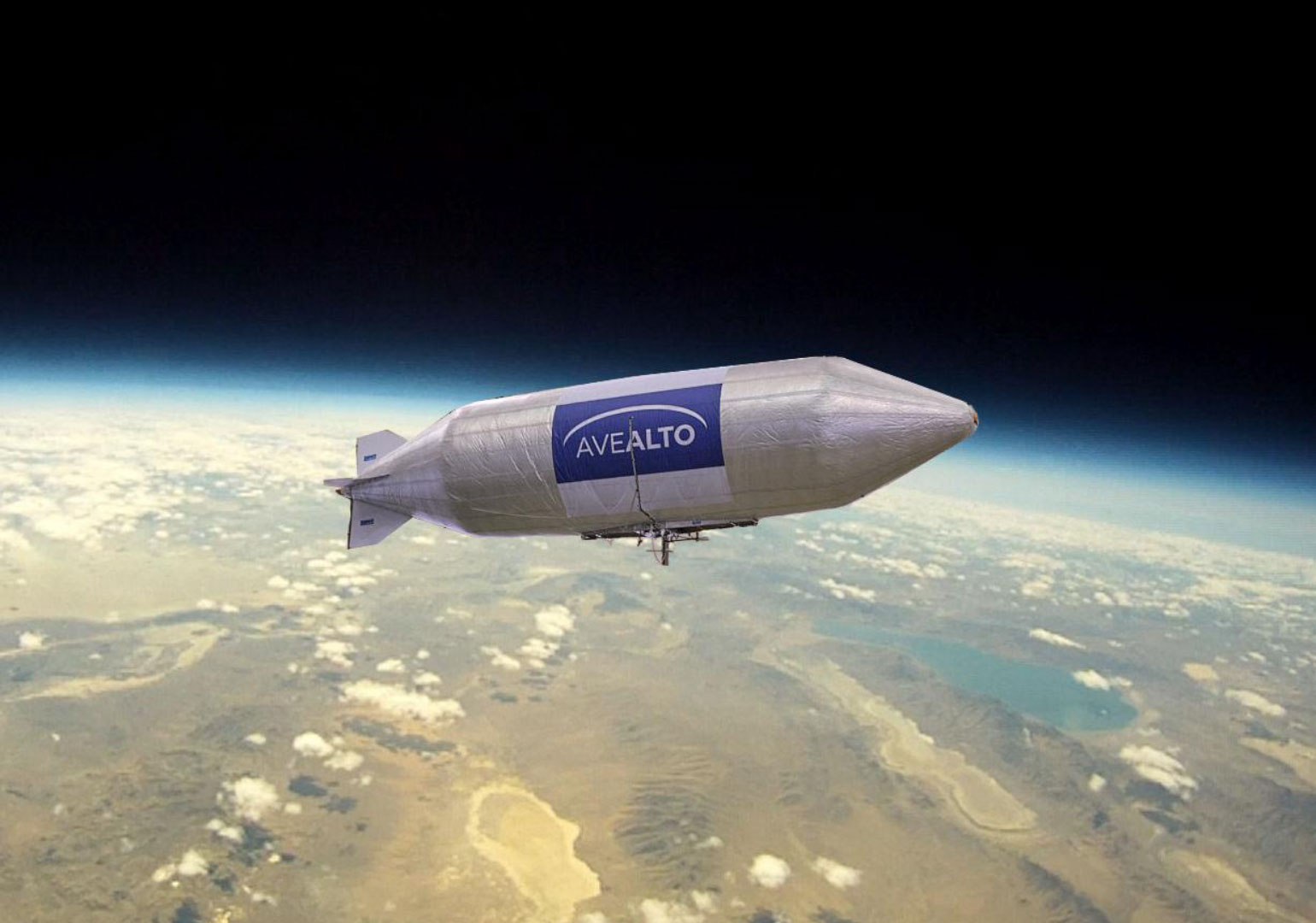
Photo courtesy of Avealto
In a remote village on one of Indonesia’s eastern islands, the internet is not a convenience; it is a distant abstraction. No fiber cables are running beneath the unpaved roads, no cell towers on the horizon, and no satellite dish affordable enough to change that.
A farmer trying to check market prices, a student attempting to access an online lesson, and a parent seeking a telehealth consultation each face the same wall. The infrastructure simply does not reach them.
They are among the approximately 2.9 billion people worldwide who remain unconnected to the internet today, with an estimated 96% of this number living in developing countries, where building conventional networks has long been deemed economically unviable.
Somewhere above that village, in the stratosphere at 20 kilometers—well above commercial air traffic, weather systems, and the reach of any cell tower—a London-based company named Avealto believes it has a transformative technology to finally change that.
A System Built for Everyone Else
The global telecommunications industry has significantly invested in infrastructure over the past three decades. Yet as of April 2026, approximately 37% of the world’s population remains offline. The gap is not narrowing fast enough. In low-income countries, internet penetration sits at just 23%, according to the International Telecommunication Union (ITU). In Africa, that figure is 36%, while in the least developed countries, only 34% of people have access.
The reasons are structural, not technological. Building terrestrial fiber across thousands of islands, dense jungle, or remote mountain ranges demands capital expenditure that operators cannot justify when the projected population density is too small.
Most of the people in the world without routine access to telecom and internet services live in regions served by telecommunications satellites. Satellites are too expensive for most users. Even newer low Earth orbit constellations remain prohibitively expensive.
The digital divide is not a failure of imagination. It is a failure of economics, and the incumbent industry has not produced a technology capable of solving it, until the coming of the high-altitude platform (HAP) company, Avealto.
Thirteen Years, One Vision, and a Stratospheric Bet
Avealto was founded in April 2013 in London by Walt Anderson, a serial telecommunications entrepreneur who has founded two prior unicorns in the telecom market segment and is the co-founder of the International Space University.
Avealto, from the Spanish “ave” meaning bird and “alto” meaning high, signals its ambitions from the outset.
The founding premise was straightforward. Recent advances in battery efficiency and solar cell technology, driven largely by the electric vehicle industry, have crossed a threshold, making a commercially viable high-altitude Wireless Infrastructure Platform finally achievable.
In June 2024, the World Economic Forum named HAPS as one of its Top 10 Emerging Technologies of 2024, noting that it can deliver connectivity, coverage, and performance enhancements that “neither satellites nor terrestrial towers can match,” particularly across mountainous terrain, archipelagos, and remote plains.
Anderson mentions, “In 2013, when we started our development, we believed that batteries would become much more efficient, and we now have the batteries that we need to create a commercially viable Wireless infrastructure Platform vehicle.
However, the development journey was neither short nor linear. Avealto’s early engineering work began with a feasibility collaboration with U.S. aerospace firm JP Aerospace, which produced prototype small airships that underwent multiple test flights in Nevada’s Black Rock Desert through 2018.
After concluding that phase, Avealto transitioned to an entirely in-house design program in the United Kingdom, using computer-aided design and extensive testing of actual flight hardware.
In late 2020, Avealto conducted subscale testing of a 15-meter prototype at the Brabazon hangar in Bristol, the same facility where Concorde was once assembled, highlighting the scale of the engineering ambition involved.
On June 28, 2021, Avealto began supervised flight testing under the formal oversight of the UK Civil Aviation Authority (CAA), validating the vehicle’s autonomous control and buoyancy management systems across multiple sequential test phases.
At the same time, Avealto partnered with UK-based satellite equipment specialist ETL Systems to design the Telecom Communications Systems Payload, which has now completed a critical design review. This onboard system will operate similarly to a telecom satellite, connecting with telecom operator customers on the ground.
Three patents filed in June 2022, covering the WIP communications platform, a novel antenna array design, and the vehicle’s proprietary control systems, have been granted.
Not a Satellite, Not a Tower; Something Altogether New
The Avealto Wireless Infrastructure Platform vehicle is a solar-powered, helium-filled stratospheric airship approximately 100 meters in length. It operates at an altitude of 20 kilometers. above the weather and air traffic, and far below the 35,786 kilometers of a geostationary satellite, for missions of three to six months at a time. From that altitude, each Wireless Infrastructure Platform vehicle provides a telecommunications footprint to a 240-kilometer (150 mile) diameter circle, covering 45,000 square kilometers.
Unlike telecom satellites, Wireless Infrastructure Platforms are designed to be fully recoverable at the end of each mission cycle, allowing for refurbishment, payload upgrades, and redeployment. The Platform can be deployed within two to three months of a commitment to service, compared to years for a satellite program.
What makes the Wireless Infrastructure Platform genuinely distinct is not only where it operates, but how it is built to operate within the existing industry. The Avealto telecom payload is designed to integrate seamlessly with existing terrestrial and satellite communications infrastructure, requiring no capital expenditure or new devices for telecom operators or their subscribers.
Avealto has a wholesale demand-driven business model and does not sell connectivity to end users. Anderson explains that it provides infrastructure capacity and backhaul services to mobile operators, wireless internet service providers, maritime communications operators, and IOT providers, who then deliver those services under their own brands. Avealto pricing will be 80% lower than telecom satellite, enabling telecom operators to compete effectively with satellite services.
“We are not competing with the regional telecom operators,” Anderson clarifies. “We give telecom operators a cost effective way for them to open new markets and serve people in areas they cannot currently reach”
In addition to a significantly lower cost, Wireless Infrastructure Platforms will provide a higher quality of service than telecom satellites, with lower latency, jitter availability, and lower bit error rate. Anderson states that in the regions Avealto chooses to serve, it will be the lowest-cost and highest-quality provider, which could be disruptive to the telecom satellite industry.
Ready for Takeoff for On the Ground Impact
Avealto has identified Malaysia as its first commercial deployment market, with other Southeast Asian countries offering even larger markets–Indonesia, with its 6,000 populated islands, and the Philippines, with 3,000 populated islands. Avealto also has customers waiting in India, Africa, the Middle East, South, Central & North America, and the Caribbean.
Anderson believes that once widely deployed, Avealto will be more than just an engineering achievement. For people in rural areas with no connectivity, it means access to better opportunities. Students can benefit from a wider range of educational resources, patients can reach a specialist without traveling for days, and small business owners can run their businesses with better insights and resources.
Anderson mentions, “No one should be left behind in the digital era. It is the very reason that Avealto exists. We are building the infrastructure to make this goal a reality.”
Avealto has already begun building its commercial pipeline. In March 2025, the company signed a memorandum of understanding with EDOTCO Malaysia, a subsidiary of AXIATA Berhad, one of Southeast Asia’s largest tower infrastructure companies, to explore high-altitude connectivity solutions through a proof-of-concept initiative. Discussions for U.S. market entry are also underway.
Today, Avealto is seeking $50 million in Series A investment to establish a manufacturing facility in the United Kingdom and produce its first three full-scale Wireless infrastructure Platform vehicles. This combination of a disruptive, cost-effective provider with unusually high margins has already attracted several early investors to the round.
After more than a decade of engineering, testing, and iterating in the stratosphere, Avealto is now ready to deploy what other telecom companies have been unable to. Now, the company is ready to prove that the sky is never the limit at all.