

Photo courtesy of Michele Bolognesi
Michele Bolognesi had already reached the kind of role that defines a banking career. At Goldman Sachs in London, he was working inside one of the firm’s most sought-after teams. Then he made a different wager: that the future of finance would belong to the people who could bring AI into real institutional work.
The Banker Who Bet on Machines
Bolognesi’s path into finance began at Bocconi University, where he graduated at the top of his class twice, including a merit-funded Master’s in Finance. His early career began at Deutsche Bank, after internships at Rothschild in Milan and Credit Suisse in Zurich. The trajectory was steep, deliberate, and elite.
At Goldman Sachs, he worked on some of the most consequential transactions in European telecom and infrastructure. His work included the fairness opinion for the divestment of Telecom Italia Sparkle in connection with the €22 billion KKR-led NetCo transaction, one of the largest leveraged buyouts in Europe of the last few years. These were decisions worth billions, made at board level, where precision was not optional.
Yet by 2025, Bolognesi had reached a conclusion that most of his peers had not. AI was not going to assist financial services. It was going to restructure it. And the people best placed to drive that change were the ones who had lived inside both the finance world and the machine — not one or the other.
“I recognized that driving meaningful innovation would be difficult within a large, established institution,” he said. “I wanted to help build that future from the ground up.”
So he joined Obin AI as Founding Chief of Staff. The company builds governed, context-aware AI agents for major financial institutions. His title is strategic, but the role is more elemental: he is the person who makes the gap between a Goldman Sachs deal room and an AI engineering team navigable.
Where Most AI Companies Stall
The financial services industry has a trust problem with AI. General-purpose tools, the kind that work brilliantly in demos, tend to collapse inside regulated institutions. Compliance requirements, audit trails, governance frameworks: these are not bureaucratic obstacles. They are the architecture of institutional trust, built over decades. Most AI vendors hit them and stop.
Bolognesi’s contribution at Obin AI was to build a strategy around this exact problem. Rather than selling a broad platform and hoping institutions would adapt, he packaged AI agents around specific, high-value deal workflows — covenant extraction, portfolio surveillance, underwriting — with compliance embedded from the start. The result was production deployments at tier-1 institutions while competitors were still running pilots.
One client, among the world’s largest private credit funds, had been processing hundreds of thousands of loan notices and amendments each year through a fragmented, manual workflow. Obin’s agents automated that process end-to-end, achieving 99%+ accuracy across the full document set. The mandate expanded. The agents moved downstream into accounting and reporting — core financial infrastructure, not peripheral automation.
“The gap between ‘AI can read a PDF’ and ‘AI runs inside a bank’s compliance framework’ is where most companies fail,” Bolognesi has explained. Obin crossed it. His strategy is a large part of why.
Teaching the Next Generation
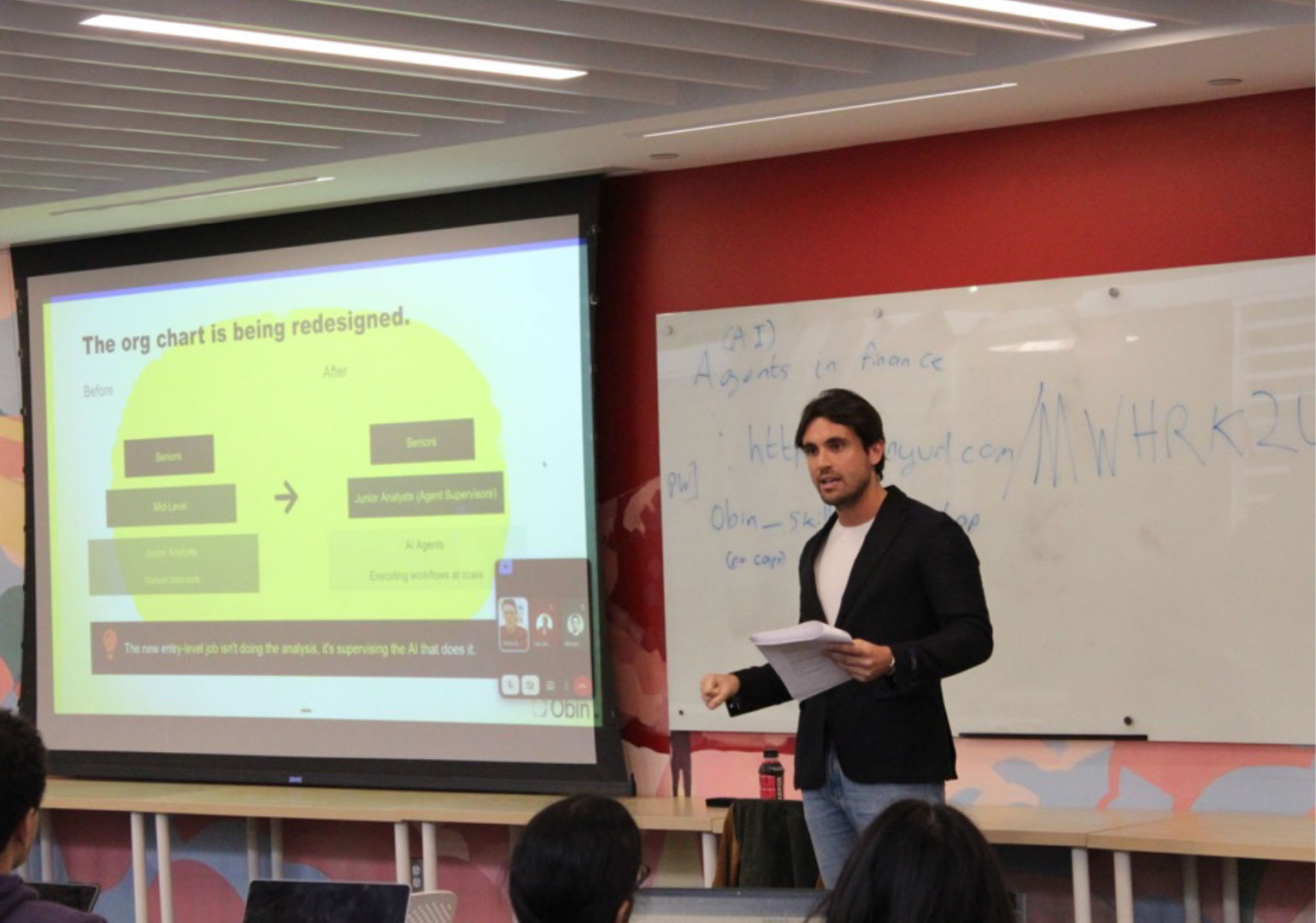
Bolognesi’s influence has extended beyond the institutions Obin serves. In March 2026, he was in Ithaca, presenting to over fifty Cornell students on AI in finance. He was not lecturing abstractly, but running live sessions where students built and operated AI agents on the Obin platform. Three weeks later, he was at Columbia Business School with another cohort of fifty-plus students, walking through how AI agents are restructuring the financial org chart.
The framework he brought to those rooms is one he developed himself: the Agent-Augmented Deal Team. Its core argument is that AI is changing the shape of financial teams. The old model — a pyramid, wide at the base with junior analysts and narrow at the top — is giving way to something closer to a diamond. AI agents absorb the high-volume execution work at the base. Human experts occupy a larger, more empowered middle layer. Strategic leadership remains at the apex, but with far more leverage than before.
This idea is not theoretical. PwC’s 2026 workforce research arrived at comparable conclusions independently. McKinsey has made similar observations about the emergence of agentic organizations. Bolognesi was presenting the practitioner’s version before either report landed.
He operates within a company whose leadership carries serious weight. Obin AI’s CEO, Apoorv Saxena, was previously the Global Head of AI at JPMorgan and a Managing Director at Silver Lake. The advisory board includes Dr. Fei-Fei Li of Stanford, one of the most widely recognized figures in AI research globally, and Lukasz Kaiser, a co-author of the foundational transformer architecture paper that underpins most modern AI systems. The $7 million seed round was led by Motive Partners, a specialist fintech investor.
Against that backdrop, Bolognesi’s role is to keep the company connected to the financial institutions it serves. To understand what a risk officer or a portfolio manager actually needs, and to build the strategy that gets the technology in front of them in a form they can trust.
The career arc — from Latin classes in an Italian school, to Bocconi, to Rothschild, to Deutsche Bank, to Goldman Sachs, to the operational core of an enterprise AI company trusted by institutions managing over a trillion dollars — is not a story about luck or timing. It is a story about reading the direction of an industry before most people in it had looked up from their screens.