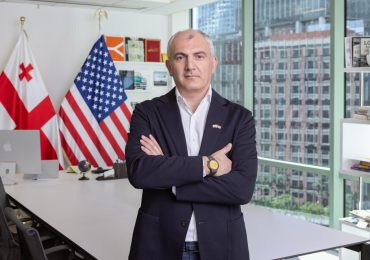

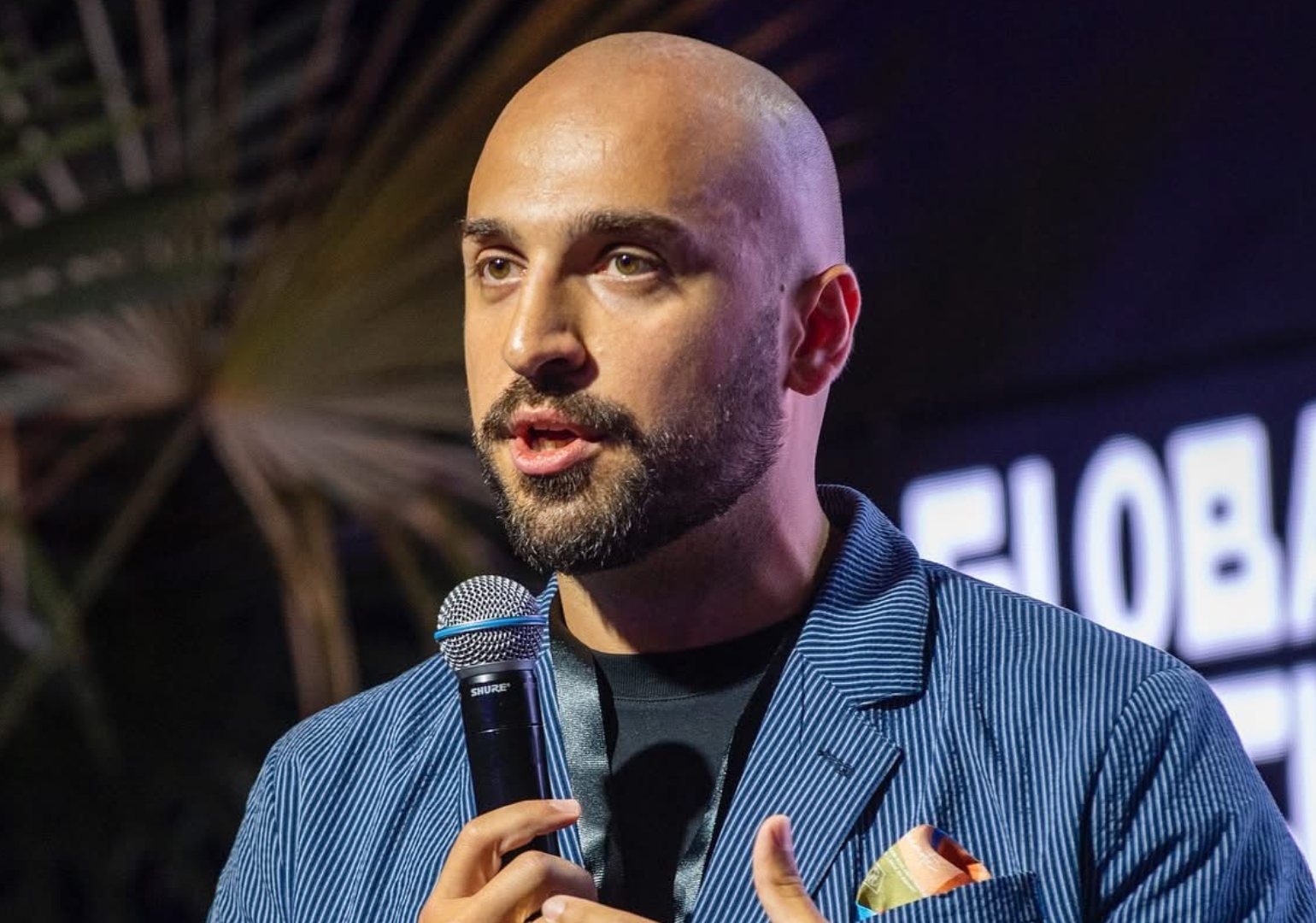
Starting from scratch in Berlin, Gegidze is today a holding company comprising around ten companies and serving more than 1,500 clients across 30 markets. 35-year-old Vako Gegidze plans to expand from exporting Georgian talent into financial services, where growth rules are set not just by him, but by regulators.
In November 2020, in the middle of the pandemic when all commercial establishments were closed, 28-year-old Vako Gegidze entered a Georgian restaurant in Berlin through the back door. The drapes were drawn in the dining area, and inside, German partners—representatives of an e-commerce agency—were waiting for him.
They already shared a business relationship. The German agency had previously asked Gegidze’s consulting firm to assemble a five-person team; he and his colleagues found the required personnel within a week. Satisfied with the result, the partners had an even more appealing proposal this time: to co-found a company that would help German businesses build remote teams.
“I wanted this venture to work out so badly that I didn’t even ask for details—I just shook hands,” Gegidze recalls.
Two months after the meeting, in January 2021, Team Up was founded. Initially, the company offered German businesses remote teams assembled in Georgia. According to Gegidze, they recouped their initial investment in three months. A year later, however, they had to scale the model: finding machine learning specialists in Georgia became difficult, but they discovered the necessary talent in neighboring Armenia. Later, Azerbaijan, Turkey, Kazakhstan, and Egypt were added.
In 2024, Gegidze and his Georgian partner, the current CEO of Team Up, Zurab Aitsuradze, bought out the company from their German partners. Today, Team Up is part of the Gegidze group—a decentralized holding that unites around ten companies. According to company data, the group serves over 1,500 clients in more than 30 markets, with the vast majority located outside of Georgia.
This growth is also supported by the expansion of Georgia’s technology sector. According to Galt & Taggart, in the first nine months of 2025, the country’s ICT (Information and Communication Technology) exports grew by 52.3% year-over-year, reaching $898 million. The export of IT services specifically amounted to ₾2.2 billion during the same period—69.3% higher than in the corresponding period of the previous year.
However, the report highlights another key circumstance: the main drivers of growth are international companies and specialists who have relocated to Georgia. While the sector is expanding rapidly, this does not automatically translate into success for local companies. They still have to earn the trust of international clients and compete against players with more capital, brand awareness, and experience. Gegidze’s story is one such Georgian attempt to establish a foothold in this market.
Early Career and the Path to Entrepreneurship
Gegidze started his first job at age 15. After school, from five in the afternoon until two in the morning, he worked selling pharmaceuticals to the U.S. market. The next morning, he would head back to school. He recalls this period as his first major sales lesson:
“When you cold call, almost everyone tells you no. That’s precisely when you become resistant to ‘no’.”
During his student years, he moved to Red Bull, where he spent five years and, as he puts it, saw for the first time from the inside how a high-profile international brand operates. In 2014, he joined Foodpanda’s Georgian team. This was his first direct contact with the tech industry, which later became one of the primary directions of his business activity.
The idea of starting his own business came to him while traveling. About ten years ago, while celebrating New Year’s in India, he wondered why he couldn’t have a business he could manage from anywhere. He first started freelancing, and later founded a digital marketing agency. The company grew quickly, but as it scaled, internal team synergy dissolved and sales fell. For Gegidze, this was a serious first lesson: more employees and more projects do not always mean a stronger business.
To find new clients, he went to Germany; around the same time, however, his paths diverged from his Georgian partners. The company remained in Tbilisi, and in 2019, Gegidze decided to start over in Berlin with his wife. He went all-in on his new venture and named the company after his surname—following the model of German family businesses named after their founders.
“To build trust and establish a mark of quality,” Gegidze says.
The initial period proved difficult. Accustomed to leveraging connections and making swift decisions in Georgia, he struggled in Berlin to get potential clients to agree to a meeting. Then he discovered that agreeing to meet didn’t mean a quick deal:
“Those who agreed to meet would tell me, ‘I really like what you’re doing, but let’s talk in three months.’ In Georgia, you’re used to doing things right away if people like it. One person told me, ‘Let me talk next year,’ another said, ‘In two years.’ In the end, things actually worked out with the person who suggested meeting in two years.”
Gegidze often says that Germany taught him long-term thinking. This experience is reflected in the structure of his holding today, though the group itself is not built around a single business model.
Holding Structure & Service Lines
Gegidze is divided into three main operational pillars:
Investment Arm: Encompasses real estate, venture investments, and B2B financing. According to the group, it primarily invests in technology and e-commerce companies—fields where the group has direct operational experience.
Digital Agency: Focuses on process automation and business transformation through artificial intelligence.
Consulting Block: Handles financial and legal advisory, tax services, human resources, and corporate administration.
Each direction operates on the principle of an independent business unit; Team Up is integrated into this system as well.
| Segment | Client Base & Coverage | Primary Markets |
| B2B / Tech / HR | ~500 corporate clients (mostly European SMEs) | German-speaking Europe (DACH), Baltics, UK, USA |
| Consulting | 1,000+ individual entrepreneurs, freelancers, SMEs | Regional & Global |
“Working with Gegidze has become an integral part of my business. I need hard-to-find specialists, and they found top-tier people for me. Everyone who joined our team has delivered,” says Graham Judd, Director of the British cybersecurity firm Mobius Binary.
Lessons in Diversification & Culture
According to company data, client retention across the holding reaches 95%. At the same time, Gegidze vividly remembers a period when a single client accounted for roughly 40% of their business. They felt that dependency particularly when the client began dictating the direction of their company’s development.
“That’s when we realized that when you are driven by a single client, you lose focus. I’ve seen far too many companies destroyed by that.”
Following that realization, they invested more resources into client acquisition and diversified their revenue streams. That original client remains with them today, but the relationship, Gegidze notes, is now “very comfortable.”
Another pillar of his sales strategy is introducing foreign clients to Georgia. Every year, they invite new partners to Tbilisi and take them to Kakheti. This is more than hospitality: pre-existing goodwill toward the country often smooths out first meetings and accelerates trust-building. Gegidze recalls clients whose initial path to the company started purely out of interest in Georgian wine and cuisine.
“Georgian work culture turned out to be a great fit. Hospitality translated into business is a wonderful synthesis,” he says.
Yet hospitality is only a door-opener. On international markets, relationships are sustained by execution—especially when you are a Georgian company that needs extra proof to earn credibility. In Gegidze’s view, his group’s core function is removing that barrier: creating access for specialists in Georgia, Armenia, and other regional markets to connect with global companies.
“There are a lot of people in Georgia who don’t have the opportunity to reach a global scale. If I have a choice, I prefer to give that opportunity to our country.”
Next Horizon: FinTech and Regulations
Now, his most ambitious plan reaches beyond HR and IT. Gegidze says the holding is developing a digital financial platform—which he refers to as a neobank—with a targeted launch by 2027.
In the interview, he did not specify the project’s licensing jurisdiction, banking status, or launch market, but he targets the EU, Latin America, Africa, and Asia.
The group also plans to expand its licensing consultancy services for internet gaming and Virtual Asset Service Providers (VASPs). These directions promise higher revenues, but they also bring far stricter compliance requirements—especially as financial regulations evolve rapidly across jurisdictions.
Gegidze himself cites unpredictable global politics and shifting regulations as his primary risks. The second major challenge is hiring the right people. Mindful of his past experiences, he avoids building an overly large team: growth once showed him how scale can damage a company’s internal connections.
The first deal struck in that closed Berlin restaurant required little more than a handshake. A financial business doesn’t work that way: here, growth relies not only on trust, but on licenses and capital, and the cost of error is significantly higher.
“My path is try and fail,” says Gegidze.
One such attempt gave birth to Team Up. Time will tell whether Gegidze can combine his resilience to failure with the strict discipline required by a regulated financial industry.