
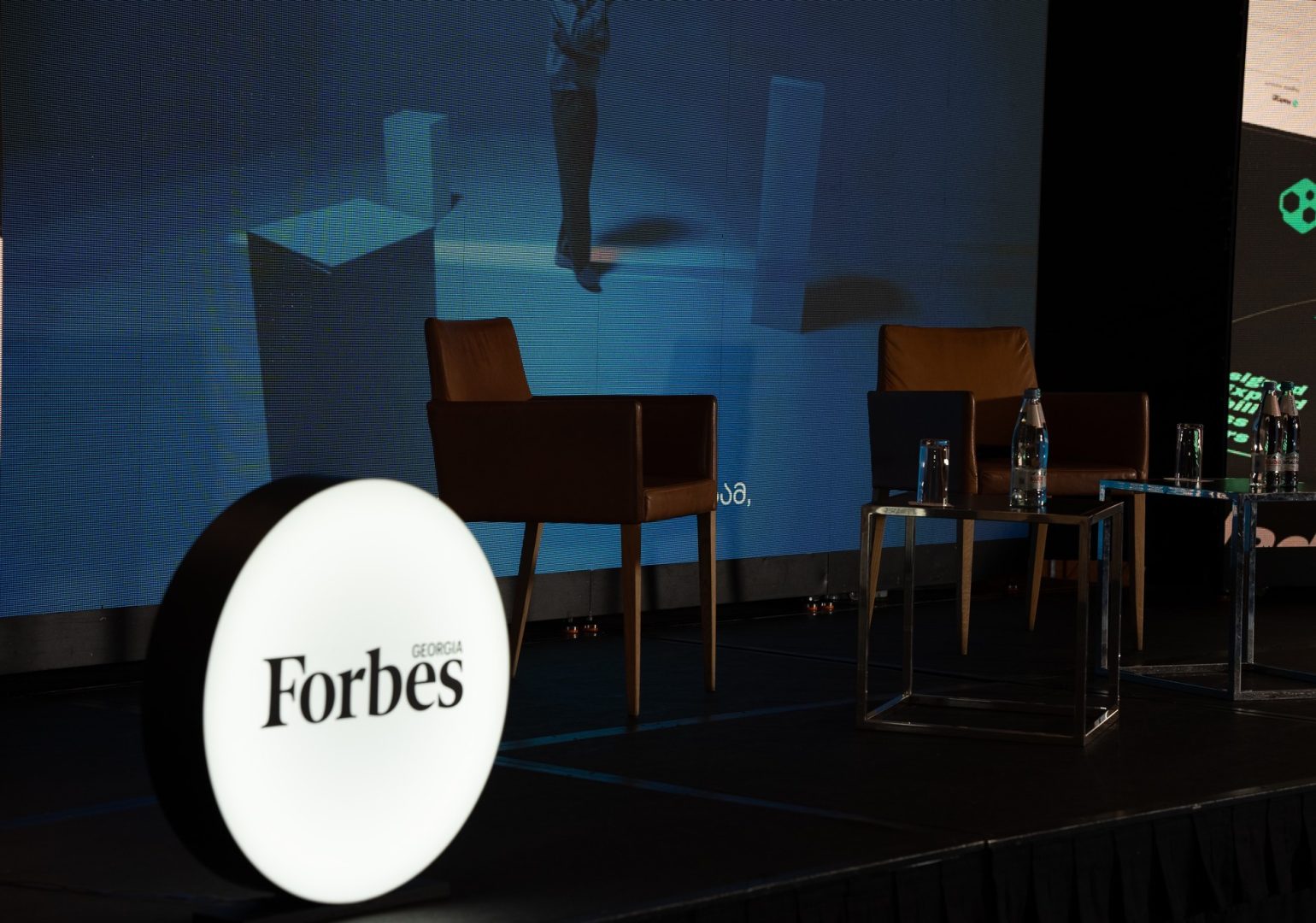
On April 24, Forbes Georgia and DGFI Conference hosted a joint Tokenization Forum at the Radisson Blu Iveria Hotel. This institutional-grade event brought together regulators, financial institutions, technology platform representatives, and capital market players under one roof.
From the outset, the forum distanced itself from “hype-driven” conferences. Each element of the program felt more like a working discussion than a standard presentation. The primary focus was not on hypothetical possibilities but on tangible results.
The event opened with a speech by Mikheil Didebulidze, representative of DGFI Conference, who emphasized that tokenization is no longer a future hypothesis; it is steadily transforming into a practical component of the financial ecosystem.
The first panel discussion, “Tokenization & Capital Markets: Bridging Regulation & Innovation,” featured representatives from the National Bank of Georgia, Silkbank, Clarsen, and international legal experts. The core message was that regulation is evolving from a barrier into a framework within which innovation must thrive. However, as the discussion revealed, challenges remain—particularly in scaling infrastructure, legal structuring, and synchronizing disparate systems. Participants noted that trust depends less on technology itself and more on robust governance frameworks.
Real-World Assets Tokenization in Practice: From Concept to Market Adoption
The second panel shifted the focus toward practical implementation: What does asset tokenization mean in the real world? How is demand created? What roles do stablecoins, distribution, and investor trust play? This session brought together key market players whose insights provided a roadmap for the industry’s evolution.
The discussion underscored that tokenization is not a “magic fix” for financial fundamentals. Rati Morchiladze (Foresight) brought a vital market perspective, noting that tokenization cannot fix a bad asset; the company itself must be “investable” first. From a broker’s lens, the quality of the issuer remains the foundation upon which everything else is built.
From an asset owner’s perspective, Nato Bochorishvili (Gumbati Holding) emphasized that liquidity remains the ultimate priority. For real estate players, the search for new capital channels is constant, and tokenization is being approached with deliberate scrutiny—understanding the mechanics and testing the model—as the first successful precedent will be a total gamechanger for the market.
Tamta Akhalkatsi (Tegeta) brought the issuer’s perspective into focus, stating that for companies already active in capital markets, tokenization only becomes relevant when it creates a superior product—improving access, diversification, and investor reach beyond existing traditional tools.
Addressing the structural side, Nikoloz Beradze (VS1) highlighted that tokenization is not just a technology problem, but a coordination problem. Scaling requires alignment between disconnected players. He noted that the role of VS1 is to connect these pieces to unlock liquidity that is already in high demand, waiting for the right structure to access it.
Finally, Mariam Goishvili (Solana Superteam) provided the infrastructure perspective, clarifying that technology is no longer the limitation. Today’s systems are fully capable of handling high transaction volumes and scalability, proving that there is no shortage of technological opportunity—only a need for implementation.
The panel concluded that while the potential for real estate and private asset tokenization is immense, success depends on the synergy between quality assets, legal coordination, and robust infrastructure.
Fireside Chat: Why Now?

One of the most content-rich segments of the event was a fireside chat with international speaker Faraj Abutalibov, representing the Stellar Development Foundation, moderated by Shota Dighmelashvili, Editor-in-Chief of Forbes Georgia.
The dialogue symbolically began with the question at the heart of the industry today: Why now?
For years, tokenization was often described as a “promise of the future”—innovative and hopeful, yet abstract. As the conversation revealed, the nature of the discussion has shifted significantly in the current stage, moving the focus squarely onto infrastructure and real-world assets (RWA).
The discussion highlighted several critical points:
What problem does tokenization solve? It is not merely a technological upgrade. Its primary value lies in improving access to capital, reducing costs, accelerating operations, and creating programmable financial instruments.
What are the real-use cases? While payments serve as a “gateway” for tokenization, the fastest-growing areas remain the tokenization of real-world assets, including real estate and private markets.
Where are the difficulties? As noted during the session, issuing a token is often the easiest step. The real complexity begins afterward: legal structuring, regulation, liquidity, investor access, and the creation of secondary markets.
Skepticism vs. Reality: A significant portion of the talk addressed factors the market rarely discusses. It became clear that parts of the narrative surrounding tokenization still require refinement, especially regarding rapid scaling and institutional adoption.
The Georgian Context
The discussion also focused on local perspectives. It was noted that for markets like Georgia, realistic opportunities may emerge in directions such as:
International payments
Attracting alternative capital
Real estate tokenization
Stablecoin-based infrastructure
Key Conclusions of the Forum
Participants agreed on several fundamental principles:
Regulation is no longer a barrier: Clear frameworks are already being established; the focus now shifts to execution and infrastructure.
The Trust Factor: Technology alone does not create trust. Trust stems from governance models and legal guarantees.
Future Outlook: Within three years, what sounds like the “early stage” today (e.g., tokenized deposits or assets) will become a standard part of the financial architecture.
The event concluded with high-level networking, where discussions regarding partnerships and future collaborations continued in an informal setting.
Strategic Partners and Industry Leaders
The success of the forum was significantly bolstered by the involvement of companies currently at various stages of developing the digital finance ecosystem. It is noteworthy that the forum’s partners were strategically selected companies that are either already involved in the tokenization process or are planning the adoption of innovative financial instruments in the near future.
Gumbati Holding (Strategic Partner): A development company with over 10 years of experience in the real estate sector. Gumbati Holding is focused on developing modern, innovative projects, including the integration of alternative financing and digital financial instruments.
Hadron by Tether: A tokenization platform that bridges real-world assets with the digital world. Through Hadron, assets such as real estate, gold, bonds, or stocks can be transformed into digital tokens on the blockchain. Utilizing such platforms presents significant prospects for Georgian businesses to attract foreign investment.
Solana Superteam Georgia: The official Solana hub in Georgia, focused on the incubation of startups built on Solana and raising awareness around Web3 in the region.
GAUS CRYPTO: A cryptocurrency exchange licensed by the National Bank of Georgia. The company provides secure crypto-asset trading services for both individuals and legal entities, providing the essential infrastructure for the functioning of a digital economy.
Such collaborations confirm that Georgia possesses the readiness and intellectual resources to become a regional leader in the transformation of digital capital markets. This is no longer a distant future — the process has already begun, and being at its center is a strategic priority for any business.