

By Ana Gelashvili
Mirian Katamadze, Giorgi Svanidze, and Petra Group are tackling the Georgian tourism economy’s most persistent challenge—seasonality—with a new formula: a $750 million planned investment uniting three destination resorts, multiple global brands, and unified management.
Shortly after Petra Group announced its partnership with MayaBay, a Monégasque citizen purchased a condominium unit in its Tsikhisdziri development—having never set foot in Georgia before.
“A single key piece of information was enough for him to make that decision,” says Mirian Katamadze, co-founder of Petra Group. “He bought the unit simply because he learned MayaBay was entering Georgia.”
At first glance, this is merely an anecdote about an individual buyer. Yet behind it lies a broader macroeconomic trend: the entry of a prominent international brand can profoundly alter the perception of a destination and establish immediate market trust.
The partnership with the Monaco-based hospitality and dining brand marks the latest milestone in Petra Group’s long-term strategy. The group’s portfolio already features high-profile international partners, including Accor flags Pullman and Swissôtel, global operator Valor Hospitality Partners, and now MayaBay.
Each partner serves a distinct strategic function: hospitality brands integrate global operational standards and brand equity; the third-party operator manages centralized rental pools and estate services; and dining and lifestyle concepts provide visitors with compelling reasons to extend their stay. Giorgi Svanidze and Mirian Katamadze’s strategy hinges on locking these interconnected components into a single, cohesive operating ecosystem.
Backed by a planned $750 million investment, Petra is establishing a new resort business model in Georgia—one that remains commercially viable long after residential sales close, attracts visitors year-round, and leverages international brand equity to elevate the location. The primary focus is pivoting from basic residential development toward managed, multifunctional destination resorts.
Historically, gross visitor volume served as the primary benchmark for growth in Georgia’s tourism sector. Today, however, the country faces a far more complex economic objective: increasing average visitor length of stay and expenditure, while ensuring that visits to Georgia are no longer driven purely by low prices or narrow seasonal peaks.
In the first half of 2026, total inbound visitor arrivals to Georgia contracted by 3.3% year-over-year. In the second quarter, international trips declined by 4.5% year-over-year, while leisure-oriented visits dropped by 2.7%. Average expenditure per trip also contracted over the same period.
Yet market fundamentals during the same timeframe revealed an entirely different dynamic: during the first quarter, occupancy rates at upscale branded hotels rose to 51%, with average daily rates (ADR) reaching $129. Furthermore, inbound visits from the European Union and the United Kingdom surged by 23.4% in the first half of 2026.
These contrasting data points signal a structural market transition. Broad, mass-market volume growth can no longer be taken for granted. Instead, demand is polarizing toward international-standard accommodations, premium service delivery, and comprehensive guest experiences. For Georgia, the primary economic upside lies in developing this upscale segment—reducing reliance on seasonal mass inflows and maximizing revenue yield per visitor.
This trend mirrors broader developments in global hospitality. The scope of a hotel brand has expanded far beyond operating a single physical structure; it now anchors branded residences, curated culinary spaces, wellness amenities, and lifestyle programming. According to Savills, the global pipeline of branded residential schemes expanded by 19% in 2025 alone. Developers are actively moving from mature prime hubs into high-growth emerging markets where comprehensive, international-grade resorts remain rare. Georgia falls squarely within this emerging category.
For Petra Group, this strategy is deployed on an institutional scale. The company’s two flagship developments address distinct seaside and alpine seasonality constraints: the Tsikhisdziri master plan aims to establish a coastal hub independent of Batumi’s narrow summer window, while Gudauri seeks to transition an alpine market dependent on a brief winter ski season into an upscale, four-season destination. The group also plans to expand its footprint with a wellness and thermal retreat in Borjomi.
Before embarking on these large-scale ventures, Petra’s principals built extensive commercial track records across diverse sectors.
Mirian Katamadze, 43, entered business early, managed commercial operations abroad, and launched his real estate development activities in Batumi in 2008.
A pivotal milestone in his career took place in Gudauri. In 2011, at the invitation of the Gudauri Development Fund, he visited the ski resort. At the time, “New Gudauri” was far from the prominent alpine cluster recognized today by thousands of domestic and foreign travelers.
Over subsequent years, Katamadze and his team drove residential and hospitality projects across Gudauri. Initially, market demand centered on accessible, entry-level apartments. The resort required a baseline volume of keys, foot traffic, and commercial activity to create sufficient local demand for broader infrastructure investments.
“If the lower tier is not yet in place, you cannot simply launch directly into the high-end luxury tier,” Katamadze notes. “Once that foundational segment is established, it unlocks the runway to move upmarket.”
The master plan for “New Gudauri” was designed by Canadian resort planning firm Ecosign. Today, Gudauri stands as the only mountain resort in Georgia developed under a master plan produced by a firm of this caliber. It was this Ecosign roadmap that guided the resort’s initial expansion under Katamadze’s previous enterprise, and which continues under Petra Group today.
The delivery volume across that period was substantial: between 2012 and 2017, Katamadze’s team delivered five apart-hotels totaling roughly 500 units and 35,000 square meters in Gudauri. A major share of inventory was pre-sold off-plan, drawing significant foreign private investment alongside local capital. The experience underscored that while real estate sales serve as a critical financing engine, brick-and-mortar development alone is insufficient for long-term viability.
“A resort’s success is never defined by real estate assets alone. The decisive drivers are lifestyle, operational service delivery, surrounding amenities, and the total experience delivered to guests and unit owners day in and day out,” Katamadze emphasizes.
That phase also exposed the structural limitations of conventional property development: density without integrated programming does not create a cohesive destination. For a residential cluster to mature into a self-sustaining resort, it demands centralized facility management, premier hospitality service, destination gastronomy, and diversified leisure infrastructure. Without these assets, even the largest developments risk devolving into disparate blocks of neighboring apartments.
Concurrently, 55-year-old Giorgi Svanidze was building enterprises across other sectors. As the founder of Svanidze Holding, his commercial interests spanned agribusiness, real estate development, and retail. His most prominent venture centered on developing Georgia’s commercial olive sector. He established his first olive plantation in 2009, eventually scaling landholdings to approximately 1,500 hectares. Achieving this required aggregating land assets, securing patient institutional capital, and integrating foreign agronomic expertise with international commercial networks.
The agribusiness venture also provided Svanidze with senior multilateral governance experience. In 2019, Georgia joined the International Olive Council (IOC), and the following year assumed its chairmanship, with Svanidze serving two terms as IOC President.
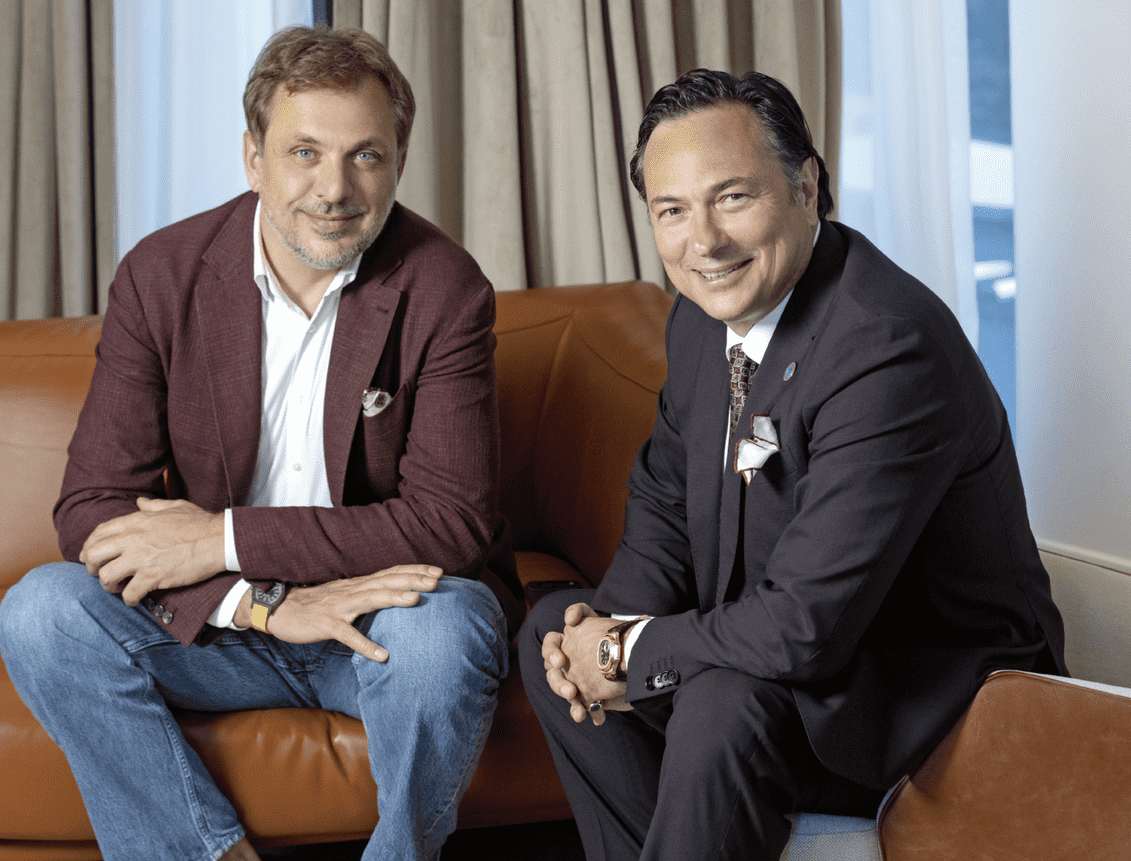
In the hospitality sector, Svanidze’s operational mandate is different, yet the fundamental commercial logic remains identical: turning local assets into competitive international products requires sustained equity, global technical know-how, and cross-border partnerships.
Within Petra Group, these competencies converge: Katamadze brings destination-building and construction execution, while Svanidze contributes capital structuring and institutional network engagement. Operating under the unified Petra Group brand since 2023, the firm’s pipeline includes Petra Sea Resort in Tsikhisdziri, Petra Ski Resort in Gudauri, and, in its next phase, Composers Resort Borjomi.
Petra’s execution model does not rely entirely on initial equity. Katamadze and Svanidze have aligned foreign institutional investors and global operators around a unified long-term master plan and single operational standard, securing hundreds of millions of dollars in foreign direct investment.
This operational model is most evident in Tsikhisdziri. Spanning roughly 27 hectares, the master-planned Petra Sea Resort will feature residential inventory, international brand-flagged hotels, a one-kilometer private beach, a marina yacht club, sports facilities, and dozens of dining establishments. With an announced total capital expenditure of $236 million, the site is under active construction: multiple structures are progressing concurrently, and two 29-story residential towers (Blocks B and C) are nearing structural completion, paving the way for interior fit-outs next year.
Under its phased master plan, the resort integrates both low- and high-density residential layouts, Pullman-branded residences, and dedicated coastal leisure infrastructure. This integrated scale sets Petra Sea Resort apart from traditional standalone hotels: the overall destination experience is driven by an amenity base that includes beach frontage, culinary concepts, recreational wellness hubs, and year-round programming.
For Petra, each international brand partner must anchor a designated functional component of the master plan: global hotel flags provide brand equity, service standards, and global distribution; Valor Hospitality Partners oversees resort-wide operational management and asset coordination; and lifestyle brands curate daily guest experiences to establish the resort’s social identity.
Valor Hospitality Partners occupies the core operational role within this synergy. Rather than contracting Valor for an isolated hotel asset, Petra engaged the firm to manage the entire Sea Resort destination. Valor’s operational remit covers up to 5,000 residential units, hotels, and all shared public amenities.
“Our decision to partner with Petra Group was driven by the ambition and scale of their vision: Petra is creating a genuinely distinctive asset for Georgia, integrating hospitality, residential living, leisure, and lifestyle into a unified destination,” says Julien Bergue, Co-founder and Managing Partner of Valor Hospitality Partners AMEA. Bergue notes that Georgia retains “significant runway for high-caliber, internationally managed resort destinations,” and that Petra Sea Resort is positioned to unlock that market opportunity.
Historically, resort real estate in Georgia has been fragmented among retail buy-to-let investors. Consequently, individual developments often end up owned by hundreds of private individuals—some living on-site, others managing informal rentals, and many awaiting capital gains. Without centralized operational governance, maintaining service consistency, executing managed rental pools, and delivering an integrated guest experience becomes nearly impossible. Petra’s model aims to consolidate individual units under an institutional resort management structure.
Under this framework, total unit pre-sales serve as only one operational metric for Petra. The long-term return profile of the asset will depend on rental-pool participation rates, sustained hotel occupancy, ancillary non-room guest spending on-site, and off-season guest retention.
A similar operational logic applies to Petra Ski Resort in Gudauri. The Swissôtel development will feature a 180-key hotel alongside 290 branded residences. In Gudauri, destination dining, wellness programming, and year-round amenities are designed to extend average stays, lift guest spend, and generate sustained visitor demand beyond the winter ski calendar.
“Every step we take serves a single strategic objective: to create a destination that travelers choose to visit across all twelve months of the year, rather than just during one seasonal window,” Katamadze emphasizes.
MayaBay is the newest brand addition to this system.
“Partnering with Petra Group was a natural choice for us, as they are one of Georgia’s preeminent development groups,” notes Richard Maria, CEO of Maya Collection. “We evaluate partners primarily on how closely their institutional values and long-term vision align with ours.”
MayaBay will debut in Tsikhisdziri in a Beach Club format, slated for a summer 2027 opening, while in Gudauri, its culinary concept will operate within the Swissôtel property. Together, the two venues will accommodate 200 to 220 guests and generate 80 to 100 jobs each. Service personnel will complete hospitality training programs in Georgia and Monaco to comply with brand standards. For the Georgian market, the entry of this operator introduces high-end international service protocols, managerial best practices, and professional operational skills.
“We had already established joint operational track records with Accor and Valor Hospitality Partners, backed by a master plan aligned with international benchmarks. It was this institutional foundation that provided Maya Collection with the certainty required to enter into a long-term partnership,” says Giorgi Svanidze.
Concurrently, Accor is expanding its footprint with Petra Group across Georgia.
“Pullman Residences Batumi and Swissôtel Hotel & Residences Gudauri reflect our shared ambition to deliver exceptional branded living concepts across two distinct, high-potential destinations,” says Daniel von Barloewen, Senior Vice President at Accor One Living.
The group’s next strategic step will be Composers Resort Borjomi. Petra plans to restore the historic Composers’ Retreat, developing a new luxury hotel, wellness facilities, and dining venues across the estate. This addition will balance the group’s portfolio across three primary tourism verticals: coastal, alpine ski, and medical/wellness tourism.
“I am confident this project will represent another major development milestone, not only for Petra Group, but for the maturation of Georgia’s hospitality sector as a whole,” Svanidze notes.
Petra’s objective is for these master-planned developments to serve as institutional case studies for the domestic market—encouraging global institutional capital to look beyond standalone hotel assets and finance fully integrated destination resorts.
Master-planned collaborations of this scale remain rare in Georgia. While international hotel chains maintain a substantial domestic footprint, placing an entire destination resort under a centralized third-party operator—while harmonizing multiple branded residential products and independent lifestyle concepts—sets a clear precedent. This structured approach makes Petra’s framework a key model for the broader sector.
Meanwhile, competition in the Black Sea residential real estate corridor continues to mount. According to Galt & Taggart, unsold housing inventory in Batumi reached approximately 12,400 units by year-end 2025—up nearly 14% year-over-year—accompanied by yield compression in average rental income. Conversely, residential schemes completed in 2025 recorded a 95% absorption rate, demonstrating that underlying buyer demand for completed, institutional-grade product remains resilient. This dynamic defines Petra’s immediate market challenge: in an environment where nominal supply outpaces absorption, sustainable margins belong to developments offering tangible build quality, centralized management, and supporting amenities that justify pricing.
The next three years will provide the first clear operational benchmarks. The MayaBay Beach Club in Tsikhisdziri is scheduled to launch in 2027, followed by subsequent phases of the Sea Resort and the Swissôtel complex in Gudauri. While each property debut will mark a major industry milestone, physical completion represents only the initial phase.
Mirian Katamadze and Giorgi Svanidze have achieved a notable milestone by assembling international hotel flags, global operators, foreign direct investment, and premier hospitality concepts onto a single operating platform. However, commercial success will depend on operational execution: ensuring these varied business components function smoothly together daily and compound asset value over the long term.
While the MayaBay brand was enough to secure an off-plan sale from an international buyer in Monaco, the founders’ broader vision is far more comprehensive: Petra Group’s developments must establish independent brand equity—ensuring that alongside their international partners, Tsikhisdziri, Gudauri, Borjomi, and Georgia as a whole emerge as compelling global travel destinations.
To achieve that, Giorgi Svanidze and Mirian Katamadze are working to introduce a new operational standard for Georgian tourism: the endless season.

Forbes Georgia: სარედაქციო გუნდი