
Georgia’s largest OTC desk has turned large crypto-to-fiat transfers into a routine banking operation, with rates that improve as the ticket grows.
A crypto country with good banks
Georgia is one of the most crypto-active countries in the world. Chainalysis ranks it third for adoption relative to population, behind only Ukraine and Moldova. Regulation has kept pace with demand. In 2023 the National Bank of Georgia brought virtual asset service providers under licensing supervision, pulling the industry out of the grey zone. Global players have followed: Tether announced GEL₮, a lari-pegged stablecoin, and Bybit chose Georgia to launch its payment card.
What drives the adoption is not weak banking, as in many emerging markets. The World Bank puts account ownership at 79 percent of adults, the two largest banks trade on the London Stock Exchange, and mobile apps are the default way people pay. Crypto is used for something bigger here: optimizing large flows. Stablecoin savings, incoming funds of relocated professionals, capital for property and business. It works alongside the banks, not instead of them.
Georgia’s biggest OTC desk
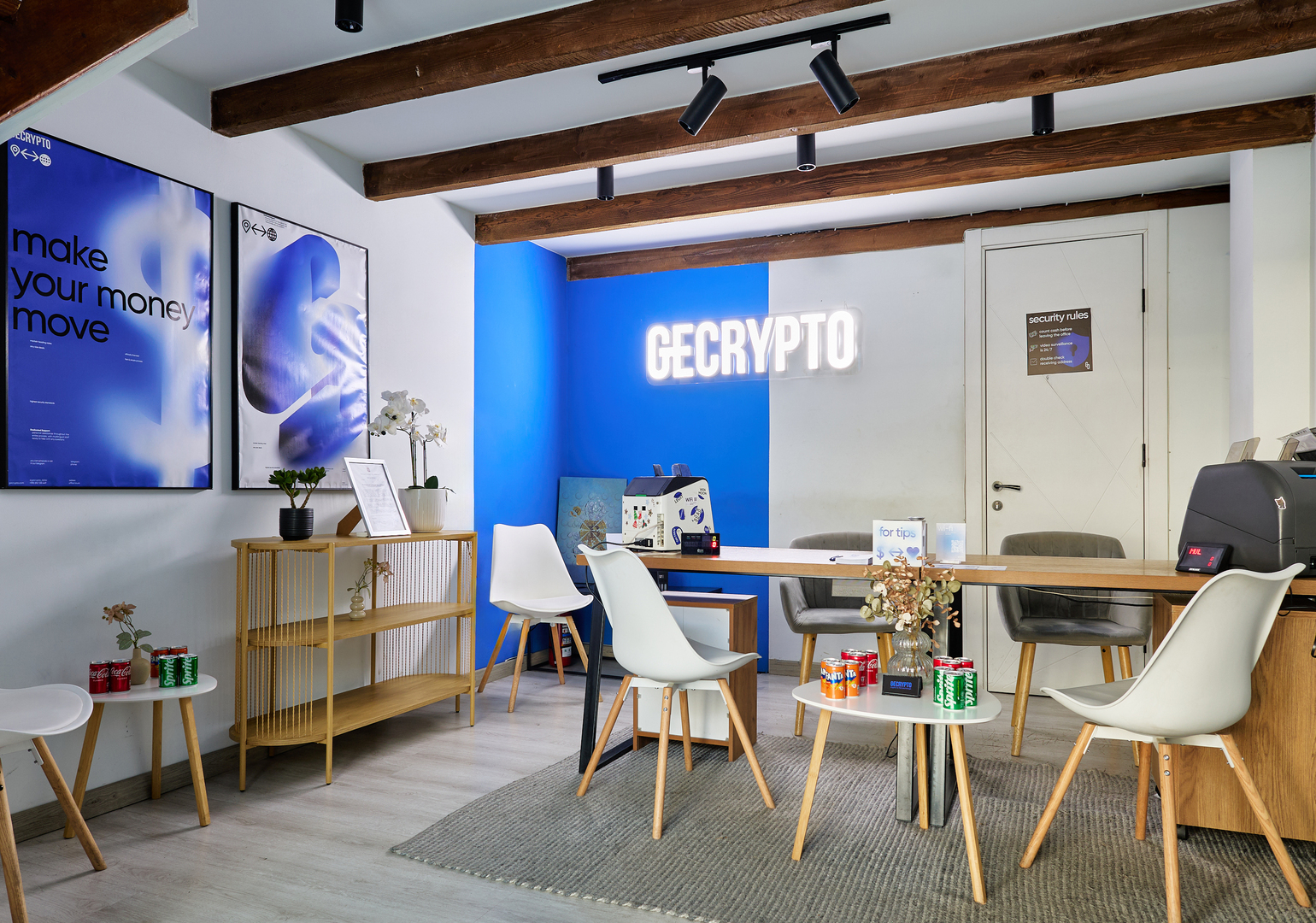
GeCrypto is the largest OTC desk in the country. It started in Tbilisi in 2022 and entered the National Bank’s VASP register in October 2024, one of the first companies licensed. Today it serves more than 10,000 active clients and is the go-to solution for buying and selling crypto in Georgia.
The desk covers all major cryptocurrencies, from USDT and Bitcoin to Ethereum, Solana and dozens of altcoins. Clients choose how the money arrives: as a transfer to a local Georgian bank account, as an international transfer (SWIFT/SEPA/ACH/…), or as cash at the Tbilisi office, paid out within minutes.
Under the hood it is not a simple cash desk but a full-scale fintech. Fiat moves over direct integrations with all major banks. Quotes draw on liquidity deep enough to price a transfer of any size. Compliance is designed as a product for the client rather than a checkbox for the regulator: documentation is prepared for every exchange, so the funds stay fully usable afterwards, wherever they go next. And the stack keeps growing, with new products in development that push the company toward a full financial platform.
Built for size
Most crypto platforms punish size. On a typical exchange, a large market order eats through the order book, so the effective rate worsens as the amount grows. Withdrawal limits, manual reviews and frozen transfers add days. GeCrypto inverted the model. The desk maintains deep liquidity through lines with major market makers and exchanges, so six and seven figure transfers execute at a single locked rate. At large size the rate improves rather than degrades, because big tickets are the desk’s specialty, not an exception it has to absorb.
The second half of the problem is banking. GeCrypto is integrated with all major Georgian banks, including Bank of Georgia and TBC, and converted funds land in a local account almost instantly. For cross-border movement it settles in dollars and euros over SWIFT, SEPA and ACH. A client converting 1.5 million dollars of USDT can have euros in an EU account within one business day, at a rate locked before the transfer began. Every transfer ships with a full documentation package: source of funds, transaction records, and the paperwork a bank, notary or tax adviser will later ask for. That is what makes the money usable after it arrives, whether it lands in Tbilisi or in Frankfurt.
“Size should be an advantage, not a problem,” says Yaroslav Bulatov, Head of Product at GeCrypto. “On most platforms a seven-figure order moves the price against you. Our clients get the opposite. The bigger the ticket, the better the rate, and the documents are ready before the money lands.”
The property pipeline
Nowhere is the model more visible than in real estate. Apartment sales in Tbilisi and Batumi passed 4.3 billion dollars in 2025 across more than 59,000 transactions, according to Colliers, and foreign buyers are a large and growing share of demand. New Tbilisi projects average around 1,500 dollars per square meter, a fraction of prices in most European capitals, with rental yields of 8 to 12 percent.
Many of those buyers hold their capital in crypto. Georgian rules do not allow paying for property in crypto directly. The compliant route runs through a licensed intermediary. The buyer converts through a VASP, receives fiat into an account in their own name, and pays the seller by ordinary bank transfer. GeCrypto has turned this route into a packaged service. A buyer with, say, 700,000 dollars in USDT completes verification, locks a rate, and receives the converted amount in their Georgian account the same day, with source-of-funds documentation the bank and the notary accept. From there the purchase proceeds like any other.
Beyond individuals
The same rails serve companies. GeCrypto’s business desk handles conversions for clients ranging from retail sellers that accept crypto payments to financial institutions that need OTC execution and treasury operations, each with a dedicated account manager. Payouts run in dollars, euros and lari. Next on the roadmap are payment cards, business accounts and named IBANs, which would push the company further into territory usually held by banks.
A model worth watching
Georgia shows what happens when grassroots adoption, clear regulation and strong banking meet in one small market. Few countries combine all three, and the combination is starting to attract companies, capital and infrastructure that used to route elsewhere. GeCrypto is the clearest expression of that mix: a licensed fintech that makes moving between crypto and the banking system a normal operation at any size. Georgia wrote clear rules. GeCrypto built the machine that runs on them.