
Photo courtesy of: eXoZymes
In March 2026, eXoZymes and Cayman Chemical scaled an NCT production process from one liter to 100 liters, producing more than 500 grams of N-trans-caffeoyltyramine at 99.6% purity. Cayman Chemical operated the reaction, downstream processing, and analytical work independently using eXoZymes’ technology-transfer package.
The milestone stands out for its timing. The NCT program moved from pathway design to a 100-liter pilot campaign in less than a year. Proof of concept took six weeks, and NCTx, the subsidiary established around the compound, was formed in 12 weeks.
The Scale-Up Problem
The relevant comparison is not with an unrelated industrial process, but with the challenges of biomanufacturing itself. In cell-based synthetic biology and precision fermentation, scientists engineer living organisms, such as yeast or E. coli, to make a target compound. Promising laboratory results can still take years to translate into robust commercial processes.
Process development commonly takes five to 10 years and can cost significantly more than scaling an equivalent chemical process. Scale-up remains a central challenge because performance often deteriorates as production moves from laboratory volumes to commercial reactors.
A living cell is both the production system and a biological organism with its own needs. Changes intended to improve output can affect growth, metabolism, stress tolerance, and product quality. As volumes, cell densities, and substrate loads increase, process conditions can introduce constraints that are difficult to reproduce or predict at bench scale.
Why Cell-Free Differs
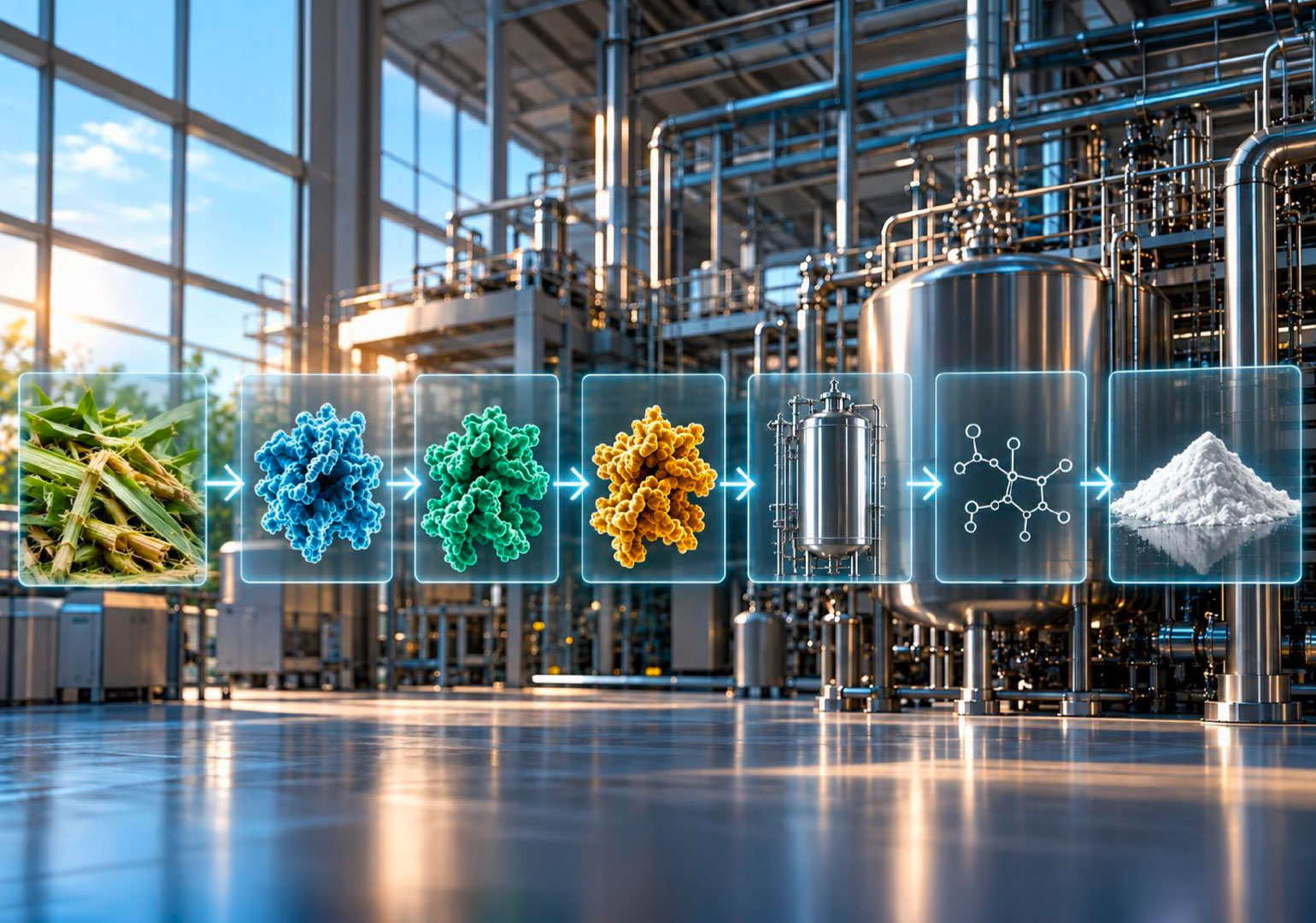
eXoZymes uses a cell-free approach. Instead of engineering a living microbe to produce a compound as part of its metabolism, the company uses enzymes outside the cell to carry out the desired reaction.
That design removes the need to manage a living production organism during the reaction itself. Developers can focus on enzyme activity, reaction conditions, pathway design, and downstream recovery. It does not remove technical risk. Cell-free systems still face challenges involving enzyme and cofactor costs, stability, downstream processing, reactor design, and commercial-scale economics.
The potential advantage is narrower but meaningful. By separating the target chemistry from the competing requirements of cell growth and metabolism, a cell-free system may reduce some of the biological uncertainty that makes cell-based scale-up difficult. Whether that advantage persists at commercial volumes remains unresolved.
What the Pilot Shows
Cayman Chemical’s 100-liter NCT pilot tested eXoZymes’ process transfer outside the company’s own operation. Cayman ran the reaction, downstream processing, and analytical work independently. Despite pH variation and precipitation during the run, the process produced more than 500 grams of NCT at 99.6% purity.
But the process did not stop there. Building on lessons from the pilot, eXoZymes subsequently increased NCT output per liter by approximately 67% while cutting reaction time by more than 80%—together producing a tenfold increase in manufacturing productivity. The company’s internal process-cost assessments also put the estimated manufacturing-cost equivalent at more than 100 times lower than its earliest NCT process. (exozymes.com)
That still does not make the 100-liter run commercial-scale manufacturing. But it changes what the pilot represents. Cayman demonstrated that the process could be transferred to an independent operator and still produce high-purity NCT under pilot conditions; the subsequent optimization showed that the same process could then be made substantially faster and more productive. Together, those steps move the question from whether the process can leave eXoZymes’ laboratory to whether those gains can now translate into a commercial manufacturing environment.
The Next Test
eXoZymes’ 100-liter NCT pilot points to a different path through one of biomanufacturing’s most persistent problems: the slow, unpredictable transition from laboratory promise to scalable production. By taking the living cell out of the reactor, the company has created a process designed to reduce the biological variables that can derail conventional scale-up.
Now comes the next test. eXoZymes has selected Curia as its commercial-scale manufacturing partner and will transfer the complete NCT process – from enzyme production through the cell-free reaction to purification – to Curia facilities in León, Spain, and Rozzano, Italy. The program is expected to progress during the fourth quarter of 2026 and establish a technical roadmap for larger-scale production in 2027.
That moves NCT beyond a successful pilot and into a commercial manufacturing environment. If the process translates successfully again, it would provide a more consequential demonstration of eXoZymes’ underlying proposition: that cell-free manufacturing can move from concept to pilot to commercial scale with greater engineering control – and potentially provide a repeatable path for molecules beyond NCT.