

Image courtesy of IVY Club by Zysphere
For years, the premium end of college admissions consulting sold refinement: tighter essays, more strategic activity lists, and cleaner personal branding. That model is now under pressure as generative AI makes much of the presentation layer faster, cheaper, and easier to replicate.
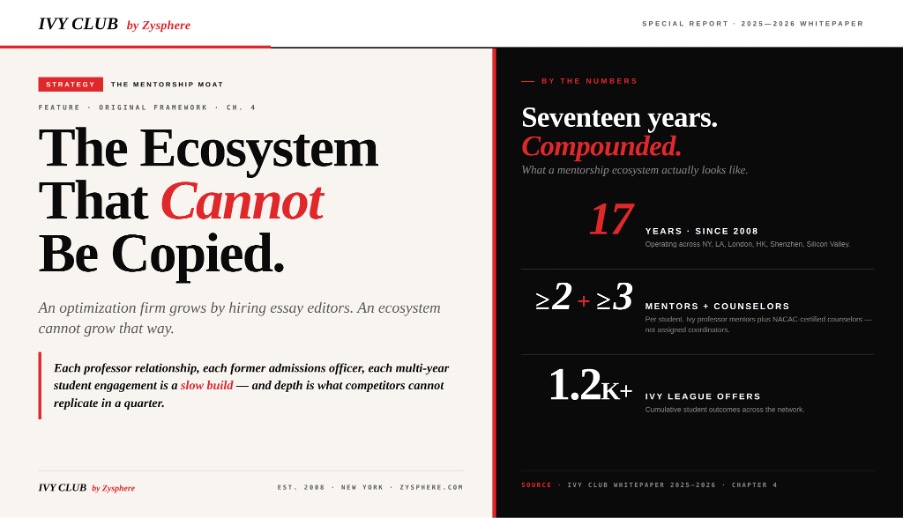
One company making that case is IVY Club by Zysphere, a New York-founded admissions mentorship organization established in 2008. The firm says its model centers less on polishing applications in the final stretch and more on helping students build academic direction over several years through mentor relationships, research exposure, and industry access. It holds organizational membership with the National Association for College Admission Counseling and is accredited by the Better Business Bureau.
The business logic is straightforward. If essay editing and résumé shaping become increasingly commoditized, the differentiator moves beneath the application itself. A polished personal statement can be produced quickly; a sustained record of research, subject-matter exploration, and mentor-led work cannot. For a student interested in molecular biology, for example, the stronger signal may come not from describing scientific ambition well, but from developing that interest over time with someone already active in the field.
IVY Club by Zysphere says it has built its business around that premise. The company reports a network that includes more than 200 Ivy League professor mentors, 210 former admissions officers, and 80 certified admissions consultants. Its argument is that long-term mentorship creates a deeper admissions narrative than short-cycle application packaging, particularly in an environment where AI has raised the baseline quality of essays and other written materials.
That is also what may make this category harder to replicate. Traditional optimization-focused firms can expand by adding editors and consultants during application season. A mentorship-led model depends on long-horizon relationships between students and domain-specific advisers, often built over several years. In that framework, scale comes less from faster delivery and more from the depth and durability of the network itself.
The broader question for the admissions industry is whether families will continue paying premium fees for packaging once high-quality polish becomes widely accessible through AI tools. If that value continues to erode, firms may need to compete on what they can help students do, not just how well they can help students present it.
That does not settle the debate. The case for long-term mentorship is timely and commercially significant, but it still requires independent validation from admissions professionals, education analysts, and families navigating the market. Until that perspective is added, the shift from optimization to ecosystem-based advising remains a credible industry thesis rather than a definitive conclusion.