

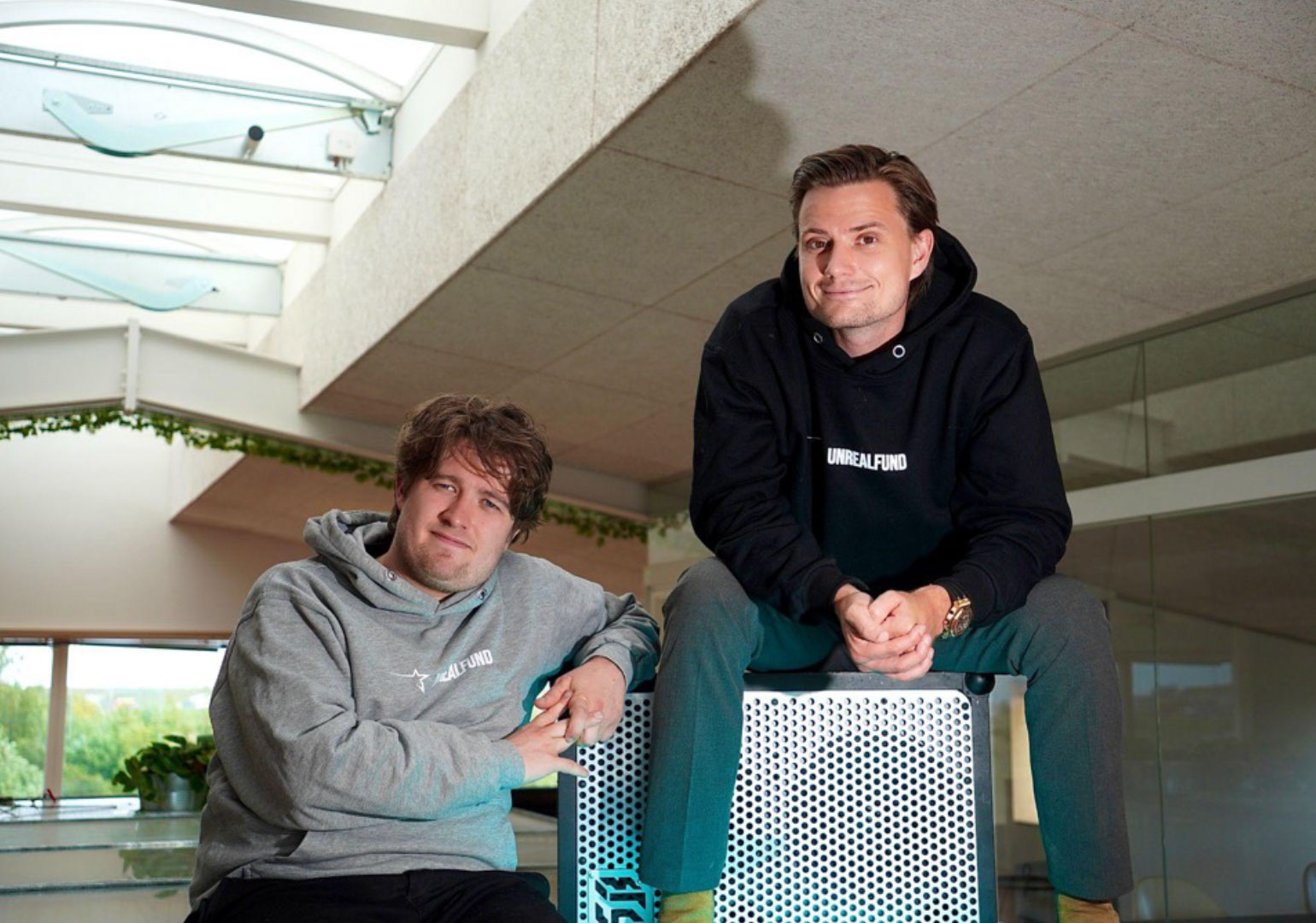
Photo Courtesy by Mads Olesen
For most of the past two decades, the logic of technology investing rested on a single assumption: software was hard to build, so companies that built it well deserved a premium. That assumption is now under pressure, and a Copenhagen-based firm called Unrealfund is building an operating model around what comes next.
Unrealfund, co-founded by Mads Andreas Olesen – a forbes 30 under 30 honoree and Christian Madsen, with Julius Gustafson serving as COO, describes itself as a distribution-first investment and operating company. Its thesis is not complicated, but it is deliberately contrarian. As artificial intelligence reduces the cost and time required to create software products, the firm argues that technology itself is a weaker long-term competitive asset than it once was. What remains durable, in its view, is something older and harder to copy: the ability to consistently reach customers.
The firm is stepping into public view after completing two acquisitions — Allcode, subsequently rebranded as Able and incorporated into its portfolio, and Postbuddy, a Copenhagen-based direct-mail automation platform. Both deals were completed, according to the company, while Unrealfund operated without a public profile.
A Different Calculation on Price
The investment case Unrealfund makes is rooted in valuation discipline rather than technology prediction. Rather than paying high multiples for companies whose future competitive position depends on assumptions about which technology will win, the firm targets what it describes as the growth segment: businesses where, in its assessment, execution creates more value than speculation.
“In a world where technology is changing faster than ever, long-term certainty is becoming increasingly rare. Paying 10x EBITDA to acquire a company based on assumptions about the distant future is becoming harder to justify. We believe the greatest opportunity is in the growth segment, where businesses often trade at 3–4x EBITDA, valuations are better aligned with uncertain markets, and operators can create value through execution rather than speculation.” — Mads Andreas Olesen, co-founder, Unrealfund
This framing puts Unrealfund in a different position from most technology-focused investment firms. It is not betting on which product category will dominate. It is betting on the durability of distribution as a competitive advantage, and on its ability to operate companies well once it owns them.
The firm focuses on cash-flowing small and mid-sized businesses, typically valued between $1 million and $5 million — companies it describes as too calm for venture capital and too small for private equity. Early-stage venture funds need exponential growth trajectories; large buyout funds need deal sizes that justify their overhead. Businesses sitting between those two poles often lack a natural institutional home.
Two Acquisitions as Proof
Able and Postbuddy are Unrealfund’s earliest public evidence that its thesis is executable rather than theoretical. Maksim Polupanov, founder of Allcode before its rebrand, framed the transaction in terms of continuity: “We have built a company with an important vision: to prepare more workers for the future demands of technological skills. We now want to give that vision a new home so that Allcode can continue to make a difference — both in current markets and on a European scale.”
Postbuddy’s former owner, Christian Vestergaard, pointed to a different quality.
“What stood out to me was the long-term perspective,” he said. “Unrealfund is not focused on short-term financial engineering but on building stronger businesses over time. That creates a solid foundation for employees, customers, and future growth.”
Both responses point to the same signal Unrealfund is trying to send: that it is an operator with a long time horizon, not a financial buyer angling for a quick return.
Building the Pipeline
There is a structural reason why private equity has not historically dug into this smaller growth segment, even when the valuations look compelling: dealflow. Deploying capital at scale into businesses priced at 3–4x EBITDA requires a consistent, high-volume pipeline of quality targets — and that kind of pipeline does not emerge from conventional sourcing. It has to be built. For Unrealfund, the answer is an accelerator: a programme that places the firm in direct relationship with founders long before any acquisition conversation begins, systematically generating the dealflow that makes the strategy viable at scale.
Beyond individual acquisitions, the firm is constructing a two-tier deal-flow architecture. An accelerator programme works directly with founders before investment conversations begin. Alongside it, a programme of small initial investments — referred to internally as microstakes — gives the firm early exposure to founder teams and business models across industries. The firm’s stated goal is 100 such investments completed before 2030. The underlying logic is that the best acquisition opportunities come from relationships built long before any deal is on the table.
Christian Madsen, co-founder of Unrealfund, described the long-term ambition plainly: “We’re building for a future where adaptability matters more than size. AI is lowering the barriers to building products. Our focus is helping great businesses reach customers, scale faster, and ultimately become category leaders.”
The firm’s aim is not simply to hold a portfolio but to build something where distribution capability, operational knowledge, and ownership reinforce each other across its holdings — a bet that the ability to reach customers will prove more enduring than the ability to build products in an era when building products keeps getting easier.