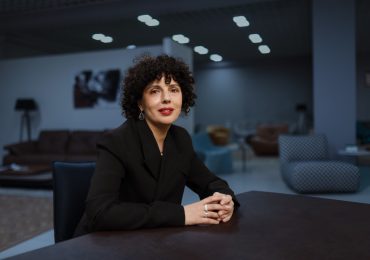


Leadership is no longer simply about being at the top of a hierarchy. A leader is the backbone of a team – someone who turns potential into tangible business results. For the past decade, Mariam Dulskienė, Managing Director of DEVELOR Georgia and Lithuania, has approached leadership and team development through this lens – and the market has responded positively. Under her leadership, DEVELOR Georgia has supported nearly 100 companies in strengthening their corporate cultures and improving business performance.
Author: Iza Gvaramadze
Mariam, what path led you to DEVELOR Georgia, and what motivated you to build your career with the company?
For nearly ten years, my professional journey has been closely connected with the development of individuals and teams. Throughout this time, my greatest motivation has always been supporting people – particularly leaders and managers – in realizing their full potential and creating workplaces where employees feel safe, valued and empowered.
When I joined DEVELOR, I quickly realized that it was much more than a training company. It is an international professional network focused on behavioral change – not simply on transferring knowledge, but on creating a measurable impact on organizational performance.
One of DEVELOR’s core strengths is its practical approach. Training is never treated as a one-off activity; it is part of a broader development process that should ultimately be reflected both in leaders’ behavior and in business results.
DEVELOR Georgia entered the local market in 2017. What challenges did the company face in its early years, and what results have you achieved since then?
When DEVELOR Georgia began operating, one of the main challenges was the stage of development of the market itself. At the time, corporate learning was often perceived as a one-off training activity rather than a long-term investment in organizational development.
Today, the market has changed significantly. More and more organizations recognize that the professional and personal development of their people is one of the key factors determining competitive advantage.
Over the years, we have worked with the teams of nearly 100 companies in Georgia, designed leadership and professional development programs, and actively leveraged the international expertise available through DEVELOR’s global network.
What specifically does DEVELOR Georgia offer its potential business partners?
At DEVELOR Georgia, our focus is on helping organizations achieve business results, create behavioral change and generate tangible value. To achieve this, we offer leadership, communication and teamwork development programs, sales effectiveness training, as well as assessment and consulting services.
One of our key advantages is our international experience. DEVELOR operates in 18 countries and brings more than 30 years of expertise to the market. This allows us to offer Georgian companies programs built to European standards while adapting them to the realities and specific needs of the local market.
Another important differentiator is our strong focus on practical application. Our trainers are professionals with hands-on business experience, and our programs are built around real business cases and challenges.
Many people are still skeptical about training because its impact can be difficult to measure. How do you assess the business impact of your programs?
For us, it is important that training does not remain a one-off experience. That is why, from the very beginning of the program design process, we connect development objectives with specific business goals and use various assessment tools – including pre- and post-program evaluations, feedback from participants and managers, and business indicators such as sales performance or employee engagement.
This allows us to see how development translates into actual workplace behavior and organizational results.
For example, an international microfinance company approached us with the goal of acquiring new customers and increasing sales. We helped the organization focus its communication more specifically on the product and the customer. As a result, the company’s regional team became the top-performing team among 32 regions, exceeding the second-place team’s sales results by 27% and outperforming the average by 87%.
Another example comes from the telecommunications sector, where we helped a company increase sales of a selected service by 89% within six months. We applied the same principle there: focusing communication on the specific product and the needs of the customer.
From your perspective, how has Georgian businesses’ attitude toward leadership and management development programs changed in recent years? What challenges still remain?
More and more companies understand that leadership and management development are directly linked to an organization’s long-term success. However, challenges remain.
Leadership development does not end with training. It requires practice, feedback and an environment that supports the adoption of new behaviors.
The support of top management is particularly important in this process. Their attitude and involvement largely determine whether an organization will be able to sustain change over the long term.
I recall working with an insurance company that wanted to increase its customer base, standardize its sales process and improve business performance. We identified the critical behaviors and key success factors for both the sales team and management, and helped the company implement an operational leadership model.
The process included diagnostics, workshops, sales training, leadership development and individual coaching. As a result, the branch became the company’s leader in terms of the number of customers per employee.
There are many more examples I could share that demonstrate the same principle: when development programs are closely connected to the real working environment and focused on behavioral change, the results become clearly visible – both in employees’ day-to-day performance and in business indicators.
As you mentioned, DEVELOR operates in 18 countries, and its offices presumably exchange experience regularly. What differences do you see between management practices in Georgia and those in other countries?
International meetings take place several times a year, bringing together managers, trainers and experts from different DEVELOR countries to exchange knowledge and work on the development of new programs.
In European markets, leadership development is often integrated more systematically into organizational strategy. In Georgia, this area is still evolving, although we have seen clear progress in recent years.
International experience gives Georgian companies the opportunity to adopt practices that have already proven successful in other markets.
What is the main barrier preventing behavioral change within organizations?
In my experience, the biggest barrier to behavioral change is often not a lack of knowledge, but deeply established working habits. People may know exactly what they should do differently, yet in their everyday working environment they often revert to methods and behaviors they have relied on for years.
Sustainable change requires systematic organizational support – leaders who model the desired behaviors, continuous feedback, and an environment that reinforces new habits rather than allowing teams to slip back into old patterns.
What is the most common mistake companies make when investing in training, and what advice would you give them?
The most common mistake is expecting a two-day training program to immediately produce behavioral change across an organization. In reality, meaningful change requires a longer-term and more systematic process.
It is also important to understand that large-scale organizational transformation is not always necessary. Sometimes a company simply needs to develop a specific set of skills within a particular team.
My advice to companies is to approach training as a deliberate investment and to clearly define the objective it is expected to serve.
What are the main challenges facing CEOs and HR leaders in Georgia today?
One of the biggest challenges is adapting to a rapidly changing environment. Companies need to keep pace with technological change while simultaneously developing their people and maintaining their competitiveness.
Attracting and retaining talent is another major priority. For many organizations, the key question today is how to create an environment where people can grow professionally and realize their potential.
One organization in the industrial sector approached us specifically because it was struggling with employee turnover. We identified the need to strengthen the role of leaders, build a stronger feedback culture and place greater emphasis on employees’ professional development.
Based on these challenges, we designed a tailored development program. Within one year, employee turnover fell from 25% to 2%, while the employee engagement index increased from 48% to 89%.

Which skills are most commonly lacking or in need of development among middle managers?
One of the most important challenges for middle managers is fully understanding their role as leaders. They often find themselves simultaneously acting as members of a team and as the people responsible for leading that team. This requires effective communication, timely decision-making and the ability to delegate responsibility appropriately.
In practice, the skills that most often require development include effective communication, delegation, constructive feedback and conflict management.
Time and priority management are equally important because middle managers are often the people responsible for translating organizational strategy into everyday action.
At the same time, change management and the ability to motivate teams are becoming increasingly important. In a rapidly changing environment, middle managers play a critical role in connecting an organization’s broader objectives with the day-to-day work of their teams.
Let’s also discuss employee well-being, which has received increasing attention in recent years. How can companies maintain a balance between high performance and employee well-being?
High performance and employee well-being are not contradictory. Quite the opposite: when employees feel safe and valued, their engagement and productivity increase.
Leaders play a particularly important role in maintaining this balance. It is the leader who creates an environment where high performance can coexist with genuine care for people.
What are the core principles of your personal leadership philosophy?
Trust and open communication are extremely important to me. When there is trust within a team, people find it easier to express their opinions, share ideas and take responsibility. That is the kind of environment where initiative emerges and real progress becomes possible.
At the same time, it is essential to me that leadership does not remain something we merely talk about. It should first and foremost be reflected in the everyday practices of our own team.
Finally, in your view, what kind of leaders – and what leadership skills – will define success over the next decade?
The successful leaders of the next decade will be those who are able to adapt to a rapidly changing environment. Flexibility, resilience and the ability to navigate uncertainty will be increasingly important.
The ability to create a psychologically safe environment will also become even more critical, particularly when working with younger generations who seek not only stability in their careers, but also a sense of meaning and purpose.
The leaders who succeed will be those who can create that shared sense of purpose and bring their teams together around a common vision.
S