
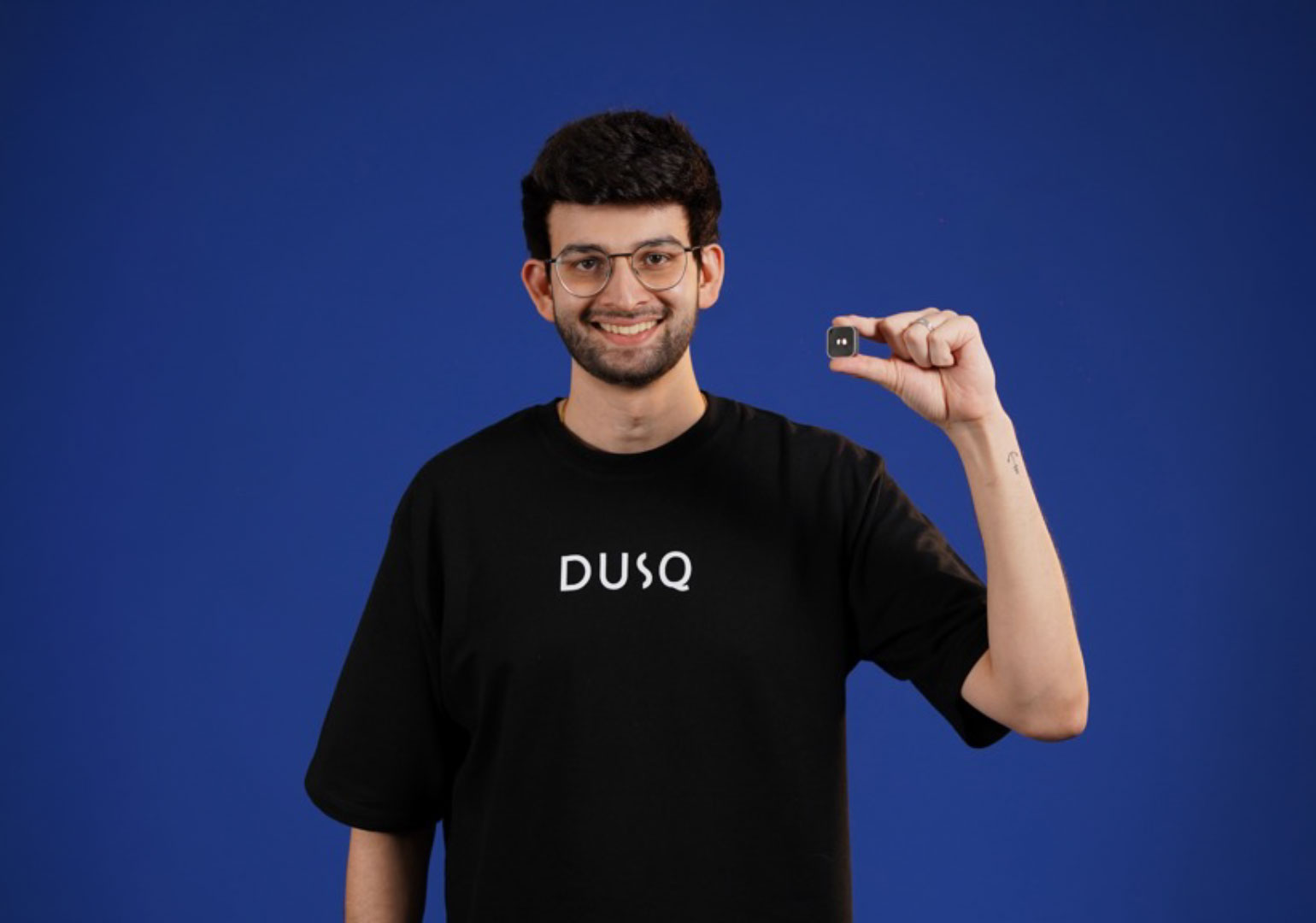
From the outside, a physician turning his own medical history into a consumer sleep technology company can sound like the kind of founder story polished after the fact. For Dr. Siddhant Bhargava, it appears more like the endpoint of a long clinical pattern. He survived lupus as a teenager and cancer in his twenties, built a nutrition business in Mumbai, then moved into harder corners of medtech. Across each chapter, he says he kept running into the same problem: sleep.
Today, that thesis sits at the center of DUSQ, the India-founded sleeptech venture Bhargava co-founded and now leads as CEO. The company’s argument: sleep technology has spent years measuring exhaustion, but not enough time trying to regulate the biology behind it.
From clinic to category
Before DUSQ, Bhargava had already built health companies across nutrition and medical devices. After lupus, he founded Food Darzee, a goal-based nutrition company that, according to the company, served more than 100,000 customers. After cancer, he shifted toward medtech, working on non-invasive glucose monitoring, electronic socks for diabetic foot ulcers, and electronic diapers for stress urinary incontinence.
The problems were varied, but the underlying theme was not. Bhargava came away convinced that poor sleep and autonomic dysfunction were contributing to a much wider range of chronic health issues than most consumer health companies were addressing. That belief became the foundation for DUSQ.
Bhargava, a Forbes 30 Under 30 Asia honoree, has positioned DUSQ not as another sleep tracker but as what the company describes as a closed-loop sleep regulation system. According to DUSQ, its 12-gram behind-the-ear device detects autonomic disruptions during sleep and responds in real time with targeted stimulation of the vagus and vestibular nerves. The company says it has collected more than 50 million physiological data points and completed one clinical trial, with a second underway. In its first company-sponsored study, which has not yet been peer-reviewed, DUSQ reports 31% more deep sleep, 38% better heart rate variability, and 22% fewer awakenings.
“You don’t manage it. You just wake up differently,” Bhargava says, summarizing the company’s pitch.
A doctor’s instinct, redirected
Bhargava’s medical background shapes how he talks about the category. In his view, much of consumer sleep technology has confused observation with care. A sleep score, he argues, can tell users what went wrong, but it does not necessarily help correct the night as it unfolds.
That distinction also shows up in how DUSQ has been built. Rather than framing the company as a single-founder story, Bhargava has assembled a team across product, technology, and commercial execution to turn a clinical thesis into a consumer category. Shalmali Kadu leads product, Mitansh Khurana leads technology, and the broader bench includes second-time founder Gursakhi Lugani and growth advisor Ronak Shah, co-founder of Obvi. The company has also raised approximately $3 million in seed funding led by Fireside Ventures, with participation from Antler India and Climber Capital, after previously securing a three-Shark deal on Shark Tank India.
For Bhargava, DUSQ is less a departure from his earlier work than a through line connecting it. Nutrition, glucose monitoring, wound prevention, and recovery all led him back to the same biological question: what happens when the body fails to fully restore itself at night? His answer is now a company, a device, and a bet that sleep technology’s next chapter will be defined not by better tracking, but by whether it can do what a decade of trackers never could — actually change how you wake up. That distinction has informed DUSQ’s positioning as it scales. The company says its goal is to move sleep technology from measurement to intervention, and to define sleep regulation as a category of its own. “According to DUSQ, its U.S. launch followed a waitlist of more than 10,000 people and opened to what the company reports as an approximately $1 million opening week on Kickstarter.”
Still, as with many early-stage health technologies, broader credibility will depend on peer-reviewed validation and how independent sleep clinicians assess the evidence over time. For now, Bhargava’s wager is that consumers are ready for something more active than a dashboard.
The second chapter
DUSQ has also built a broader infrastructure around that thesis. Bhargava says the company has used its in-house sleep laboratory and early commercial user base in India to develop a proprietary metric called Sleep Quotient, or SQ, which it describes as a leading indicator of the body’s readiness for sleep rather than a retrospective score.
The team around him reflects a blend of scientific rigor and consumer-focused execution. That balance is central to DUSQ’s broader ambition as it scales: to build not just a device, but a category that moves sleep technology beyond retrospective scoring and toward real-time intervention. In that sense, the company’s next test is not only whether its data continues to hold up, but whether consumers and clinicians come to see sleep regulation as distinct from the tracking tools that defined the last decade.