
Photo Courtesy of Harmony Liu
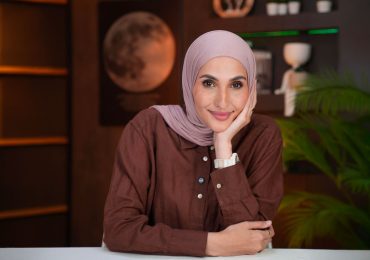
When 14-year-old Eirene Hope Liu first proposed commemorating America’s 250th anniversary through art, she was a ninth-grade student in New York with a sketchbook and a specific idea: a large-scale painting that would connect the country’s founding history to its AI-era future. What began as a student’s concept became a formal international project under the World Harmony Foundation (WHF), a nonprofit accredited to the Governing Council of the United Nations Environment Program (UNEP) since 2005.
The project brought together four people from different professional backgrounds. Liu, who serves as Vice President and Artistic Ambassador of the Youth Leadership Development Organization (YLDO), developed the creative concept and thematic framework. Wu Xiaoping, Vice Chairman of WHF’s China Region, provided philanthropic support and helped formalize the initiative within WHF’s organizational structure. Professor Peng Zhaoguang, President of the WHF World Harmony Academy of Arts, created the principal artwork. Guo Dehong, Vice President of the Academy and an established oil painter, contributed a companion piece. Together, they formed what the foundation calls the U.S. 250th Anniversary Art Creation Committee.
After several months of work, two paintings were completed. Professor Peng produced a pastel work titled “God Bless America and Make America Great Again.” Guo completed an oil painting titled “Liberty and the Future,” which centers on the Statue of Liberty set against futuristic cityscapes and advanced technology. Both works are framed around the 1776-2026 milestone.
A Written Response From the White House
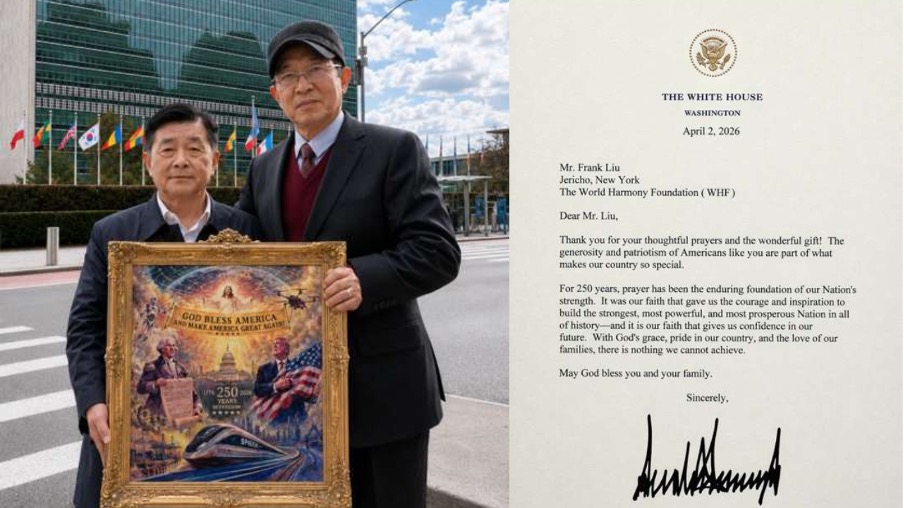
In late March 2026, Liu submitted photographs of the artworks to the White House on behalf of WHF, along with a written explanation of the project’s concept. The submission was addressed to the White House in WHF’s name. On April 2, 2026, WHF received a written reply from President Donald Trump. In his letter, Trump wrote: “For 250 years, prayer has remained a cornerstone of America’s strength. Faith has given us the courage and inspiration to build the strongest and most prosperous nation in history. With God’s grace, love of country, and devotion to family, there is nothing we cannot accomplish.”
The letter did not comment directly on the artwork, but its arrival during the Easter season drew attention to the project within cultural and philanthropic circles connected to WHF’s international network. For a youth-led art initiative that had not yet been publicly exhibited, the correspondence represented a notable moment in the project’s development.
A Young Voice in a National Conversation
Liu’s path to this project was shaped by earlier work in AI advocacy. In January 2026, she participated in the White House Presidential AI Challenge and received an official recognition letter from the White House. Her proposal focused on using artificial intelligence to improve school safety and reduce the risk of school violence. She has since spoken about the concept of “AI for Good” at youth forums and educational conferences, making the case that technology should address real social problems, not just commercial ones.
Those experiences informed the creative brief she brought to WHF. She wanted the artwork to do more than commemorate a date. She wanted to argue that America’s next 250 years would be shaped by the same founding principles, expressed through the language of artificial intelligence, aerospace, and global connectivity.
What the Paintings Show
Professor Peng’s pastel composition places Jesus Christ at the top of the canvas. George Washington stands to the left, holding a document representing the founding ideals of the United States. President Trump stands to the right, holding the American flag. At the center, the words “1776, 250 Years of Freedom, 2026” anchor the historical framing. The lower portion shows modern cities, transportation infrastructure, and industrial imagery. Above them, robots, drones, and satellite networks carry a banner reading “God Bless America.”
Guo Dehong’s oil painting takes a different approach. The Statue of Liberty occupies the center, surrounded by futuristic cityscapes and technological imagery. Where Peng’s work moves vertically through history and faith, Guo’s moves outward through space and innovation. The two paintings were designed to complement each other, covering different dimensions of the same theme.
The Artists and the Foundation
Professor Peng’s portrait work has been collected by United Nations Secretary-General António Guterres, and he has participated in multiple UN peace-related art initiatives. For the UN’s 80th Anniversary, he was invited by a UN NGO Anniversary Committee to serve as the designated portrait artist for a commemorative porcelain collection. Guo Dehong is known for historical and realist oil paintings and has exhibited internationally.
Professor Li Tongxin, President of the East-West Artists and Cultural Exchange Association of America and a Chinese-American artist whose work has been exhibited at the United Nations Headquarters in New York, reviewed the project. “The most interesting aspect of these works is how they integrate historical portraiture with a contemporary visual language,” he said. “What matters is not only the paintings themselves, but what the younger generation is trying to say through them.”
WHF’s institutional background gives the project a broader context. Accredited to the UNEP Governing Council since 2005, the foundation has maintained observer participation privileges at public sessions of the council and has worked with UN entities on peacebuilding, environmental protection, and youth leadership programs over the past two decades.
Looking Ahead
For Liu, the project marks two years of increasingly public work. She has received multiple White House recognition letters, directed an international art commission, and spoken at youth forums on AI governance, all before turning 15. She has said she believes young people should not wait to be invited into national conversations.
For Wu Xiaoping, Peng Zhaoguang, and Guo Dehong, the project reflects what can come from collaboration across generations and disciplines. Whether the two paintings ultimately become part of America’s official 250th Anniversary cultural record is an open question. What they have already documented is the partnership that made them: a 14-year-old with an idea, a philanthropist who backed it, and two artists who painted it.